|

EUR/USD Elliott Wave: Incomplete bearish pattern

Executive summary

  • Price appears trapped within a bearish pattern.
  • The current decline model appears incomplete.
  • Price is bearish while below 1.1685.

Current Elliott Wave analysis
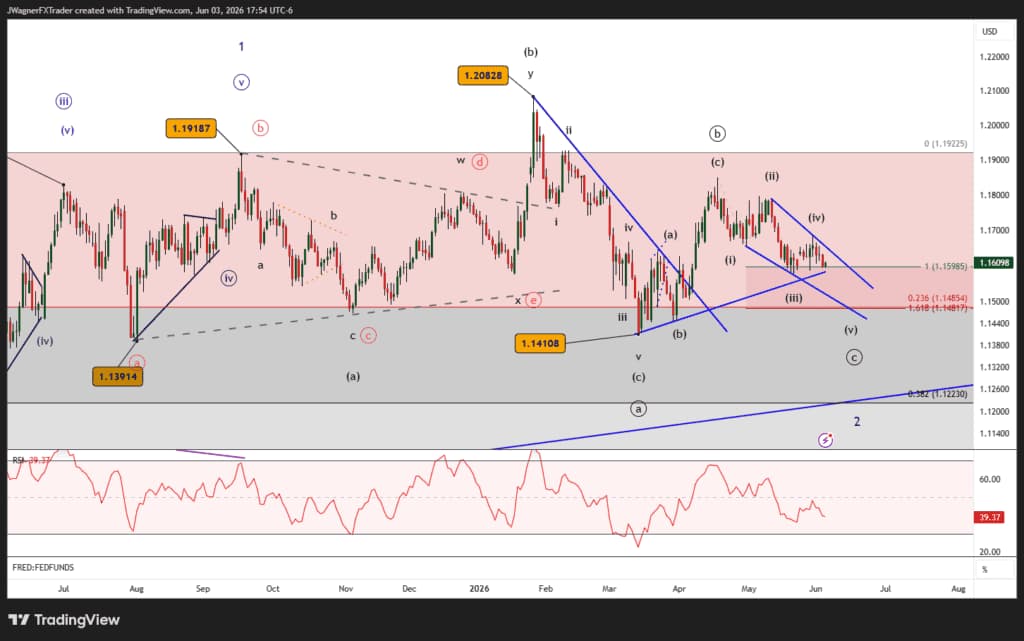
Reviewing the daily price chart on EURUSD, when I stand back and look at the screen, I see bearish patterns.

Prices are currently challenging the support trend line dating back to March 2026. Eventually, this probably will break down and we’ll see a retest of 1.1410.

The key Elliott wave pattern to this picture is the rally from March 13 to April 17. 

That pattern is clearly a 3-wave zigzag rally. This means the rally is corrective and likely to be fully retraced. This implies a decline back to 1.1410 and possibly lower levels.

The only way to make that rally a more bullish pattern would require starting the rally later, on March 30. However, that requires the previous down wave to be a truncated pattern which is rare. 

Therefore, sticking with the probabilities, EURUSD appears to need a handshake with 1.1410 and possibly lower levels down into the 1.12 region. If that low takes place on divergence with DXY, then we’ll know it’ll become an important turning point.

Bottom line

The Elliott wave count we are tracing is that a renewed decline may carry EURUSD below 1.1410 and possibly down to 1.12. If EURUSD is successful in reaching those lower price levels, then we’ll consider looking for bullish reversals.

Author

Zorrays Junaid

Zorrays Junaid

Alchemy Markets

Zorrays Junaid has extensive combined experience in the financial markets as a portfolio manager and trading coach. More recently, he is an Analyst with Alchemy Markets, and has contributed to DailyFX and Elliott Wave Forecast in the past.


More from Zorrays Junaid
Share:

Editor's Picks

AUD/USD bounces off nearly two-month low; upside seems limited

AUD/USD rebounds from its lowest level since April 13, touched during the Asian session on Monday, as the US Dollar pauses following Friday's upbeat US NFP-led blowout rally to a two-month high. However, persistent geopolitical uncertainties, along with surging bets on Fed rate hikes, might continue to act as a tailwind for the USD. Furthermore, diminishing odds of a near-term RBA rate hike should cap gains for the Aussie.

USD/JPY bulls seem hesitant amid intervention fears

USD/JPY touches a fresh high since late April following an Asian session dip, though intervention fears limit losses for the Japanese Yen (JPY) and cap the upside. This counters Japan’s revised GDP print, which confirmed that the economy lost momentum in the first quarter. Meanwhile, Friday's upbeat US NFP report lifted bets of a Fed rate hike and favors the US Dollar bulls, backing the case for a further move higher for the currency pair.

Gold recovers slightly from the $4,300 neighborhood; not out of the woods yet

Gold attracts some buyers at the start of a new week and reverses part of Friday's decline to its lowest since March 24, around the $4,300 mark. The US Dollar pauses after Friday’s upbeat US NFP-led blowout rally to a two-month high and supports the bullion. However, a surge in bets on a Fed rate hike, along with geopolitical uncertainties, favors USD bulls. The backs the case for the emergence of fresh sellers around the precious metal at higher levels.

Week ahead: Fed countdown begins amid US inflation data and geopolitical risks
The countdown to the biggest event of the year so far, the first Fed meeting under Chair Warsh on June 17, has officially commenced. Next week’s key events could serve as the best appetizer for Warsh’s first press conference, although market participants will probably be distracted by developments elsewhere.
Week ahead – Fed countdown begins amid US inflation data and geopolitical risks

Fed Chair Warsh’s first meeting approaches as key US inflation data could reshape expectations. Oil prices remain elevated as US-Iran talks continue; tariffs also return to the spotlight. ECB is expected to hike; will it be a one-off move or is July live?

The US economy defies the rules: 100 days into the Oil shock and the recession signal is still missing

More than three months after the start of the Iran war and the resulting disruption to global energy markets, the US economy continues to display remarkable resilience. The conflict has triggered a sharp rise in Oil prices, reignited inflationary pressures and fueled widespread concerns about a potential economic slowdown.