EUR/USD rallies to 1.1720 ahead of ECB interest rate decision
- EUR/USD bounces up to session highs at 1.1720 with the ECB in the spotlight.
- Eurozone data has shown surging inflation numbers and weakening economic growth.
- The ECB is expected to leave rates on hold and hint at a rate hike in the coming months.

The Euro (EUR) is paring losses against the US Dollar (USD) on Thursday, testing Wednesday's highs at 1.1720 at the time of writing after bouncing from 1.1660 lows. Investors seem to have focused on the high Eurozone inflation data ahead of the European Central Bank's (ECB) monetary policy decision due later on Thursday, dismissing the weakening growth in the region.
Eurozone's preliminary Harmonized Index of Consumer Prices (HICP) figures have shown that inflation surged to a 3% year on-on-year (YoY) rate, its highest level since September 2023, from 2.6% in March and above the 2.9% anticiparted by the market consensus. Excluding food and energy prices, the core HICP eased to a 2.2% YoY rate from 2.3% in March.
At the same time, Gross Domestic Product (GDP) figures released by Eurostat revealed that economic growth slowed down to a 0.1% growth in Q1, from 0.2% in the last quarter of 2025, against expectations of a steady 0.2% growth.
These figures pose a significant challenge for the European Central Bank (ECB), which is expected to leave its benchmark rate unchanged, and hint at a rate hike in the coming months. Recent Eurozone data, however, reveal that the bank will have to fine-tune its monetary policy to fight inflation without crushing an ailing growth.
The Fed moves away from monetary easing
On Wednesday, the Fed left rates on hold at the 3.50%-3.75% band, as expected, yet with the most divided committee since 1992, as three policymakers argued that the “easing bias” phrase is no longer appropriate given the spike in energy prices.
Beyond that, Fed Chairman Jerome Powell, who ends his term on May 15, affirmed that he will remain at the bank as Governor, replacing Stephen Miran, who was appointed by Trump in 2025 and voted for a rate cut on Wednesday. Investors dropped expectations of further Fed rate cuts following the meeting, with futures markets shifting to a rate hike by mid-2027. US Treasury yields jumped, and the US Dollar rallied across the board.
Technical Analysis: Euro remains steady above a key support zone
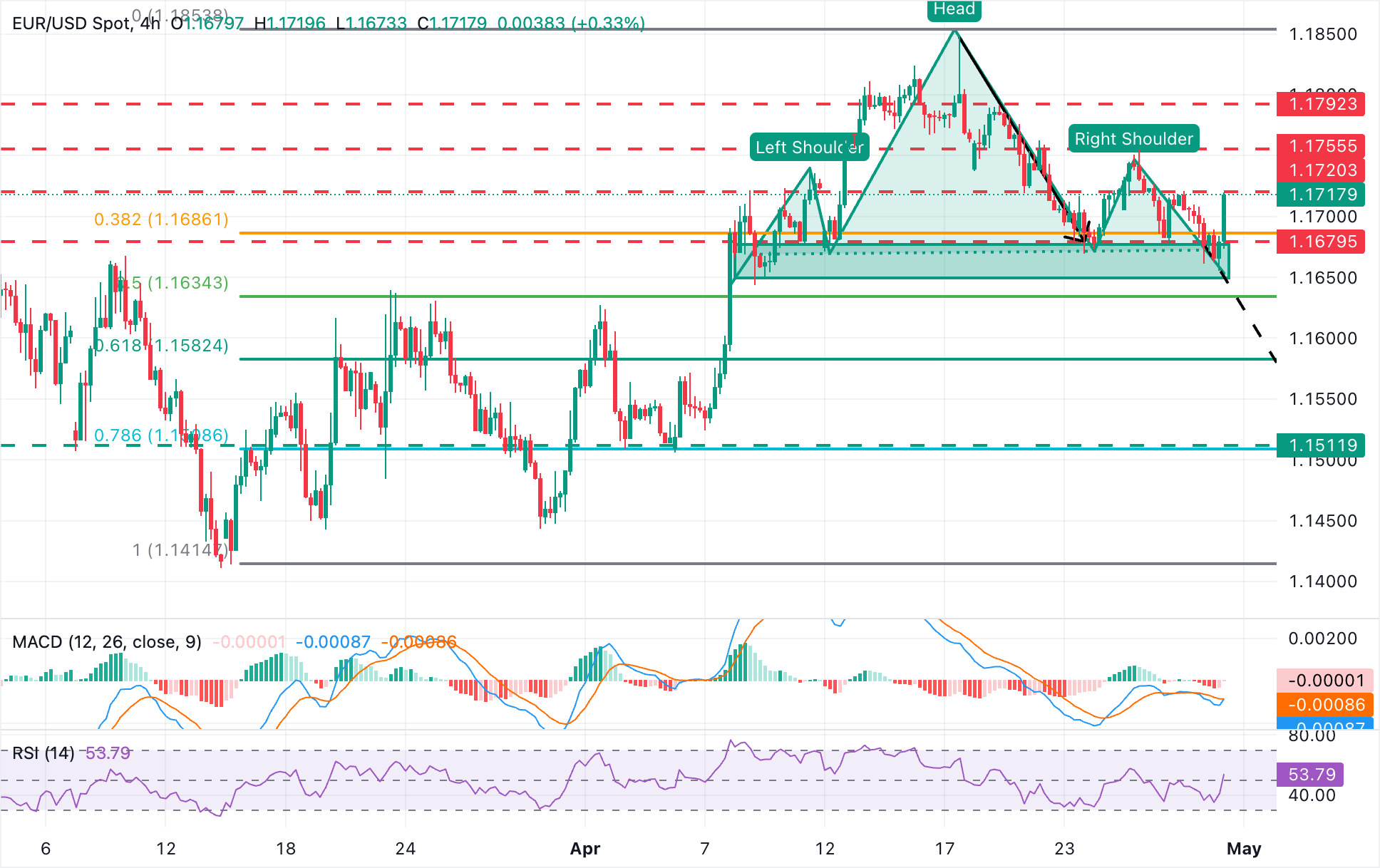
EUR/USD is shrugging off previous bearish pressure as price action returns to Wednesday's peak, at 1.1720. Technical indicators on the 4-hour are also shifting to bullish, with the Relative Strength Index (RSI) popping up above the key 50 level, and the Moving Average Convergence Divergence (MACD) line about to cross the Signal line.
Bulls are likely to meet resistance at Wednesday's highs around 1.1720, which is closing the path to the weekly high at 1.1755. A confirmation beyond that level negates the near-term bearish bias and brings the April 20 high at 1.1790 into focus.
Bearish attempts, on the other hand, are facing an important cluster of supports between 1.1675 and the April 8 intraday low, in the area of 1.1645. A confirmation beyond this area would activate a bearish Head & Shoulders formation, with its measured target near the April 6 low in the 1.1500 area.
(The technical analysis of this story was written with the help of an AI tool.)
Economic Indicator
ECB Rate On Deposit Facility
One of the European Central Bank's three key interest rates, the rate on the deposit facility, is the rate at which banks earn interest when they deposit funds with the ECB. It is announced by the European Central Bank at each of its eight scheduled annual meetings.
Read more.Next release: Thu Apr 30, 2026 12:15
Frequency: Irregular
Consensus: 2%
Previous: 2%
Source: European Central Bank
Economic Indicator
ECB Press Conference
Following the European Central Bank’s (ECB) economic policy decision, the ECB President gives a press conference regarding monetary policy. The president’s comments may influence the volatility of the Euro (EUR) and determine a short-term positive or negative trend. If the president adopts a hawkish tone it is considered bullish for the EUR, whereas if the tone is dovish the result is usually bearish for the Euro.
Read more.Next release: Thu Apr 30, 2026 12:45
Frequency: Irregular
Consensus: -
Previous: -
Source: European Central Bank
Author

Guillermo Alcala
FXStreet
Graduated in Communication Sciences at the Universidad del Pais Vasco and Universiteit van Amsterdam, Guillermo has been working as financial news editor and copywriter in diverse Forex-related firms, like FXStreet and Kantox.