Japanese Yen strengthens against British Pound amid intervention speculation
- GBP/JPY falls as suspected Japanese intervention rattles foreign exchange markets.
- The wide BoE-BoJ interest-rate gap supports the cross’s broader outlook despite the pullback.
- GBP/JPY slips below its 21-day, 50-day and 100-day SMAs, pointing to renewed downside pressure.

GBP/JPY extends its slide on Friday as suspected intervention by Japanese authorities rattles the FX market and lifts the Yen across the board, pushing the cross further away from the multi-year high of 219.16 touched earlier this month. At the time of writing, GBP/JPY trades around 213.75, hovering near June lows.
Reuters reported, citing a market source, that Japan likely conducted a large-scale US Dollar-selling, Japanese Yen-buying intervention worth as much as $58.97 billion during Thursday's American trading hours. The move triggered a drop of more than 500 pips in GBP/JPY.
Separately, Reuters, citing a source familiar with the matter, reported that the US Treasury informed a number of banks it may intervene in the Yen market on Friday and advised them to "stand ready for future action."
The latest leg lower has weakened GBP/JPY’s near-term bullish structure. However, the broader outlook remains tilted to the upside, underpinned by the wide interest-rate differential between the Bank of England (BoE) and the Bank of Japan (BoJ).
The BoJ left its policy rate unchanged at 1.0% on Friday in an 8-1 vote. The central bank reiterated that it would continue raising borrowing costs if economic activity and inflation evolve in line with its forecasts.
Meanwhile, the BoE kept the Bank Rate unchanged at 3.75% on Thursday in a 6-3 vote, with three policymakers backing an immediate rate hike to 4.0%. The central bank stands ready to adjust its policy stance if higher energy prices lead to second-round effects.
Technical analysis
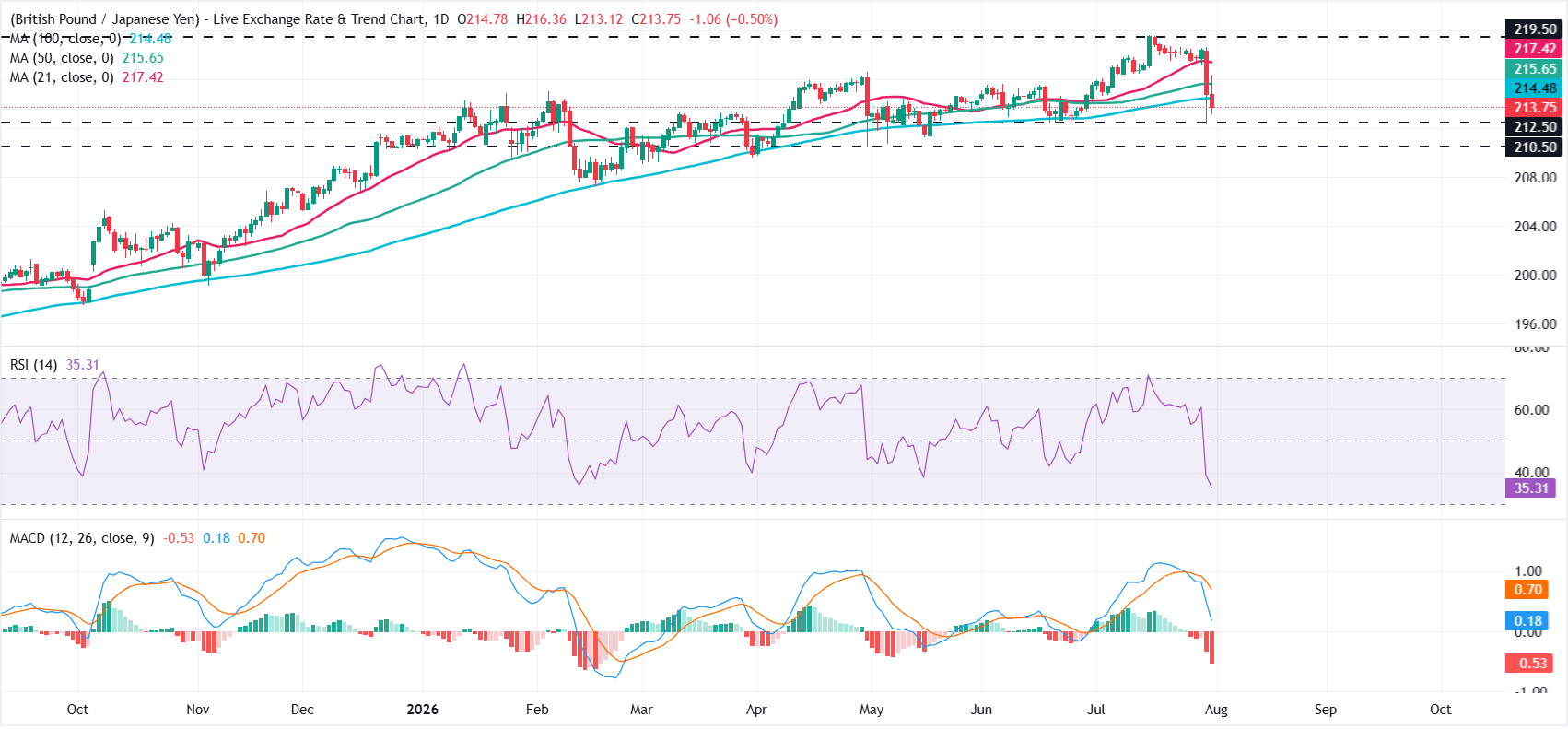
The daily chart points to a bearish shift, with GBP/JPY now trading below the 21-day, 50-day and 100-day Simple Moving Averages (SMAs).
The Relative Strength Index (RSI) hovers in the mid-30s and Moving Average Convergence Divergence (MACD) is negative and declining, which together suggest renewed downside pressure while the cross remains capped by these overhead trend filters.
On the topside, initial resistance emerges at the 100-day SMA near 214.48, followed by the 50-day SMA around 215.65, with the 21-day SMA higher up at 217.42 before a more pronounced barrier at the horizontal pivot near 219.50.
On the downside, immediate support is seen at the prior floor around 212.50, with a deeper cushion at 210.50, and a daily close below these levels would further extend the current corrective phase.
(The technical analysis of this story was written with the help of an AI tool. Know more.)
Bank of Japan FAQs
The Bank of Japan (BoJ) is the Japanese central bank, which sets monetary policy in the country. Its mandate is to issue banknotes and carry out currency and monetary control to ensure price stability, which means an inflation target of around 2%.
The Bank of Japan embarked in an ultra-loose monetary policy in 2013 in order to stimulate the economy and fuel inflation amid a low-inflationary environment. The bank’s policy is based on Quantitative and Qualitative Easing (QQE), or printing notes to buy assets such as government or corporate bonds to provide liquidity. In 2016, the bank doubled down on its strategy and further loosened policy by first introducing negative interest rates and then directly controlling the yield of its 10-year government bonds. In March 2024, the BoJ lifted interest rates, effectively retreating from the ultra-loose monetary policy stance.
The Bank’s massive stimulus caused the Yen to depreciate against its main currency peers. This process exacerbated in 2022 and 2023 due to an increasing policy divergence between the Bank of Japan and other main central banks, which opted to increase interest rates sharply to fight decades-high levels of inflation. The BoJ’s policy led to a widening differential with other currencies, dragging down the value of the Yen. This trend partly reversed in 2024, when the BoJ decided to abandon its ultra-loose policy stance.
A weaker Yen and the spike in global energy prices led to an increase in Japanese inflation, which exceeded the BoJ’s 2% target. The prospect of rising salaries in the country – a key element fuelling inflation – also contributed to the move.
Author

Vishal Chaturvedi
FXStreet
I am a macro-focused research analyst with over four years of experience covering forex and commodities market. I enjoy breaking down complex economic trends and turning them into clear, actionable insights that help traders stay ahead of the curve.