EUR/USD comes under pressure as Fed’s Williams warns of more interest rate hikes
- Euro retreats to near 1.1380 against the US Dollar after Fed Williams’ hawkish commentary.
- US Treasury Yields post a fresh 19-year high near 5.14%.
- German IFO data for September has come in stronger-than-projected.

The Euro (EUR) faces slight selling pressure against the US Dollar (USD), retreating from intraday high of around 1.1400 to near 1.1380 as the Greenback rises, following hawkish remarks from New York Federal Reserve (Fed) Bank John Willams, who is a permanent voting member.
At press time, the US Dollar Index (DXY), which gauges the Greenback’s value against six major currencies, trades slightly higher to near 101.17. The DXY is closer to its eight-week high of 101.23 posted on Wednesday.
Williams flags resilience and inflation risks as Fed keeps hawkish bias
Fed’s Williams delivered a notably firmer tone, with the 7.2/10 FXS Speechtracker score standing above the 6.2/10 historical average, underscoring a stance that is more hawkish relative to the established baseline. Emphasis on “remarkable resilience” in the US economy, receding downside risks to maximum employment, strong AI-driven demand, and the remark that another rate hike by year-end is “reasonable” all highlight persistent inflation concerns and a clear preference to keep policy restrictive even as explicit forward guidance is dialed back.
The FXS Fed Sentiment Index slipped by 0.18 points to 148.63, signaling a modest pullback in hawkish intensity. Despite the decline, the index remains deep in hawkish territory above 100, indicating that the broader Fed communication still leans toward tighter policy even as uncertainty around the persistence of higher yields grows.
Hawkish remarks from Fed's Williams have boosted US Treasury Yields further. 10-year US bond Yields have posted a fresh 19-year high at 5.14%.
Earlier in the day, the Euro attracted bids after the release of the stronger-than-expected German IFO data for September. The IFO report showed that the Business Climate Index improves at a faster-than-expected pace to 89.9 in September, beating 89.0 estimates and the August reading of 88.9. Current Assessment and Expectations indices also arrived higher-than-expected at 89.5 and 90.4, respectively.
EUR/USD Technical Analysis
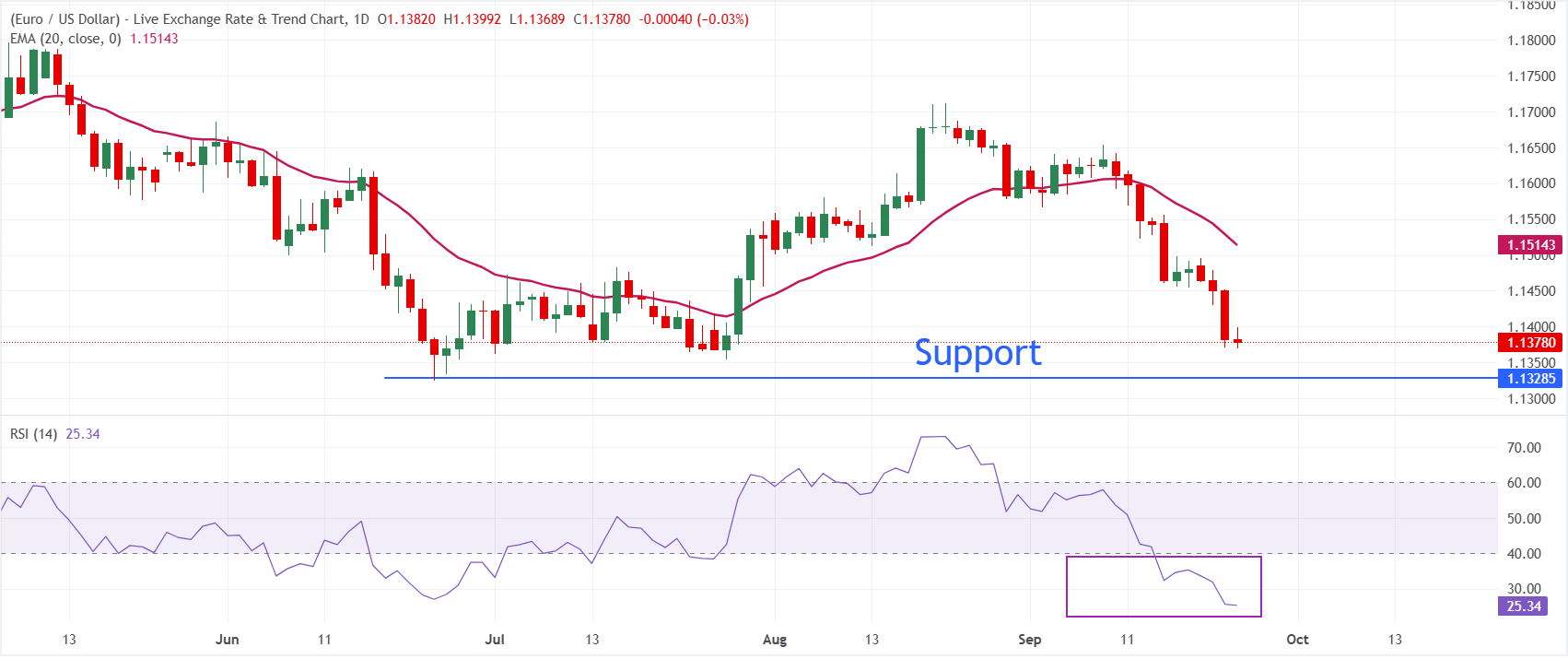
EUR/USD trades at 1.1380, maintaining a bearish near-term bias as the pair holds beneath the 20-period exponential moving average (EMA) at 1.1515. The positioning below this key trend gauge suggests that recent weakness remains in force, while the Relative Strength Index (RSI) at 25.5 shows oversold conditions that could slow immediate downside impulse without yet signaling a clear recovery.
On the topside, initial resistance is located at the 20-period EMA around 1.1515, and a daily close above this level would be needed to ease bearish pressure and open the way for a more sustained rebound. On the downside, the pair is exposed to the Year-Till-Date (YTD) low at 1.1325.
(The technical analysis of this story was written with the help of an AI tool. Know more.)
Economic Indicator
IFO – Business Climate
This German business sentiment index released by the CESifo Group is closely watched as an early indicator of current conditions and business expectations in Germany. The Institute surveys more than 7,000 enterprises on their assessment of the business situation and their short-term planning. The positive economic growth anticipates bullish movements for the EUR, while a low reading is seen as negative (or bearish).
Read more.Last release: Thu Sep 24, 2026 08:00
Frequency: Monthly
Actual: 89.9
Consensus: 89
Previous: 88.8
Source: IFO Institute
Author

Sagar Dua
FXStreet
Sagar Dua is associated with the financial markets from his college days. Along with pursuing post-graduation in Commerce in 2014, he started his markets training with chart analysis.

















