EUR/USD declines as US signals 90-day pause in execution of Trump tariffs
- EUR/USD weakens as the US Dollar revives losses after US Hassett signaled a 90-day pause on tariff imposition for all, except China.
- Analysts at JP Morgan expect the US economy to contract by 0.3% this year due to implementation of full-cale Trump tariffs.
- ECB Schnabel expects more Trump tariffs to fuel uncertainty further.

EUR/USD recovers some intraday losses to near 1.0940 during North American trading hours on Monday after sliding around 1.0880 earlier in the day. The major currency pair is still down almost 0.25%, at the time of writing, as the US Dollar (USD) gains after recovering losses. The US Dollar Index (DXY), which tracks the Greenback’s value against six major currencies, jumps to near 103.20.
The Greenback attracts bids as Director of the United States (US) National Economic Council Kevin Hassett has signaled that President Donald Trump is considering a 90-day pause on tariffs for all of its trading partners, except China, Reuters report. However, the White House has not confirmed the same. A three-month-long pause on tariffs becoming effective would offer a significant time to targeted nations to escape higher import duties by negotiating a deal with Washington.
Such a scenario will be favorable for the US economy, which has been attracting downward revisions from market experts for US President Trump sweeping reciprocal tariffs on Wednesday.
The new suite of levies announced by Trump had spooked global markets, resulting in equities melting down across the globe. However, Trump was not concerned about investors losing trillions from the world stock market and expected that higher levies would bring a lot of money to the US each year. "I don’t want anything to go down. But sometimes you have to take medicine to fix something," Trump said while speaking at Air Force One over the weekend.
Market experts had become increasingly concerned over the US economic outlook, assuming that the real burden of higher import duties will be on domestic importers. Investment banking firm JP Morgan had forecasted that the US economy could end the year with a 0.3% decline in the Gross Domestic Product (GDP) growth.
Also, Federal Reserve (Fed) Chair Jerome Powell stated on Friday that the President’s protectionist policies could lead to an increase in inflationary pressures and slower economic growth. Powell still supports interest rates remaining in the current range of 4.25%-4.50% as it is “too soon to say what will be the appropriate path for monetary policy."
During European trading hours, Donald Trump has urged the Fed to start cutting interest rates as conditions have become favorable, though his post on Truth.Social. "Oil prices are down, interest rates are down (the slow moving Fed should cut rates!), food prices are down, there is no inflation, and the long time abused USA is bringing in billions of dollars a week from the abusing countries on tariffs that are already in place," Trump wrote.
Daily digest market movers: EUR/USD drops as US Dollar rebounds
- The downside move in the EUR/USD pair is also driven by the uncertainty over the Euro’s (EUR) outlook. The Euro is expected to face pressure as European Central Bank (ECB) officials have pushed back fears that tariff-driven inflation will be persistent in the Eurozone, allowing traders to raise bets supporting more interest rate cuts this year.
- ECB executive board member Isabel Schnabel said at an economic forum in northern Italy over the weekend that fresh tariffs by the US have made structural economic headwinds of the Eurozone even worse. Schnabel warned that higher import duties by the US have led to a “dramatic surge in uncertainty” and should brace for more ahead.
- The ECB has already reduced its key borrowing rates in both of the two policy meetings this year and is also expected to cut again on April 17. The central bank is likely to continue with its gradual monetary policy easing pace, which will push the Deposit Facility rate lower to 2.25%. Such a scenario will be unfavorable for the Euro.
- During European trading hours, Eurostat reported that Retail Sales grew at a slower-than-expected pace on a monthly basis in February. Retail Sales, a key measure of consumer spending, rose by 0.3%, slower than estimates of 0.5%, after remaining flat in January. On year, the consumer spending measure rose by 2.3%, stronger than expectations and the prior release of 2.3%.
- On the global front, European Commissioner (EC) President Von der Leyen has commented during North American trading hours that we are ready to "negotiate with the US on tariffs," and the nation intends to strengthen itself in response to Trump's tariffs. Separately, European Union trade commissioner Maros Sefcovic said, "We have offered to the US zero-for-zero tariffs for cars and all industrial goods." Positive attempts by Eurozone to diminish fears of potential trade war with the US would ease domestic growth worries.
Technical Analysis: EUR/USD finds support near 10-day EMA
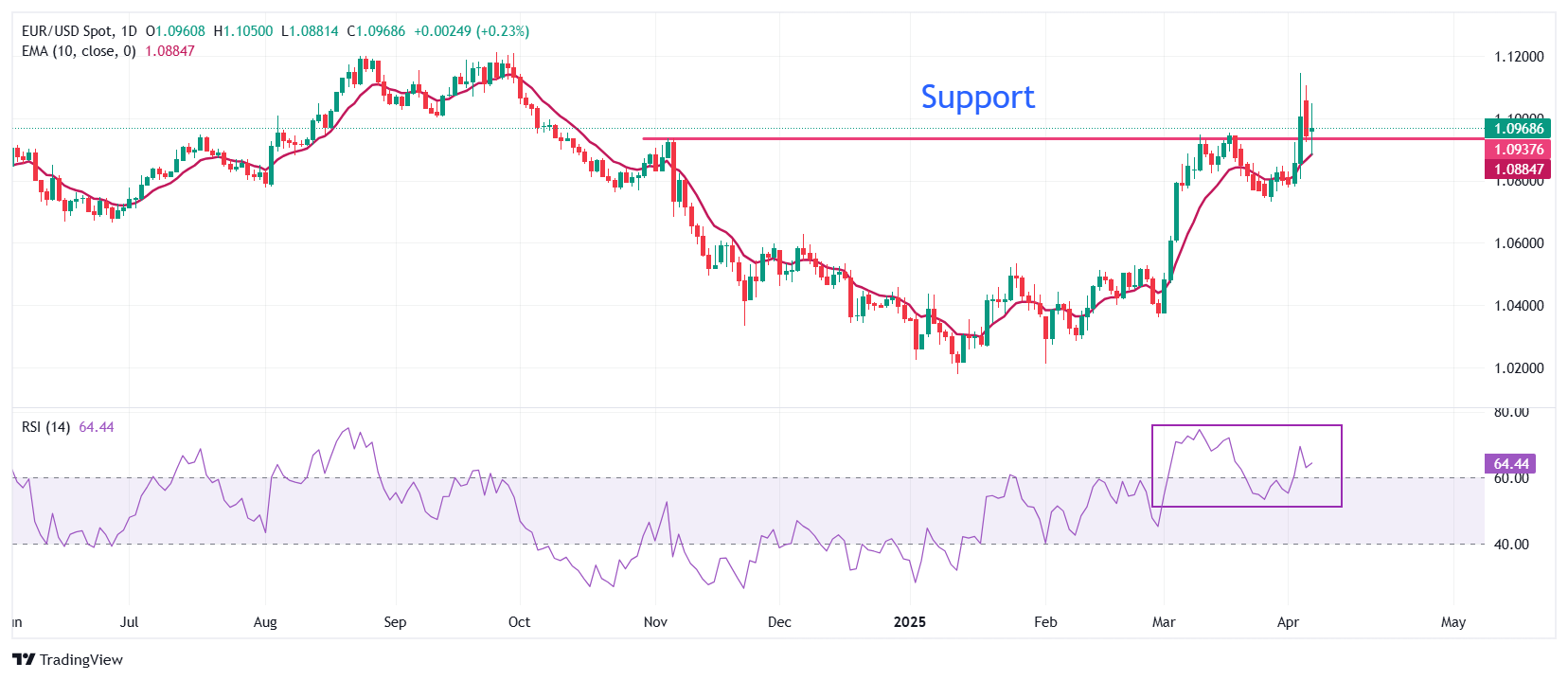
EUR/USD resumes its upward journey after a healthy correction from the six-month high of 1.1145 reached on Thursday to near 1.0880 earlier in the day. The major currency pair rebounds as the 10-day Exponential Moving Average (EMA) acts as major support around 1.0886. The pair aims to hold the key support of 1.0938 plotted from the November 5 high.
The 14-day Relative Strength Index (RSI) stays above 60.00, suggesting that the bullish momentum is intact.
Looking down, the March 31 high of 1.0850 will act as the major support zone for the pair. Conversely, the September 25 high of 1.1214 will be the key barrier for the Euro bulls.
US Dollar FAQs
The US Dollar (USD) is the official currency of the United States of America, and the ‘de facto’ currency of a significant number of other countries where it is found in circulation alongside local notes. It is the most heavily traded currency in the world, accounting for over 88% of all global foreign exchange turnover, or an average of $6.6 trillion in transactions per day, according to data from 2022. Following the second world war, the USD took over from the British Pound as the world’s reserve currency. For most of its history, the US Dollar was backed by Gold, until the Bretton Woods Agreement in 1971 when the Gold Standard went away.
The most important single factor impacting on the value of the US Dollar is monetary policy, which is shaped by the Federal Reserve (Fed). The Fed has two mandates: to achieve price stability (control inflation) and foster full employment. Its primary tool to achieve these two goals is by adjusting interest rates. When prices are rising too quickly and inflation is above the Fed’s 2% target, the Fed will raise rates, which helps the USD value. When inflation falls below 2% or the Unemployment Rate is too high, the Fed may lower interest rates, which weighs on the Greenback.
In extreme situations, the Federal Reserve can also print more Dollars and enact quantitative easing (QE). QE is the process by which the Fed substantially increases the flow of credit in a stuck financial system. It is a non-standard policy measure used when credit has dried up because banks will not lend to each other (out of the fear of counterparty default). It is a last resort when simply lowering interest rates is unlikely to achieve the necessary result. It was the Fed’s weapon of choice to combat the credit crunch that occurred during the Great Financial Crisis in 2008. It involves the Fed printing more Dollars and using them to buy US government bonds predominantly from financial institutions. QE usually leads to a weaker US Dollar.
Quantitative tightening (QT) is the reverse process whereby the Federal Reserve stops buying bonds from financial institutions and does not reinvest the principal from the bonds it holds maturing in new purchases. It is usually positive for the US Dollar.
resulting
Author

Sagar Dua
FXStreet
Sagar Dua is associated with the financial markets from his college days. Along with pursuing post-graduation in Commerce in 2014, he started his markets training with chart analysis.