|

EUR/JPY Price Analysis: Cross gains ground with subtle consolidation signs

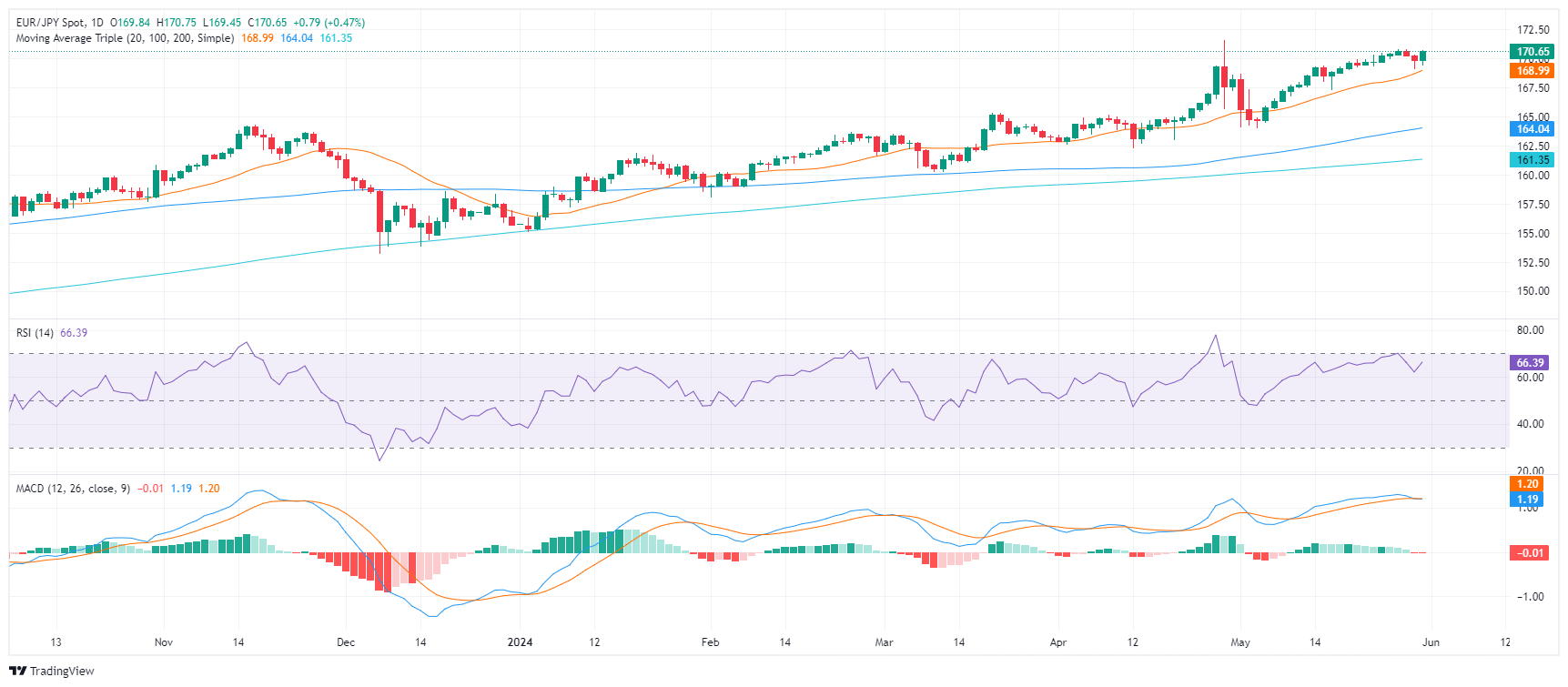
  • The daily RSI is pointing upwards, hovering around 70, but continuing red bars in the MACD show a trailing consolidation.
  • On the hourly chart, indicators are neutral and reside in the positive terrain.
  • The 20-day SMA at 169.00 serves as an important threshold for sellers.

On Friday's trading session, despite recent downside corrections, the EUR/JPY pair managed to reclaim its stance above 170.00. This indicates a shifting of the bearish momentum observed on Thursday when the pair marked a daily low at 169.00.

The daily Relative Strength Index (RSI) has pivoted, now pointing upwards near 70, suggesting a possible reversal. However, the MACD is still printing red bars, confirming that the pair is in a consolidation phase with limited upside. These mixed signals necessitate following the pair closely to determine if this marks a fresh bullish momentum or merely a pause in a more pronounced downward correction.

EUR/JPY daily chart
On the hourly chart, indicators are maintaining their neutrality, inhabiting the positive territory. This could potentially point to a subtle strengthening of bullish sentiment despite the ongoing consolidation phase.

EUR/JPY hourly chart
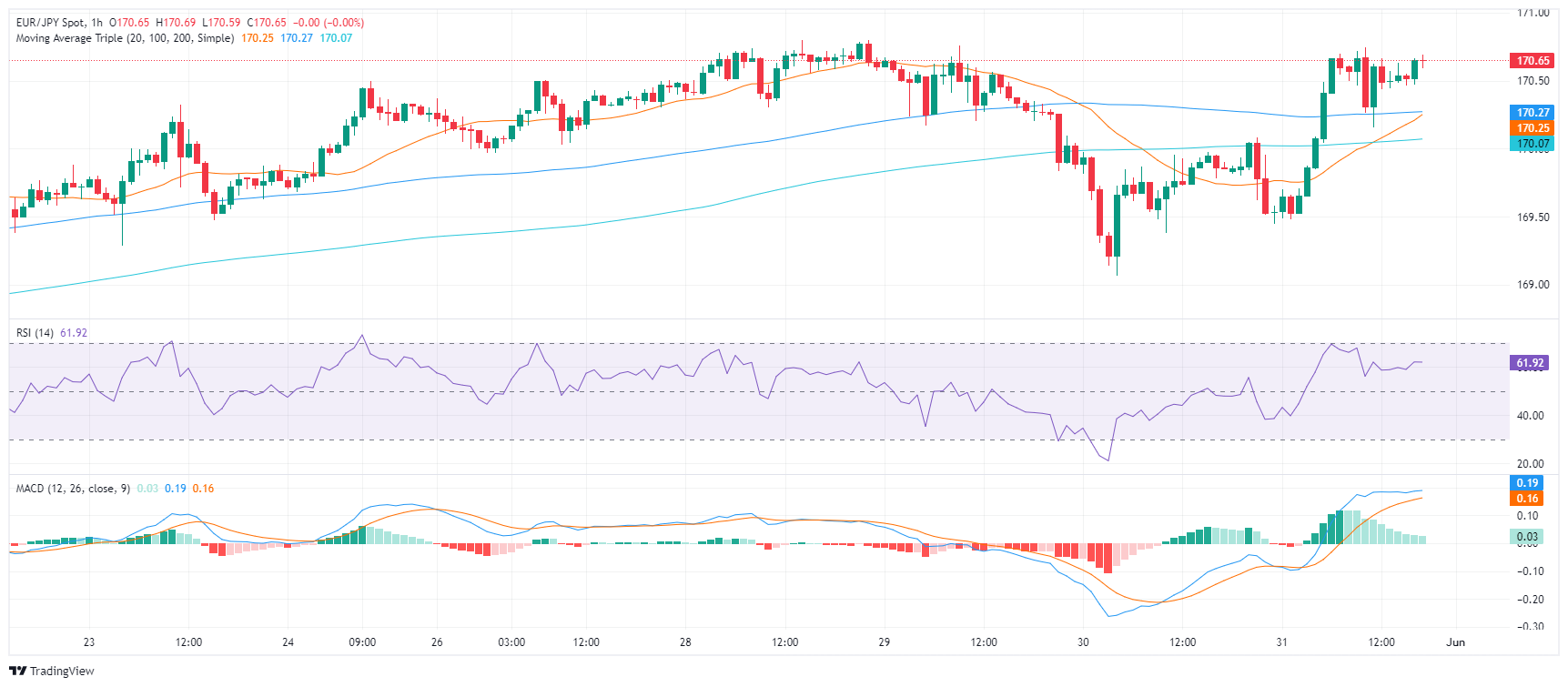
Critically, the position of the EUR/JPY pair continues to hover above the significant SMAs. The 20-day SMA at 169.00 in particular stands out as a crucial threshold and sellers must conquer this level to flip the near-term bullish outlook. Should the position fall below this key support level, the 100 and 200-day SMAs provide further safety barriers for potential sellers.

Author

Patricio Martín

Patricio is an economist from Argentina passionate about global finance and understanding the daily movements of the markets.


More from Patricio Martín
Share:

Editor's Picks

GBP/USD strengthens beyond mid-1.3300s vs weak USD amid fresh Iran diplomacy hopes

The GBP/USD pair builds on Friday's modest bounce from a three-week low and gains strong follow-through positive traction at the start of a new week. This marks the second straight day of a positive move and lifts spot prices above mid-1.3300s during the Asian session amid a broadly weaker US Dollar.

EUR/USD climbs beyond 1.1400 as renewed Iran diplomacy hopes undermine safe-haven USD

The EUR/USD pair builds on a modest bullish gap opening and climbs back above the 1.1400 mark during the Asian session on Monday. The intraday move up is sponsored by a broadly weaker US Dollar, weighed down by renewed optimism over a diplomatic resolution to end a five-month-old US-Iran war.

Gold sticks to gains as falling oil ease inflation fears and temper Fed rate hike bets

Gold (XAU/USD) sticks to modest intraday gains heading into the European session on Monday, though it struggles to build on the momentum beyond the $4,100 mark as bulls seem hesitant ahead of the crucial FOMC meeting this week. In the meantime, reviving hopes for a diplomatic resolution to end a five-month-old US-Iran war led to an intraday slump in crude oil prices.

Cardano: Under pressure as bearish derivatives cap recovery

Cardano remains under pressure, trading lower at $0.165 on Monday after mild losses in the previous week. Weakening derivatives metrics and subdued momentum indicators suggest that ADA's upside move remains limited, keeping downside risks in focus. Derivatives data for Cardano shows bearish sentiment among traders.

Australian Dollar outlook: Chances of another rally won’t be decided in Canberra, but in Washington

The Australian Dollar rode a rollercoaster in the first half of the year, hitting a four-year high and then correcting. The currency enters the second half with an outlook full of uncertainty due to renewed hostilities in the Middle East, which clouds the inflation outlook and interest rates.

US Dollar mid-year outlook: Exceptional currency, exceptional risks?
The US Dollar enters the second half of 2026 in a markedly different position from a year ago. The King currency has recovered, reflecting persistent US inflation, changing expectations for Fed policy, geopolitical tensions and renewed demand for defensive assets.















