EUR/GBP Price Forecasts: Euro hovers below 0.8655 resistance amid weak German data
- The euro retreats from session highs near 0.8650 against the British Pound, but remains between previous ranges above 0.8630.
- German Factory Orders dropped well beyond expectations in April.
- The EUR/GBP pair is forming a triangle pattern, with a bearish outcome favoured.

The Euro (EUR) has turned lower against the British Pound (GBP) on Monday, although it remains moving within Friday's range. The pair retreated from session highs near 0.8650 and trades at 0.8637 at the time of writing, as downbeat German Factory Orders have set the Euro under renewed pressure.
Data released by Destatis earlier on Monday revealed that industrial orders dropped 3.8% in April, more than three times the 1,2% decline anticipated by the market consensus. Beyond that, March figures have been revised down to a 4.5% increase from the previous 5.0% estimate. These figures highlight the negative impact of the Middle East war on the Eurozone’s industrial sector.
Technical Analysis: In a triangle pattern with a bearish outcome favoured
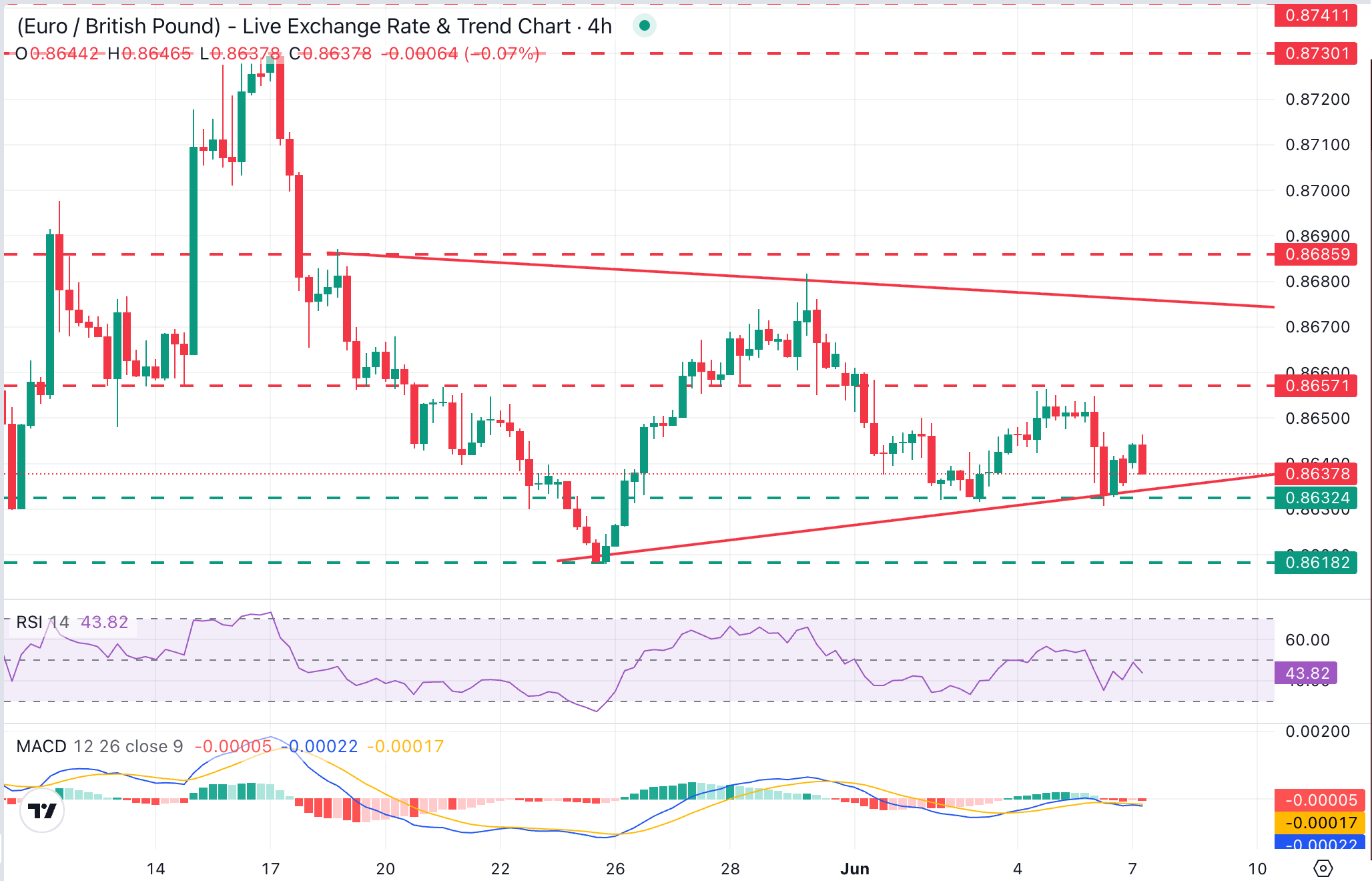
EUR/GBP is trading sideways, with technical indicators showing a neutral-to-bearish momentum. The Relative Strength Index (RSI) in the 4-hour chart remains unable to extend above the 50 mark while the Moving Average Convergence Divergence (MACD) is marginally negative and flattening, altogether hinting at a mild bearish momentum.
The technical picture shows the pair trading within a symmetrical triangle. This is considered a continuation pattern and, therefore, the favoured outcome is negative. Sellers, however, will have to confirm below Friday's low, at 0.8630, to expose the May 25 low at 0.8618 and the year-to-date (YTD) lows, at 0.8611.
Upside attempts, on the other hand, are likely to be tested at the 0.8655 area (May 4, 5 highs). Further up, the top of the triangle, at 0.8675, and the area between May 29 and May 19 highs at 0.8681 and 0.8687, respectively, are the next targets.
(The technical analysis of this story was written with the help of an AI tool.)
Euro Price Today
The table below shows the percentage change of Euro (EUR) against listed major currencies today. Euro was the strongest against the Swiss Franc.
| USD | EUR | GBP | JPY | CAD | AUD | NZD | CHF | |
|---|---|---|---|---|---|---|---|---|
| USD | -0.01% | 0.01% | -0.06% | 0.00% | -0.11% | -0.21% | 0.13% | |
| EUR | 0.00% | 0.00% | -0.07% | 0.00% | -0.12% | -0.19% | 0.11% | |
| GBP | -0.01% | -0.01% | -0.09% | -0.01% | -0.17% | -0.21% | 0.09% | |
| JPY | 0.06% | 0.07% | 0.09% | 0.05% | -0.09% | -0.12% | 0.15% | |
| CAD | -0.00% | -0.00% | 0.01% | -0.05% | -0.13% | -0.19% | 0.10% | |
| AUD | 0.11% | 0.12% | 0.17% | 0.09% | 0.13% | -0.05% | 0.25% | |
| NZD | 0.21% | 0.19% | 0.21% | 0.12% | 0.19% | 0.05% | 0.28% | |
| CHF | -0.13% | -0.11% | -0.09% | -0.15% | -0.10% | -0.25% | -0.28% |
The heat map shows percentage changes of major currencies against each other. The base currency is picked from the left column, while the quote currency is picked from the top row. For example, if you pick the Euro from the left column and move along the horizontal line to the US Dollar, the percentage change displayed in the box will represent EUR (base)/USD (quote).
Author

Guillermo Alcala
FXStreet
Graduated in Communication Sciences at the Universidad del Pais Vasco and Universiteit van Amsterdam, Guillermo has been working as financial news editor and copywriter in diverse Forex-related firms, like FXStreet and Kantox.