|premium|

Elliott Wave view: General Electric (GE) ended 5 waves rally [Video]

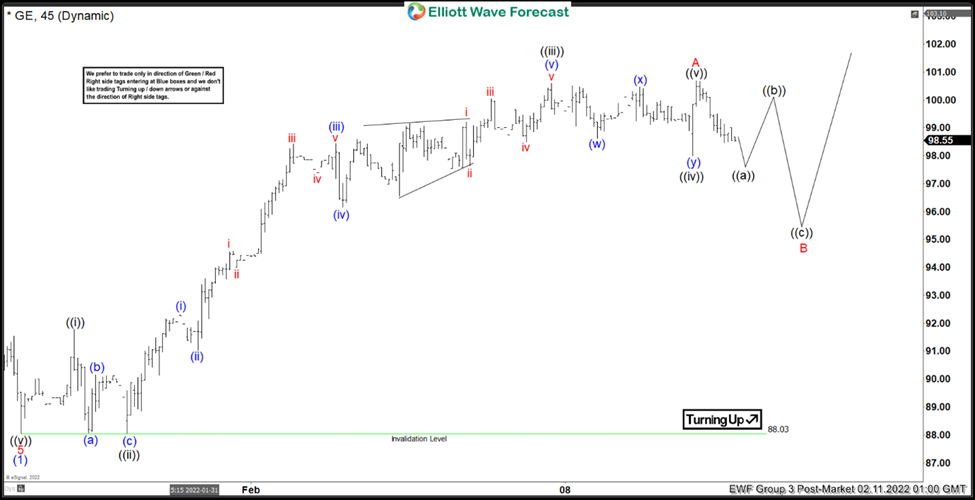
The short-term Elliott Wave view in General Electric (GE) ended wave (1) at 88.03 low. Wave (2) rally is currently in progress as a zigzag Elliott Wave structure. Up from wave (1), wave A of the zigzag ended at  100.68 with internal subdivision as 5 waves impulse. Up from wave (1), wave ((i)) ended at 91.77 and pullback in wave ((ii)) ended at 88.05. The stock then extended higher again in wave ((iii)) towards 100.59. Wave ((iii)) subdivided again as a 5 waves of lesser degree. Up from wave ((ii)), wave (i) ended at 92.28, wave (ii) dips ended at 91.03, wave (iii) ended at 98.44, wave (iv) ended at 96.16, and wave (v) ended at 100.59.

Wave ((iv)) pullback ended at 98. Internal of wave ((iv)) subdivided as a double three. Down from wave ((iii)), wave (w) ended at 98.63, wave (x) ended at 100.47, and wave (y) ended at 98. This completed wave ((iv)). Stock then extended higher in wave ((v)) towards 100.68 which should also complete wave A. The stock is now pulling back in wave B to correct cycle from January 27 low. Internal of wave B is unfolding as a zigzag structure where wave ((a)) should end soon. The stock should bounce in wave ((b)) before it resumes lower again in wave ((c)). As far as pivot at 88.03 low stays intact, expect pullback to find support in 3, 7, or 11 swing for more upside.

GE (General Electric) 45 Minutes Elliott Wave chart
Chart

GE Elliott Wave video

Premium

You have reached your limit of 3 free articles for this month.

Start your subscription and get access to all our original articles.

Subscribe to PremiumSign In

Author

Elliott Wave Forecast Team

Elliott Wave Forecast Team

ElliottWave-Forecast.com

More from Elliott Wave Forecast Team
Share:

Editor's Picks

USD/JPY hovers below 160.50 intervention zone ahead of FOMC decision

USD/JPY remains below the 160.50 intervention zone in the Asian session on Wednesday. Despite the BoJ's rate hike to its highest level since 1995, Japan's borrowing costs remain significantly lower than the US, undermining the Japanese Yen. However, thpair US Dollar remains on the back foot amid the optimism over the US-Iran peace deal and ahead of the Fed policy decision, weighing on the pair.

AUD/USD holds steady above 0.7050; looks to Fed for fresh impetus

AUD/USD is consolidating above mid-0.7000s in the Asian session on Wednesday as traders await the outcome of a two-day FOMC meeting due later in the day. In the meantime, the optimism over an interim peace deal between the US and Iran keeps the US Dollar bulls on the defensive. This, along with the RBA's hawkish pause on Tuesday, acts as a tailwind for the pair.

Gold buyers lack conviction as Fed policy decision looms

Gold is holding its five-day winning streak near $4,350 in Asian trading on Wednesday, but remains within this week’s familiar range. Traders look forward to the all-important US Federal Reserve monetary policy decision for a clear directional impetus.


Bitcoin holds $65,000 as Uniswap and Worldcoin extend rally
Bitcoin (BTC) is experiencing headwinds above $65,000 following the Bank of Japan’s rate hike to 1% on Tuesday. Still, Uniswap (UNI) and Worldcoin (WLD) continue to rally amid rising retail interest, while Bitcoin’s recovery grows heavy. Bitcoin edges higher at press time on Wednesday, inching closer to $66,000 as it maintains a mixed near-term tone following the recent rebound from $60,000.
The most important event will be the Fed meeting with Mr. Warsh now in charge

The most important event will be the Fed meeting on Wednesday, with Mr. Warsh now in charge. As more than one analyst points out, the case for holding rates the same is strengthened by the Iran deal and the prospect of the Strait re-opening, although nobody thinks Warsh can marshal enough doves to do a cut this time.

Why a hawkish RBA is no longer enough to lift the Australian Dollar

The Reserve Bank of Australia delivered more than what markets expected: a hawkish hold that should have supported the Aussie. But markets widely ignored it, focusing instead on slowing economic growth and proving that central bank messaging alone isn’t always enough to drive currencies.