|

Elliott Wave outlook: Google anticipating a larger‑degree pullback toward $300

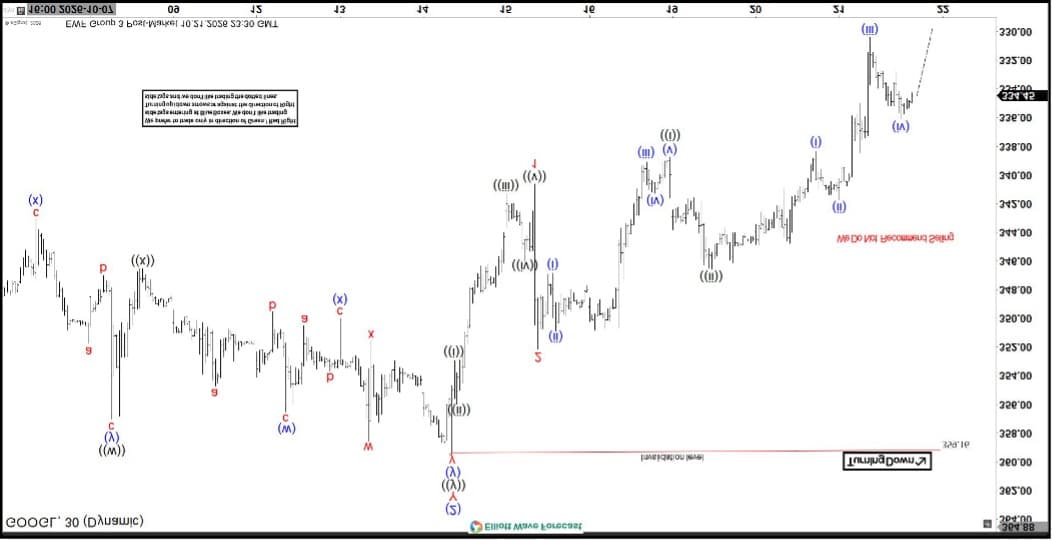
Since forming the all‑time high at $408.61 in May 2026, Google (GOOGL) has begun a larger‑degree correction. The broader extreme area for this cycle sits at 288-306, and the current decline continues to track toward that region. Short term, the cycle from the September 22, 2026 high remains in progress as a clear impulsive structure. Within this sequence, wave (1) ended at $336.02, and the subsequent rally in wave (2) ended at $359.16.

The stock then turned lower in wave (3), which shows internal subdivision consistent with a five‑wave impulse. Down from wave (2), wave 1 ended at $340.61, and the rally in wave 2 ended at $352.15. The decline resumed in wave 3 with an impulsive profile that reinforces the broader corrective theme. Down from wave 2, wave ((i)) ended at $338.75, and the rally in wave ((ii)) ended at $346.58. The structure suggests that wave ((iii)) of 3 should extend lower and maintain the dominant bearish momentum.

Near term, the pivot at $359.16 remains the key level. As long as this pivot stays intact, any rally should fail in three or seven swings and lead to further downside. This view aligns with the larger‑degree correction already underway and supports the expectation for continued weakness toward the extreme area.

Google 30 minute Elliott Wave chart
Google Elliott Wave [Video]
Youtube preview


Author

Elliott Wave Forecast Team

Elliott Wave Forecast Team

ElliottWave-Forecast.com

More from Elliott Wave Forecast Team
Share:

Editor's Picks

AUD/USD pulls back from monthly high but holds above 0.7000

AUD/USD retreats from the monthly high set earlier this Thursday, sliding back to 0.7000 during the Asian session as a further escalation of tensions in the Middle East undermines the risk-sensitive Aussie. However, recent hawkish comments from RBA officials could support the Australian Dollar. Furthermore, the prevailing US Dollar selling bias, despite Fed hike bets and geopolitical uncertainties, could limit losses for the pair.

USD/JPY declines to a one-week low; eyes trading range support near 157.50 on weaker USD

USD/JPY drops to a one-week low during Thursday’s Asian session, with bears now awaiting a break below multi-week range support near mid-157.00s before placing fresh bets amid a broadly weaker US Dollar. Despite bets for a December Fed rate hike and Middle East jitters, the recent decline in US bond yields keeps USD depressed near a three-week low. Moreover, hawkish BoJ expectations and intervention risks underpin the Japanese Yen, further weighing on the currency pair.

Gold weakens to near $4,110 amid broader strength in oil prices

Gold is down 1% to near $4,095 in the Asian trading session on Thursday on the back of fears that global inflation expectations could accelerate further due to heightened geopolitical tensions in the Middle East.


XRP and XLM recovery stalls below EMAs
Ripple (XRP) and Stellar (XLM) remain under pressure on Thursday as both struggle to sustain their recent recovery attempts. XRP trades below $1.36, while XLM slips beneath $0.183, as mixed derivatives metrics, weakening momentum indicators and heating market conditions suggest cautious market sentiment. Derivatives data shows weakening conditions for Ripple and Stellar.
The US Oil reserve hit a 44-year low. Now the barrels are coming back

Washington lent out a third of the Strategic Petroleum Reserve this year rather than selling it. The loans come due from now to 2029, and after the midterms, the reserve has nothing left to hold fuel prices down. The US Strategic Petroleum Reserve held 282.7 million barrels in the week to October 16, down another 300K, and lower than at any point since October 1982.

The US Dollar fell. Gold didn't rally. That tells you everything
Gold (XAU/USD) is struggling to capitalize on a weaker US Dollar (USD), after repeatedly failing to establish itself above the $4,200 level. The precious metal remains confined to a relatively narrow trading range despite a combination of developments that would normally support higher prices.