Dow Jones Industrial Average maintains the red
- Dow Jones retreats as US manufacturing activity data beats expectations.
- Real Estate and Health sectors are leading losses, while Communication Services and Energy advance.
- DJIA corrects lower after rejection at the 40,000 psychological level.

The Dow Jones Industrial Average (DJIA) is going through a significant pullback on Monday. The positive surprise in the US ISM Manufacturing PMI Index has poured cold water on the US Federal Reserve’s (Fed) easing expectations which has triggered a sharp rebound in US Treasury yields.
The US manufacturing sector’s activity expanded again after more than one year of contraction. The headline PMI rose to 50.3 from 47.8 in March, beating expectations of a milder increase to 48.4. Beyond that, the Prices Paid sub-index surged to 55.8, its highest reading since July 2022 and a positive contribution to inflationary trends.
These figures will likely back Fed hawks’ view that there is no rush to start lowering borrowing costs. This week we have a string of Fed speakers and key employment figures to provide more clues about the central bank’s plans.
Dow Jones news
The Dow Jones Index loses 0.64%, to 39,545 during Monday's afternoon trade, with most sectors in the red. The Real Estate and Health sectors are the biggest losers, dropping 1.46% and 1.06% respectively. On the positive side, Communication Services advances 1.1%, followed by the Energy sector, 0.74% up.
Home Depot (HD) shares are leading the decline with a 3.14% drop to $371.61, followed by Nike (NKE), down 1.93% to $92.17. Boeing (BA) continues bleeding with the company under a major crisis that has led to the replacement of the board. The planemaker loses 1.48% to $190.16.
On the positive side, 3M (MMM) outperformed the rest of the companies in the Index with a 4.55% jump to $92.72, followed by Chevron (CVX), up 0.9% to $159.17.
Dow Jones technical outlook
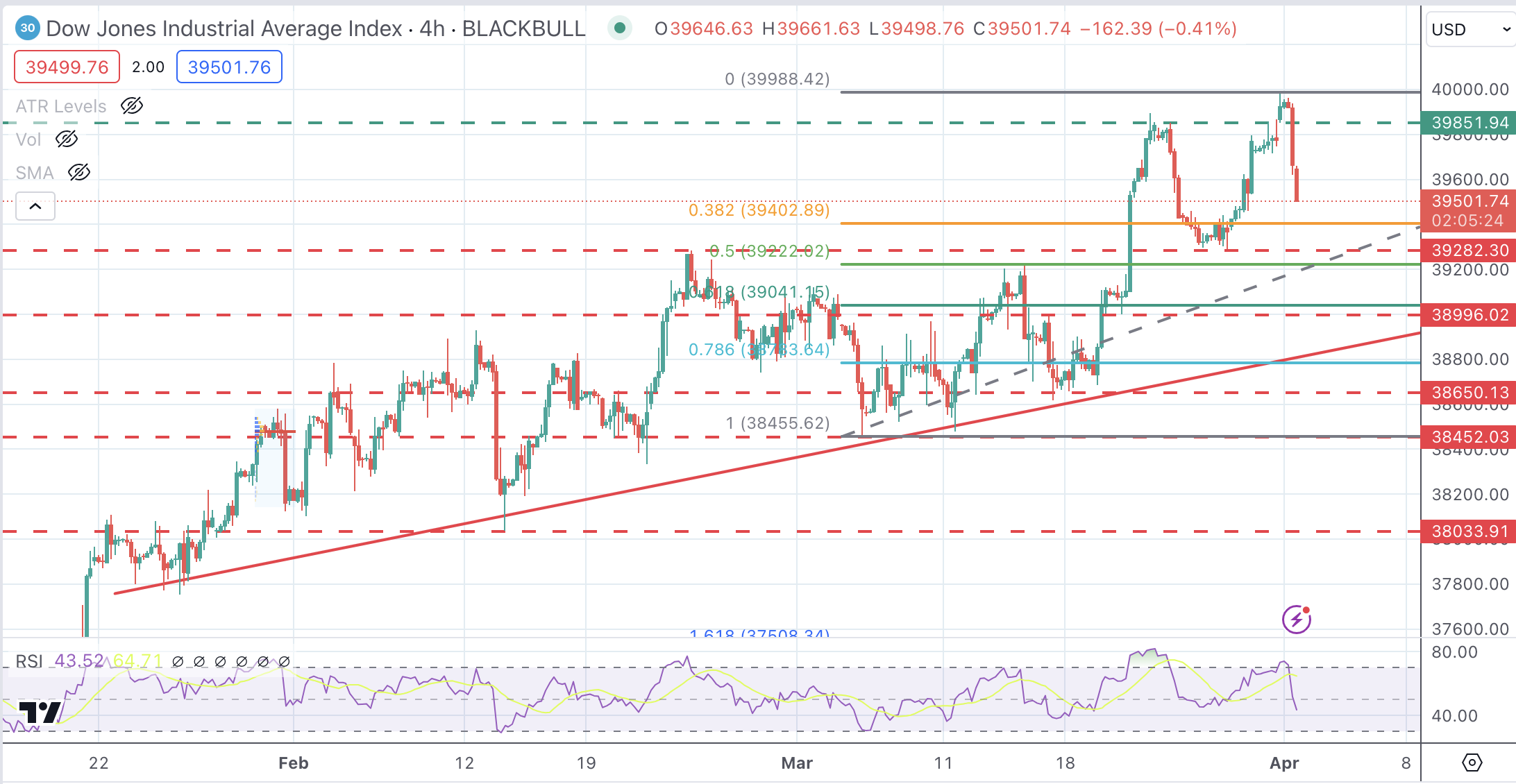
The Dow Jones Index is going through a significant downward correction on Monday, giving away half of the ground taken last week. The overall trend remains bullish, but the pullback from all-time highs gives bears hopes of testing support at the previous resistance level of 39,240.
DJIA remains bullish, standing comfortably above previous highs and the 4-hour 50 Simple Moving Average (SMA) at 39,250. Below here, the next downside targets lie at the 39,000 level and the trendline support at 38,775.
Further down, the trendline resistance from late January lows at 38,850 would be next.
On the upside, the resistance area between 39,850 and the 40,000 psychological levels seems a tough nut to crack for bulls.
DJIA 4-Hour Chart
Nasdaq FAQs
The Nasdaq is a stock exchange based in the US that started out life as an electronic stock quotation machine. At first, the Nasdaq only provided quotations for over-the-counter (OTC) stocks but later it became an exchange too. By 1991, the Nasdaq had grown to account for 46% of the entire US securities’ market. In 1998, it became the first stock exchange in the US to provide online trading. The Nasdaq also produces several indices, the most comprehensive of which is the Nasdaq Composite representing all 2,500-plus stocks on the Nasdaq, and the Nasdaq 100.
The Nasdaq 100 is a large-cap index made up of 100 non-financial companies from the Nasdaq stock exchange. Although it only includes a fraction of the thousands of stocks in the Nasdaq, it accounts for over 90% of the movement. The influence of each company on the index is market-cap weighted. The Nasdaq 100 includes companies with a significant focus on technology although it also encompasses companies from other industries and from outside the US. The average annual return of the Nasdaq 100 has been 17.23% since 1986.
There are a number of ways to trade the Nasdaq 100. Most retail brokers and spread betting platforms offer bets using Contracts for Difference (CFD). For longer-term investors, Exchange-Traded Funds (ETFs) trade like shares that mimic the movement of the index without the investor needing to buy all 100 constituent companies. An example ETF is the Invesco QQQ Trust (QQQ). Nasdaq 100 futures contracts allow traders to speculate on the future direction of the index. Options provide the right, but not the obligation, to buy or sell the Nasdaq 100 at a specific price (strike price) in the future.
Many different factors drive the Nasdaq 100 but mainly it is the aggregate performance of the component companies revealed in their quarterly and annual company earnings reports. US and global macroeconomic data also contributes as it impacts on investor sentiment, which if positive drives gains. The level of interest rates, set by the Federal Reserve (Fed), also influences the Nasdaq 100 as it affects the cost of credit, on which many corporations are heavily reliant. As such the level of inflation can be a major driver too as well as other metrics which impact on the decisions of the Fed.
Author

Guillermo Alcala
FXStreet
Graduated in Communication Sciences at the Universidad del Pais Vasco and Universiteit van Amsterdam, Guillermo has been working as financial news editor and copywriter in diverse Forex-related firms, like FXStreet and Kantox.