Charter Communications has been cut by 70 percent but this pattern at the lows deserves attention

Charter Communications is one of the largest cable and broadband providers in the United States. It has been in a sustained downtrend since trading above $800 in August 2021. The stock is now trading around $240, which is roughly 70% off those highs. That is a long, painful move lower, and for most of that decline there has been nothing on the chart worth getting excited about. That changes with what has been forming at these lows.
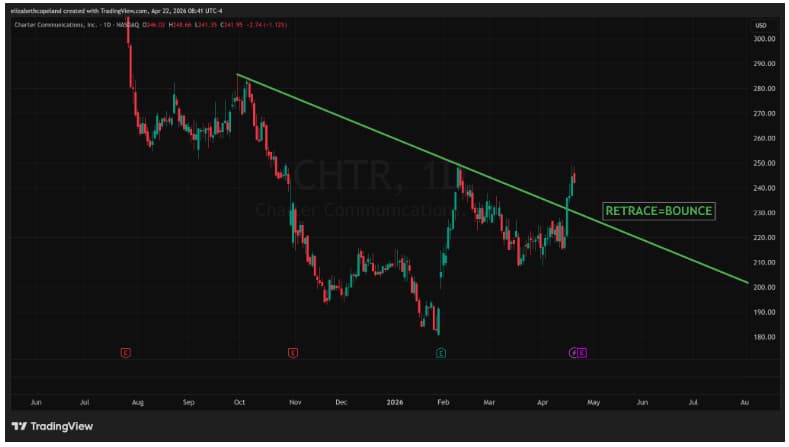
An inverse head and shoulders pattern has developed on the daily chart, and the neckline has already been broken to the upside. Inverse head and shoulders patterns that form after extended downtrends carry more weight than the same pattern appearing mid-trend or even at tops of charts.
The neckline break is the first confirmation that the structure has activated. Price has pushed above it, and now we are watching for the retrace. The retrace back toward the broken neckline is where the high-probability entry sets up. That neckline is a descending trendline, so exactly where price meets it depends on when the retrace arrives.
When a neckline breaks and price pulls back to retest it, that former resistance becomes support. A hold there with a confirmed bounce is the signal that the pattern is playing out as intended.
Aggressive traders can look to enter now at current levels, with the neckline confirmed break as the reference for the stop. More cautious traders can wait for the retrace to the neckline and enter on the bounce with confirmation, getting a slightly better entry with a tighter risk level defined by that same neckline.
I've seen this setup before at the bottom of long downtrends. When it works, it works well. When it doesn't, the neckline tells you quickly. A previous head and shoulders pattern almost played out fully at the last pivot low around April of 2024. 70% was the measured move, but it did play out around 30% before dropping on earnings in April 2025.
Author

Elizabeth Copeland
Verified Investing
Elizabeth is a trader and financial journalist who uses her sharp analytical skills to spot market shifts early and trade with precision.


![How Wall Street rigs the game [Video]](https://editorial.fxsstatic.com/images/i/market-chaos-01.jpg)