Silver Price Forecast: XAG/USD clings to gains near $62 with US NFP in focus
- Silver price remains firm near $62.00 as oil prices are expected to resume the decline.
- Investors await key US NFP data for June, which will be released on Friday.
- Absent the Fed’s forward guidance, the NFP data will significantly influence the central bank’s interest rate prospects.
Silver price (XAG/USD) holds onto two-day gains at around $62.00 during the European trading session on Thursday. The white metal trades firmly amid hopes of a further decline in oil prices.
In the European trade, the WTI Oil price trades 0.9% higher at around $75, but is closer to its three-week low of $73.51 posted on Wednesday.
Lower oil prices keep global inflation expectations in check, a scenario that diminishes fears of interest rate hikes by central banks. Such a case bodes well for non-yielding assets, like Silver.
Brent holds below $80 as hopes build for US–Iran deal on Strait of Hormuz
Analysts at ING highlight that "ICE Brent continues to trade below $80/bbl as the market pins its hopes on a deal between the United States (US) and Iran" that would "resume energy flows through the Strait of Hormuz." They note that Iran has "signalled progress toward this goal," having announced it has reached "an agreement with Oman on new shipping arrangements for the strait," with "a joint statement on the deal now being prepared," reinforcing market expectations of a potential easing in supply-route tensions.
Meanwhile, investors await the US Nonfarm Payrolls (NFP) data for July, which will be released on Friday. Investors will pay close attention to the official employment data, as its impact is likely to be significant on the Federal Reserve’s (Fed) interest rate expectations, given than the central bank has stopped providing forward guidance.
ADP slowdown reinforces TD Securities view of moderating US job gains
According to TD Securities, July ADP employment data "surprised to the downside, moderating to 44k (TD: 50k, cons: 65k)," reinforcing their view that job growth is cooling after a strong start to the year. The bank stresses that it does "not put much weight on ADP when it comes to m/m moves in NFP," but notes that "the trend in the data is in line with what we are expecting." They highlight that "both the monthly and weekly ADP data have moderated this summer," and judge that "a similar trend is likely to occur with NFP job gains," consistent with their expectation of softer official payrolls prints ahead.
Silver Technical Analysis
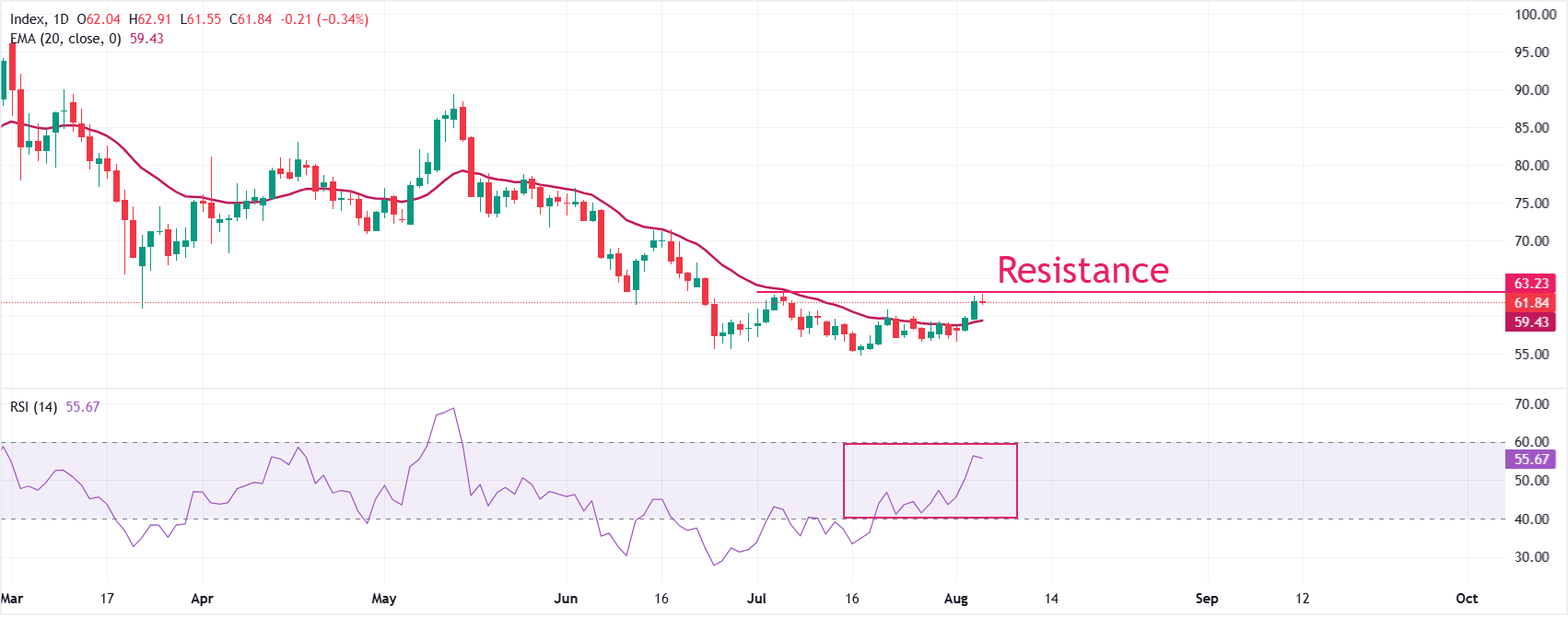
XAG/USD trades at around $61.85, holding a bullish near-term bias as it remains above the 20-day exponential moving average (EMA) at $59.43. The metal has reclaimed higher ground after its recent pullback, and the positioning over the short-term EMA suggests underlying demand remains in place.
Momentum, as reflected by the Relative Strength Index (14) at 55.71, stays in mildly positive territory, hinting that buyers retain the upper hand while avoiding overbought conditions.
On the downside, initial support emerges at the 20-day EMA at $59.43, where a break would signal fading bullish pressure and force a return to the July 17 low at $54.77. Looking up, the July high at $63.28 is the key hurdle for the Silver price; above that, it could extend the advance towards the June 22 high at $67.17.
(The technical analysis of this story was written with the help of an AI tool. Know more.)
Silver FAQs
Silver is a precious metal highly traded among investors. It has been historically used as a store of value and a medium of exchange. Although less popular than Gold, traders may turn to Silver to diversify their investment portfolio, for its intrinsic value or as a potential hedge during high-inflation periods. Investors can buy physical Silver, in coins or in bars, or trade it through vehicles such as Exchange Traded Funds, which track its price on international markets.
Silver prices can move due to a wide range of factors. Geopolitical instability or fears of a deep recession can make Silver price escalate due to its safe-haven status, although to a lesser extent than Gold's. As a yieldless asset, Silver tends to rise with lower interest rates. Its moves also depend on how the US Dollar (USD) behaves as the asset is priced in dollars (XAG/USD). A strong Dollar tends to keep the price of Silver at bay, whereas a weaker Dollar is likely to propel prices up. Other factors such as investment demand, mining supply – Silver is much more abundant than Gold – and recycling rates can also affect prices.
Silver is widely used in industry, particularly in sectors such as electronics or solar energy, as it has one of the highest electric conductivity of all metals – more than Copper and Gold. A surge in demand can increase prices, while a decline tends to lower them. Dynamics in the US, Chinese and Indian economies can also contribute to price swings: for the US and particularly China, their big industrial sectors use Silver in various processes; in India, consumers’ demand for the precious metal for jewellery also plays a key role in setting prices.
Silver prices tend to follow Gold's moves. When Gold prices rise, Silver typically follows suit, as their status as safe-haven assets is similar. The Gold/Silver ratio, which shows the number of ounces of Silver needed to equal the value of one ounce of Gold, may help to determine the relative valuation between both metals. Some investors may consider a high ratio as an indicator that Silver is undervalued, or Gold is overvalued. On the contrary, a low ratio might suggest that Gold is undervalued relative to Silver.
Author

Sagar Dua
FXStreet
Sagar Dua is associated with the financial markets from his college days. Along with pursuing post-graduation in Commerce in 2014, he started his markets training with chart analysis.














