Canadian Dollar fails to hold ground, extends into fresh losses
- Canadian Dollar is losing traction after a brief reprieve from US Dollar bidding.
- Canada economic calendar data has wrapped up for the week.
- Crude Oil softly bounces after getting pummeled.

The Canadian Dollar (CAD) finally caught some relief, digging in its heels and clawing back losses from its three-day backslide against the US Dollar (USD). The Loonie found some bids as the Greenback eased slightly heading into the back half of the trading week. Now, markets are seeing a pivot back into USD bidding, and the Loonie is giving back most of its Thursday intraday gains and now heads into new weekly low bids.
There is little of note remaining on the economic calendar for Canada this week, and USD flows will be in the driver’s seat through Friday.
Fed officials delivered dovish comments, jobless claims were mixed, and investors await another appearance from Federal Reserve (Fed) President Jerome Powell later in the day.
Daily Digest Market Movers: Canadian Dollar bounces back as US Dollar slips
- The CAD caught a mild relief rally on Thursday after USD bets trimmed, but the move proved short-lived.
- US Fed Presidents Harker and Barkin gave mildly dovish comments early Thursday, both see potential for downside risks.
- Fed Chairman Jerome Powell speaks later today, investors to be focusing intently.
- Crude Oil prices are finding a slight lift heading into the back half of the week.
- CAD discovers support from recovering Crude bids, accelerating the rebound.
- US Michigan Consumer Sentiment data on Friday to close out the trading week.
Technical Analysis: Canadian Dollar rebound goes up in smoke, USD/CAD bounces back into high ground
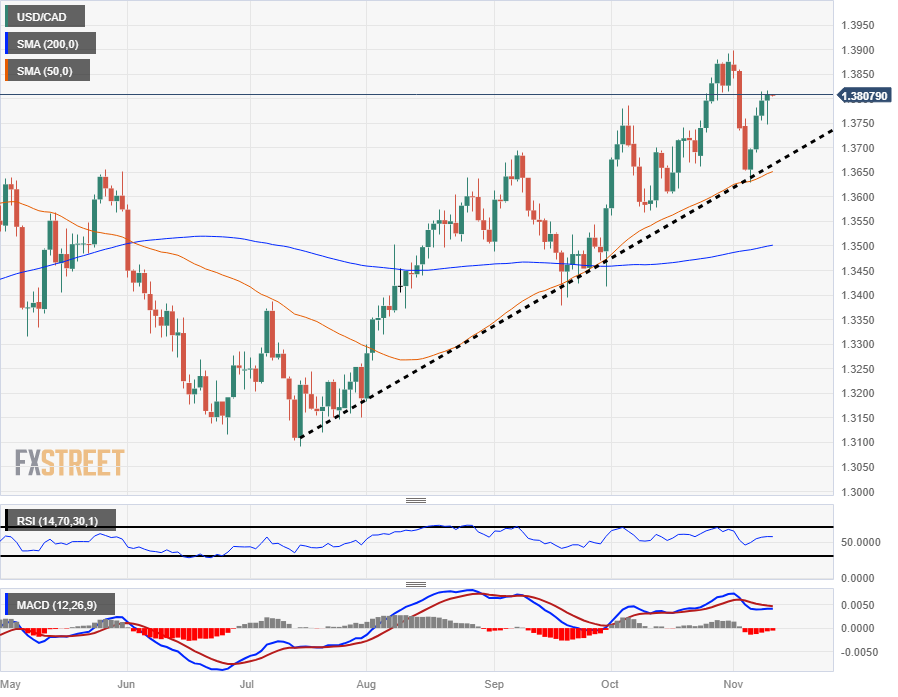
The Canadian Dollar (CAD) found enough bullish spark to push the USD/CAD pair back down the charts, but plenty of upside potential remains in the Greenback, and the pair is currently catching a recovery bounce from 1.3750 with the USD reclaiming the 1.3800 handle.
1.3800 is set to be the main battleground for the back half of the trading week, with the pair etching in a fresh intraday high near 1.3820. A bearish continuation from this region will see a new technical ceiling baked into the USD/CAD.
Intraday action is getting hung up with returns to near-term medians. Most daily price action is sticking close to the 200-hour Simple Moving Average (SMA).
Daily candlesticks see the USD/CAD still on the high side of a higher low pattern firming up from a bullish bounce off the 200-day SMA back in late September. The last swing low saw a topside rebound from the 50-day SMA near 1.3650 just last week.
USD/CAD Daily Chart
Canadian Dollar price this week
The table below shows the percentage change of Canadian Dollar (CAD) against listed major currencies this week. Canadian Dollar was the weakest against the US Dollar.
| USD | EUR | GBP | CAD | AUD | JPY | NZD | CHF | |
| USD | 0.60% | 1.24% | 1.07% | 2.26% | 1.24% | 1.61% | 0.47% | |
| EUR | -0.60% | 0.65% | 0.49% | 1.66% | 0.64% | 1.03% | -0.14% | |
| GBP | -1.25% | -0.65% | -0.18% | 1.02% | 0.00% | 0.37% | -0.79% | |
| CAD | -1.11% | -0.50% | 0.15% | 1.18% | 0.15% | 0.52% | -0.64% | |
| AUD | -2.31% | -1.69% | -1.04% | -1.21% | -1.03% | -0.65% | -1.83% | |
| JPY | -1.26% | -0.65% | -0.22% | -0.16% | 1.03% | 0.37% | -0.78% | |
| NZD | -1.64% | -1.03% | -0.38% | -0.55% | 0.66% | -0.38% | -1.17% | |
| CHF | -0.47% | 0.13% | 0.77% | 0.61% | 1.79% | 0.78% | 1.16% |
The heat map shows percentage changes of major currencies against each other. The base currency is picked from the left column, while the quote currency is picked from the top row. For example, if you pick the Euro from the left column and move along the horizontal line to the Japanese Yen, the percentage change displayed in the box will represent EUR (base)/JPY (quote).
Fed FAQs
What does the Federal Reserve do, how does it impact the US Dollar?
Monetary policy in the US is shaped by the Federal Reserve (Fed). The Fed has two mandates: to achieve price stability and foster full employment. Its primary tool to achieve these goals is by adjusting interest rates.
When prices are rising too quickly and inflation is above the Fed’s 2% target, it raises interest rates, increasing borrowing costs throughout the economy. This results in a stronger US Dollar (USD) as it makes the US a more attractive place for international investors to park their money.
When inflation falls below 2% or the Unemployment Rate is too high, the Fed may lower interest rates to encourage borrowing, which weighs on the Greenback.
How often does the Fed hold monetary policy meetings?
The Federal Reserve (Fed) holds eight policy meetings a year, where the Federal Open Market Committee (FOMC) assesses economic conditions and makes monetary policy decisions.
The FOMC is attended by twelve Fed officials – the seven members of the Board of Governors, the president of the Federal Reserve Bank of New York, and four of the remaining eleven regional Reserve Bank presidents, who serve one-year terms on a rotating basis.
What is Quantitative Easing (QE) and how does it impact USD?
In extreme situations, the Federal Reserve may resort to a policy named Quantitative Easing (QE). QE is the process by which the Fed substantially increases the flow of credit in a stuck financial system.
It is a non-standard policy measure used during crises or when inflation is extremely low. It was the Fed’s weapon of choice during the Great Financial Crisis in 2008. It involves the Fed printing more Dollars and using them to buy high grade bonds from financial institutions. QE usually weakens the US Dollar.
What is Quantitative Tightening (QT) and how does it impact the US Dollar?
Quantitative tightening (QT) is the reverse process of QE, whereby the Federal Reserve stops buying bonds from financial institutions and does not reinvest the principal from the bonds it holds maturing, to purchase new bonds. It is usually positive for the value of the US Dollar.
Author

Joshua Gibson
FXStreet
Joshua joins the FXStreet team as an Economics and Finance double major from Vancouver Island University with twelve years' experience as an independent trader focusing on technical analysis.