Canadian Dollar spins in place as Fed rate call looms
- The Canadian Dollar went nowhere fast on a tense Tuesday.
- Global markets are awaiting the Fed’s last rate call and SEP update of 2025.
- The Fed is widely expected to deliver a third straight rate call, but tone will matter.

The Canadian Dollar (CAD) struggled to find momentum on Tuesday, holding steady against an equally-sluggish US Dollar (USD) as investors brace for the last Federal Reserve (Fed) interest rate decision of the year. A third straight interest rate cut is functionally a foregone conclusion, but investors will be tuning in to see both changes to the Fed’s Summary of Economic Projections (SEP), as well as any tonal shifts in one of Fed Chair Jerome Powell’s last interest rate decision pressers before the end of his term.
Outside of potential market upheaval from any abrupt shifts in Fed policy rhetoric, Canadian Dollar markets will be keeping a close eye on trade war developments with the Trump administration. US President Donald Trump revealed his plans to deliver $12 billion in extra agricultural support for battered American farmers, who continue to be the worst-hit victims of his global trade war aspirations.
President Trump also doubled down on expressing his frustration at his own inability to force Canada into a disadvantageous trade position, threatening fresh tariffs on US companies that import Canadian fertilizer products, which are again overwhelmingly US farmers. The American farming industry is singularly dependent on Canadian fertilizer suppliers, rendering the policy shift a uniquely problematic way to gain the upper hand in trade talks with Canada, which remains leery of engaging in trade talks with the Trump administration ever since Trump began threatening to blow up his own bespoke trade deal that he forcibly renegotiated with Canada and Mexico during his first term.
Daily digest market movers: Canadian Dollar momentum remains low as markets brace for Fed
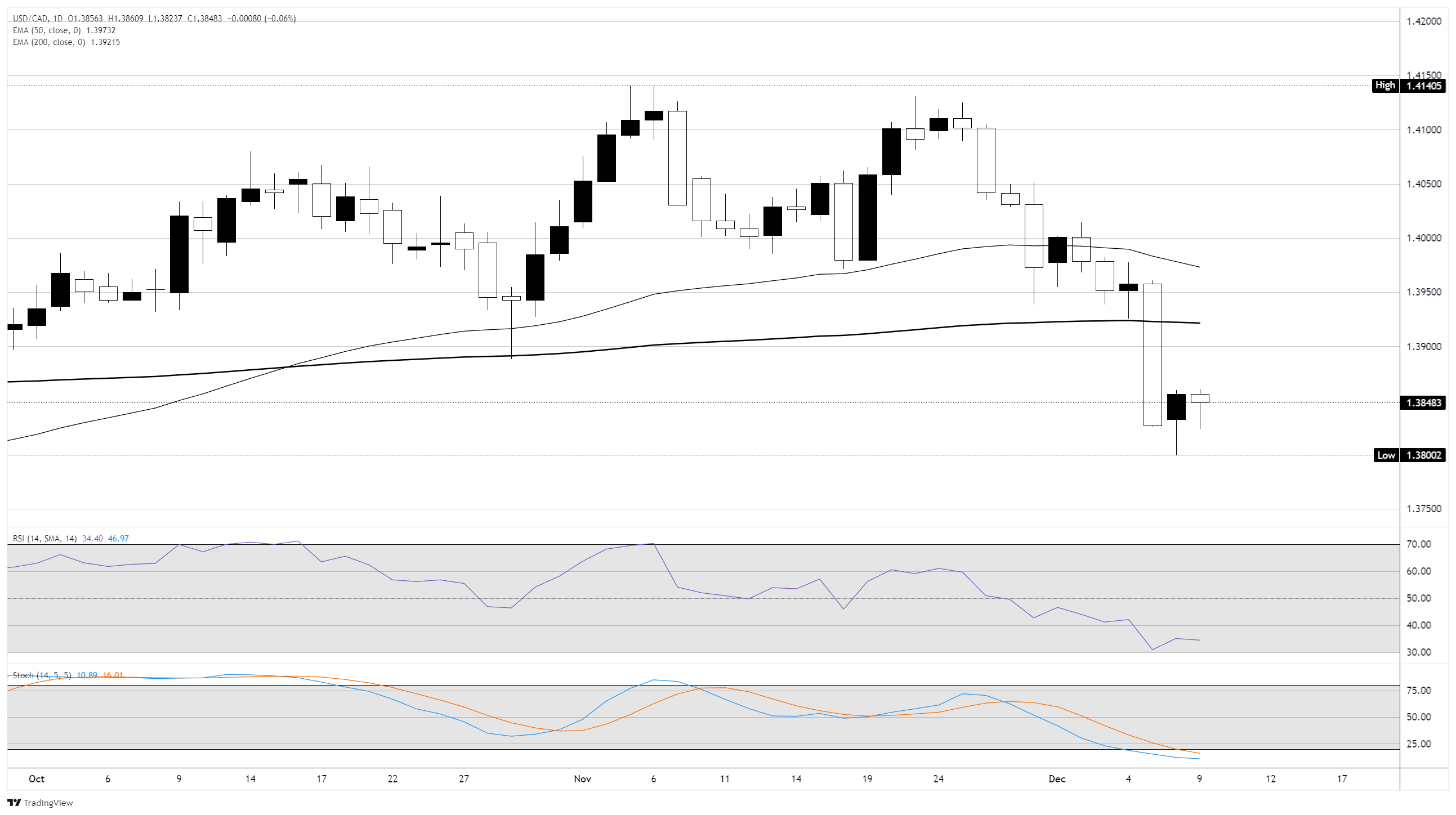
- Canadian Dollar remains trapped in a pre-Fed holding pattern, keeping USD/CAD price action capped near 1.3850.
- The Canadian Dollar gained ground sharply over a two-week period, climbing 2.3% bottom-to-top after falling to seven-month lows in early November.
- Bullish Loonie momentum has stalled ahead of the Fed’s final interest rate decision of 2025.
- Markets will be keeping a close eye on shifts to the Fed’s dot plot of interest rate expectations heading into 2026.
- The Fed is broadly expected to cut interest rates for a third straight meeting on Wednesday, but investors’ primary focus will be Fed Chair Powell’s tone regarding ‘data dependency’ as his term as Fed Chair approaches its end, and due to wrap up in March.
Canadian Dollar price forecast
Following a bout of Canadian Dollar strength that squeezed the USD/CAD chart into fresh lows, bearish momentum looks poised for an extended pause, if not an outright turnaround. Technical oscillators have slumped into oversold territory, and a technical bounce from the 1.3800 handle suggests a near-term Loonie surge may have run its course.
USD/CAD daily chart
Canadian Dollar FAQs
The key factors driving the Canadian Dollar (CAD) are the level of interest rates set by the Bank of Canada (BoC), the price of Oil, Canada’s largest export, the health of its economy, inflation and the Trade Balance, which is the difference between the value of Canada’s exports versus its imports. Other factors include market sentiment – whether investors are taking on more risky assets (risk-on) or seeking safe-havens (risk-off) – with risk-on being CAD-positive. As its largest trading partner, the health of the US economy is also a key factor influencing the Canadian Dollar.
The Bank of Canada (BoC) has a significant influence on the Canadian Dollar by setting the level of interest rates that banks can lend to one another. This influences the level of interest rates for everyone. The main goal of the BoC is to maintain inflation at 1-3% by adjusting interest rates up or down. Relatively higher interest rates tend to be positive for the CAD. The Bank of Canada can also use quantitative easing and tightening to influence credit conditions, with the former CAD-negative and the latter CAD-positive.
The price of Oil is a key factor impacting the value of the Canadian Dollar. Petroleum is Canada’s biggest export, so Oil price tends to have an immediate impact on the CAD value. Generally, if Oil price rises CAD also goes up, as aggregate demand for the currency increases. The opposite is the case if the price of Oil falls. Higher Oil prices also tend to result in a greater likelihood of a positive Trade Balance, which is also supportive of the CAD.
While inflation had always traditionally been thought of as a negative factor for a currency since it lowers the value of money, the opposite has actually been the case in modern times with the relaxation of cross-border capital controls. Higher inflation tends to lead central banks to put up interest rates which attracts more capital inflows from global investors seeking a lucrative place to keep their money. This increases demand for the local currency, which in Canada’s case is the Canadian Dollar.
Macroeconomic data releases gauge the health of the economy and can have an impact on the Canadian Dollar. Indicators such as GDP, Manufacturing and Services PMIs, employment, and consumer sentiment surveys can all influence the direction of the CAD. A strong economy is good for the Canadian Dollar. Not only does it attract more foreign investment but it may encourage the Bank of Canada to put up interest rates, leading to a stronger currency. If economic data is weak, however, the CAD is likely to fall.
Author

Joshua Gibson
FXStreet
Joshua joins the FXStreet team as an Economics and Finance double major from Vancouver Island University with twelve years' experience as an independent trader focusing on technical analysis.