Canadian Dollar slides to five-week low after Fed’s hawkish decision
- The Canadian Dollar is under pressure against the US Dollar after the Fed’s monetary policy decision.
- Traders have raised hawkish Fed bets as the central bank warns of upside inflation risks.
- Oil prices struggle to sustain above the $100 mark.

The Canadian Dollar (CAD) trades weakly against the US Dollar (USD) on Thursday. In the Asian session, the USD/CAD pair posts a fresh five-week high to near 1.4000. The Loonie pair gains significantly as the US Dollar outperforms, following the Federal Reserve’s (Fed) monetary policy announcement on Wednesday.
US Dollar Price This week
The table below shows the percentage change of US Dollar (USD) against listed major currencies this week. US Dollar was the strongest against the New Zealand Dollar.
| USD | EUR | GBP | JPY | CAD | AUD | NZD | CHF | |
|---|---|---|---|---|---|---|---|---|
| USD | 1.22% | 1.17% | 1.61% | 0.88% | 0.86% | 1.64% | 1.19% | |
| EUR | -1.22% | -0.07% | 0.41% | -0.35% | -0.35% | 0.41% | -0.03% | |
| GBP | -1.17% | 0.07% | 0.48% | -0.25% | -0.28% | 0.49% | 0.00% | |
| JPY | -1.61% | -0.41% | -0.48% | -0.77% | -0.81% | -0.07% | -0.51% | |
| CAD | -0.88% | 0.35% | 0.25% | 0.77% | 0.02% | 0.76% | 0.28% | |
| AUD | -0.86% | 0.35% | 0.28% | 0.81% | -0.02% | 0.77% | 0.31% | |
| NZD | -1.64% | -0.41% | -0.49% | 0.07% | -0.76% | -0.77% | -0.48% | |
| CHF | -1.19% | 0.03% | -0.01% | 0.51% | -0.28% | -0.31% | 0.48% |
The heat map shows percentage changes of major currencies against each other. The base currency is picked from the left column, while the quote currency is picked from the top row. For example, if you pick the US Dollar from the left column and move along the horizontal line to the Japanese Yen, the percentage change displayed in the box will represent USD (base)/JPY (quote).
As of writing, the US Dollar Index (DXY), which gauges the Greenback’s value against six major currencies, trades firmly near Thursday’s high at around 100.33.
In the policy meeting, the Fed hiked interest rates by 25 basis points (bps) to 3.75%-4.00%, as expected, after remaining on hold in the last five meetings.
Financial market participants have raised hawkish Fed bets after remarks from Chairman Kevin Warsh that prices pressures are significantly higher for a long time. However, he didn’t deliver any guidance on the monetary policy outlook, as expected.
According to the CME FedWatch tool, the odds of the Fed delivering at least two interest rate hikes by the year-end have increased to 88.7% from 79% seen before the policy announcement.
On the Canadian Dollar front, a pause in the oil price rally has also weighed some pressure. Oil prices struggle to extend the rally above $100, diminishing the appeal of currencies from economies, such as Canada, which are net energy expoerter.
USD/CAD Technical Analysis
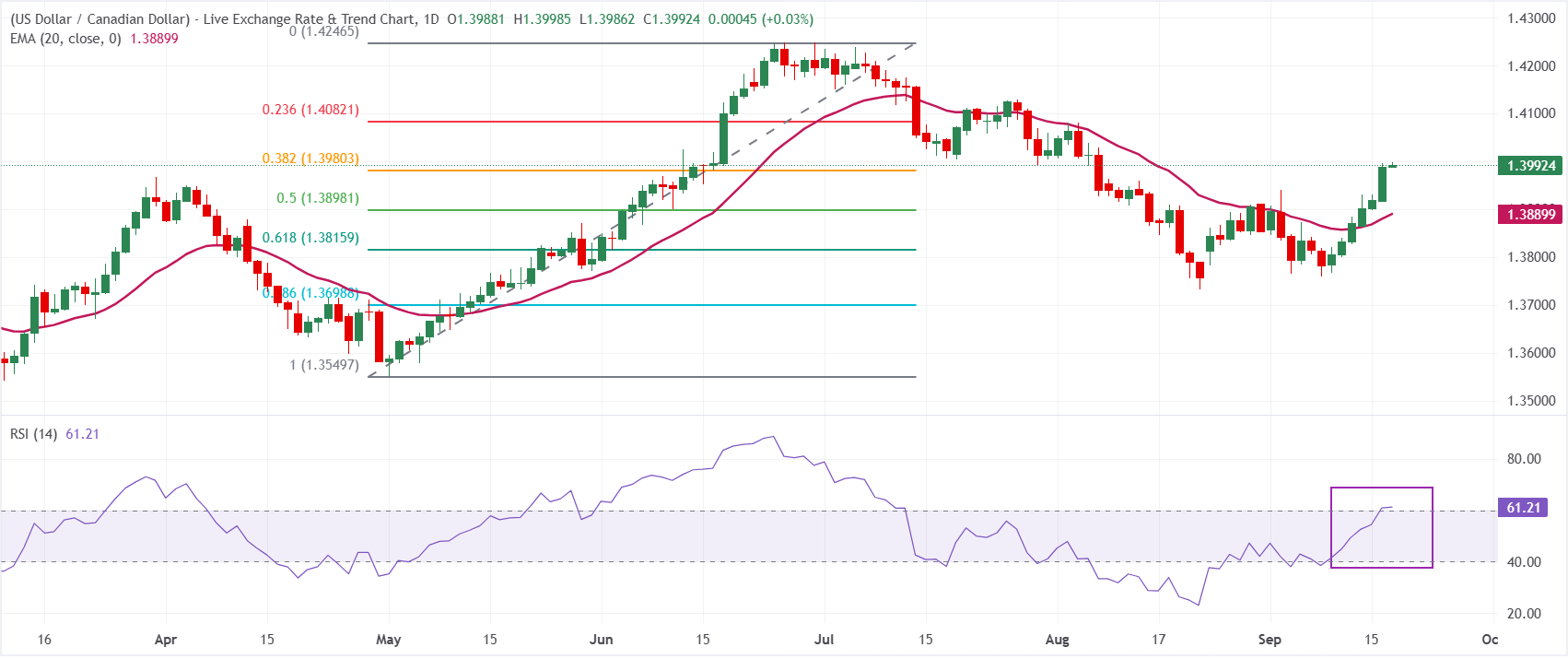
In the daily chart, USD/CAD trades at 1.3992. The pair holds above the 20-period Exponential Moving Average (EMA) at 1.3890, keeping the near-term bias bullish as price also sits above a dense Fibonacci support band, including the 38.2% retracement at 1.3980 and the 50.0% level at 1.3898. The Relative Strength Index (14) at 61.2 points to firm, though not extreme, bullish momentum, suggesting buyers remain in control while the latest rebound extends away from the recent lows.
On the downside, immediate support is clustered around the 38.2% Fibonacci retracement at 1.3980, followed by the 50.0% level at 1.3898 and the 20-period EMA at 1.3890, with deeper cushions at the 61.8% retracement at 1.3816 and the 78.6% level at 1.3699. On the topside, initial resistance emerges at the 23.6% Fibonacci retracement at 1.4082, ahead of the cycle high anchor near 1.4247, where a break would be needed to unlock a more extended bullish phase.
(The technical analysis of this story was written with the help of an AI tool. Know more.)
Economic Indicator
Fed Interest Rate Decision
The Federal Reserve (Fed) deliberates on monetary policy and makes a decision on interest rates at eight pre-scheduled meetings per year. It has two mandates: to keep inflation at 2%, and to maintain full employment. Its main tool for achieving this is by setting interest rates – both at which it lends to banks and banks lend to each other. If it decides to hike rates, the US Dollar (USD) tends to strengthen as it attracts more foreign capital inflows. If it cuts rates, it tends to weaken the USD as capital drains out to countries offering higher returns. If rates are left unchanged, attention turns to the tone of the Federal Open Market Committee (FOMC) statement, and whether it is hawkish (expectant of higher future interest rates), or dovish (expectant of lower future rates).
Read more.Last release: Wed Sep 16, 2026 18:00
Frequency: Irregular
Actual: 4%
Consensus: 4%
Previous: 3.75%
Source: Federal Reserve
Author

Sagar Dua
FXStreet
Sagar Dua is associated with the financial markets from his college days. Along with pursuing post-graduation in Commerce in 2014, he started his markets training with chart analysis.