Can the KOSPI index sustain its record-breaking performance in 2026? (Part two)
While the KOSPI index is once again outperforming in 2026 by gaining around 25% so far this year (after +75% in 2025), violent swings test the nerves of investors. Can the South Korean index keep rising in 2026 and hit new highs? Let’s take a closer look:
Part two: 2026 - Momentum, Volatility, and the Question every investor is asking
Strong Gains, But With Wild Swings—What Is Driving the Volatility?
Entering 2026, the KOSPI has continued to outperform. The index is up approximately 25% year-to-date as of early March—a remarkable figure at a time when many of the world’s major markets are struggling. The CAC 40 is down more than 3.8% since January, the DAX has shed over 5.4%, and the Nasdaq has fallen nearly 5.8%. By those measures, Seoul remains in a league of its own.
But the ride has been anything but smooth since the Iran war. In a single session last Wednesday, the KOSPI plunged as much as 12%—its largest single-day drop ever recorded. The very next day, it surged nearly 10%, its best daily performance since records began in 1985, according to Dow Jones Market Data. Circuit breakers were triggered. Trading was briefly suspended.
Today, March 9, 2026, was another day of intense volatility for the KOSPI. The index ended the session with a loss of nearly 6.0%, a partial recovery after intraday losses exceeded 8.0%. This sharp decline forced the Korea Exchange to activate circuit breakers for the second time this month.
The source of the turbulence is not hard to identify. The escalating conflict in the Middle East has sent oil prices sharply higher (now over $100/barrel), and South Korea—a major energy importer with limited domestic production—is acutely sensitive to those moves. Rising energy costs threaten corporate margins, stoke inflation, and weigh on consumer confidence. When oil spikes, Korean markets feel it quickly and disproportionately.
The market’s structure amplifies these moves further.
With Samsung and SK Hynix (both shares down almost 18% in the last 5 days) making up such an outsized share of the index, any rotation away from technology or deterioration in the semiconductor outlook sends exaggerated ripples through the KOSPI. A more diversified index absorbs sector-specific shocks more easily—the KOSPI, by contrast, magnifies them.
The large and active base of retail investors, many of whom are newer to markets and more reactive to short-term news, adds another layer of volatility. The derivatives market, which is among the most active in Asia, further amplifies intraday swings when sentiment shifts rapidly.
A Structural Shift in Domestic Markets: Wealthy Investors Join the Rallye
Perhaps the most significant development for the KOSPI’s 2026 trajectory is a shift in who is now buying. While the 2025 rally was driven substantially by younger retail investors priced out of housing, a new cohort is beginning to enter the market—high-net-worth individuals who previously anchored their wealth in property.
As the government moves to impose stricter capital gains taxes on owners of multiple properties, private bankers at Korea’s five largest banks are reporting a notable uptick in consultations from wealthy clients looking to sell apartments and redirect proceeds into financial assets and equities.
The calculus is changing: assets once held conservatively to fund children’s home purchases are now flowing into the stock market. Clients who previously favoured principal-protected products or low-coupon bonds are shifting toward equities. The concept of what constitutes a "safe" asset in South Korea is itself being redefined.
This is a meaningful structural development. Retail momentum from younger investors can be fickle—it accelerates during bull markets and evaporates when volatility spikes. Wealthy investor flows tend to be larger, more patient, and more deliberate. If property transactions accelerate as tax pressure mounts, analysts expect a significant additional wave of capital to enter domestic equities—providing a deeper and potentially more durable foundation for the market’s continued rise.
The AI boom could be far from over for Samsung and SK Hynix
Another force standing out as particularly relevant for what comes next: the potentially continued and accelerating global appetite for AI hardware—and the two Korean chipmakers sitting at the centre of it.
As of January 2026, overseas holdings of South Korean equities topped $1.1 trillion—more than double the level recorded just a year earlier, and equivalent to 32% of the market’s total capitalisation. Much of that inflow has been concentrated in Samsung and SK Hynix, whose dominance in memory semiconductors makes them among the most direct ways to gain exposure to the AI infrastructure build-out anywhere in the world.
SK Hynix shares have risen around 345% over the past twelve months, a performance that has vastly outpaced even Nvidia (+66% over the same period)—its own key customer and the defining stock of the AI era. The signal that sends is significant: global capital is increasingly treating Seoul’s chip giants not merely as technology stocks, but as essential infrastructure plays for the next decade of computing.
Memory chip businesses carry high operating leverage, meaning that as prices rise, the benefits flow through to profits rapidly and disproportionately. With AI-related demand for high-bandwidth memory continuing to outpace supply, analysts have repeatedly been forced to revise their earnings estimates for South Korean companies upward. Goldman Sachs analyst Moe has raised his market earnings growth forecast three times in 2026 alone (most recently from 120% to 130%) a pattern that reflects not optimistic projection but the genuine difficulty of keeping up with the strength of actual demand.
That earnings momentum helps explain something that might otherwise seem puzzling: despite the KOSPI’s extraordinary gains, valuations remain genuinely attractive by global standards. The index trades at price-to-earnings multiples of 8.8 times for 2026 and 7.8 times for 2027—a meaningful discount to emerging markets as a whole.
Even stripping out Samsung and SK Hynix entirely, the remaining market trades at just 12.9 times earnings, with an estimated return on equity of 20% for this year. For some experts, these are not the numbers of a market in bubble territory. They are the numbers of a market that, despite its run, is still being re-rated from a low base.
Can the KOSPI index Sustain its record-breaking performance this year?
The KOSPI’s path forward is not without risk. The trajectory of oil prices, the duration of Middle East tensions, the pace of further corporate governance reform, and the degree to which domestic capital continues rotating out of property and into equities—each of these variables carries real uncertainty, and any one of them could disrupt the momentum that has made this the world’s best-performing major market.
But stepping back from the near-term noise, the structural case remains compelling. Last week’s sharp selloff—which saw the index meet the technical definition of a bear market after a cumulative drop of roughly 20% across Tuesday and Wednesday—rattled nerves. Goldman Sachs, however, was quick to put it in context: the KOSPI has delivered a 176% return since April of last year, and what looked like a crisis was, in Moe’s assessment, an overdue correction within a longer uptrend that remains firmly intact. Goldman has since raised its year-end target to 7,000—implying a further 33% upside from current levels.
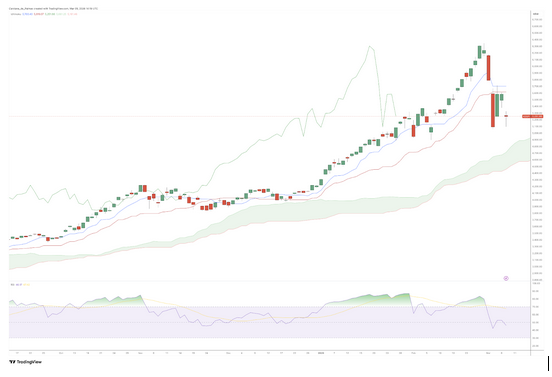
Daily KOSPI Index Chart - Source: TradingView
The most compelling sectors, according to Goldman’s analysis, stretch beyond semiconductors. AI-adjacent themes including robotics, power infrastructure, industrials and defence, shipbuilding, and consumer stocks benefiting from the global K-culture wave all represent areas of potential growth that suggest the KOSPI’s story is broader and deeper than a two-stock trade.
What has unfolded in South Korea over the past eighteen months is not a speculative bubble driven by momentum and hype. Many believe it is a genuine market re-rating—powered by a generational shift in how Koreans build wealth, a corporate governance revolution that is measurably narrowing the Korea Discount, and two world-class technology companies at the epicentre of the most important infrastructure investment cycle of our time. The volatility is real, and it will likely persist as long as the Iran war goes on. But for investors with the conviction and the stomach for it, the underlying story remains very much alive.
Stay up to date with what's moving and shaking on the world's markets and never miss another important headline again! Check ActivTrades daily news and analyses here.
Author

Carolane de Palmas
ActivTrades
Carolane graduated with a Masters in Corporate Finance & Financial Markets and got the AMF Certification (Financial Markets Regulator in France). Afterward, she became an independent trader, investing mostly in European and American stocks/indices.