British Pound Sterling's turnaround is dead on arrival
- GBP/USD extended its decline on Wednesday and closed just above fresh lows for the move.
- Every attempt at a bullish turn has failed, with price stuck well below its key moving averages.
- A leadership vacuum at home and a bare data calendar leave Sterling at the mercy of a firmer Dollar and Thursday's US Core PCE.
GBP/USD spent Wednesday confirming what the daily chart has signalled for a week, that the Pound's attempted recovery has run out of road. Cable drifted lower through the session to a low just under 1.3150 before clawing back a little into the close, settling just above fresh lows for the move. The pressure is all on the Dollar, lifted broadly by a Federal Reserve (Fed) that has turned hawkish, and nothing on the UK side has been able to stand in its way.
The chart has already made the call
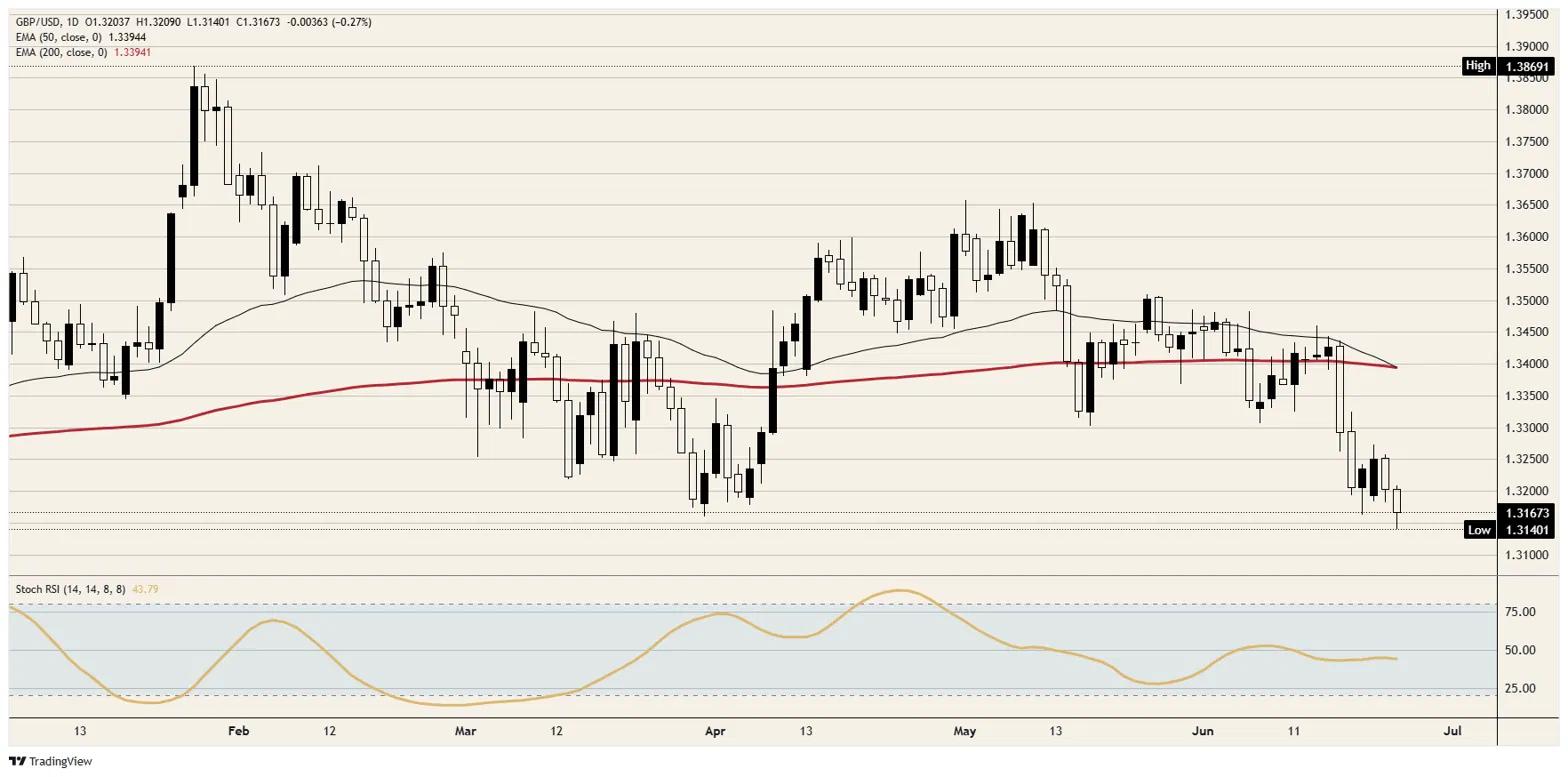
The daily chart is unambiguous, and not flattering. Price has broken below both the 50-day Exponential Moving Average (EMA) and the 200-day EMA, which have converged almost exactly near the 1.3400 handle and now form a single thick band of resistance roughly 225 pips overhead. Beneath that wall there is little obvious support before the 1.3000 handle. The daily Stochastic Relative Strength Index (Stoch RSI) sits only mid-range, nowhere near oversold, so the chart has room to extend lower before anything looks stretched.
A hawkish hold that bought Sterling nothing
Sterling's deeper problem is that even a hawkish central bank has not stemmed the slide. The Bank of England (BoE) held Bank Rate steady last week, with two of its nine members voting for a hike, the sort of result that normally puts a floor under a currency. The Pound slid anyway, and with the next BoE decision not due until late July and only a couple of policymaker speeches this week, no fresh domestic catalyst is coming.
Westminster offers a vacuum, not a backstop
On top of that sits a political vacuum the market has learned to charge for. Keir Starmer's resignation has left a caretaker government in charge while Labour runs a leadership contest set to grind through the summer, with Andy Burnham the clear favourite to succeed him before Parliament returns in September. Until that resolves, no one is positioned to act decisively on the economy or the currency, and the uncertainty keeps a risk premium stapled to Sterling that a firm Dollar is happy to press.
Thursday's number is the only mover left
The only release heavy enough to move the pair this week is American, not British. Thursday at 12:30 GMT brings the core Personal Consumption Expenditures Price Index (PCE), the Fed's favoured inflation gauge, with consensus at 0.3% MoM and 3.4% YoY, both a touch above the prior month. A firm number feeds straight into the hawkish Dollar trade and likely drags Cable toward the 1.3000 handle. With no domestic data to lean against, the risk is skewed lower, and only a soft print offers Sterling any relief.
Levels to watch
Resistance: The 1.3200 handle caps the immediate upside, and the converged moving averages near 1.3400 form the ceiling any genuine recovery would have to break first; nothing between the two argues for it.
Support: The 1.3150 area is the first shelf, with 1.3100 beneath it and the 1.3000 handle the obvious magnet should Thursday's data cooperate.
Bias: Lower. A broken chart, a firmer Dollar and a Britain offering neither a fresh catalyst nor a settled government leave Sterling nothing to rally on; a hawkish BoE hold already failed to change that. Rallies are for selling until price reclaims its moving averages.
GBP/USD daily chart
Pound Sterling FAQs
The Pound Sterling (GBP) is the oldest currency in the world (886 AD) and the official currency of the United Kingdom. It is the fourth most traded unit for foreign exchange (FX) in the world, accounting for 12% of all transactions, averaging $630 billion a day, according to 2022 data. Its key trading pairs are GBP/USD, also known as ‘Cable’, which accounts for 11% of FX, GBP/JPY, or the ‘Dragon’ as it is known by traders (3%), and EUR/GBP (2%). The Pound Sterling is issued by the Bank of England (BoE).
The single most important factor influencing the value of the Pound Sterling is monetary policy decided by the Bank of England. The BoE bases its decisions on whether it has achieved its primary goal of “price stability” – a steady inflation rate of around 2%. Its primary tool for achieving this is the adjustment of interest rates. When inflation is too high, the BoE will try to rein it in by raising interest rates, making it more expensive for people and businesses to access credit. This is generally positive for GBP, as higher interest rates make the UK a more attractive place for global investors to park their money. When inflation falls too low it is a sign economic growth is slowing. In this scenario, the BoE will consider lowering interest rates to cheapen credit so businesses will borrow more to invest in growth-generating projects.
Data releases gauge the health of the economy and can impact the value of the Pound Sterling. Indicators such as GDP, Manufacturing and Services PMIs, and employment can all influence the direction of the GBP. A strong economy is good for Sterling. Not only does it attract more foreign investment but it may encourage the BoE to put up interest rates, which will directly strengthen GBP. Otherwise, if economic data is weak, the Pound Sterling is likely to fall.
Another significant data release for the Pound Sterling is the Trade Balance. This indicator measures the difference between what a country earns from its exports and what it spends on imports over a given period. If a country produces highly sought-after exports, its currency will benefit purely from the extra demand created from foreign buyers seeking to purchase these goods. Therefore, a positive net Trade Balance strengthens a currency and vice versa for a negative balance.
Author

Joshua Gibson
FXStreet
Joshua joins the FXStreet team as an Economics and Finance double major from Vancouver Island University with twelve years' experience as an independent trader focusing on technical analysis.