British Pound Sterling rallies on a hawkish vote the Bank of England immediately talked down
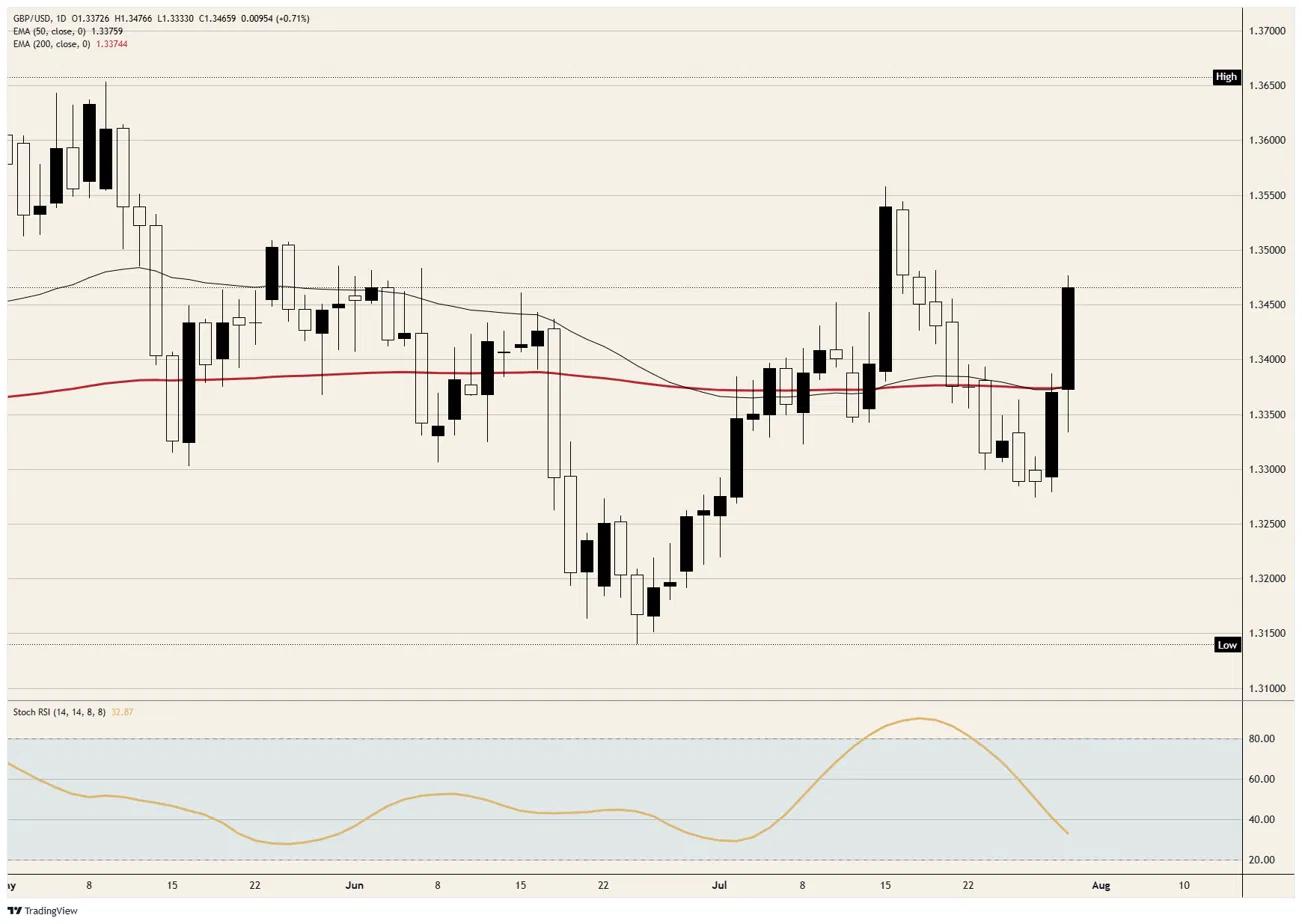
- GBP/USD trades above 1.3450 after a 0.71% advance, cutting through the converged 50-day and 200-day EMAs as though neither was there.
- A 6-3 hold with three votes for an immediate hike beat the expected 7-2 split, and the press conference spent its hour insisting nobody should read a tightening cycle into it.
- A 0.2% gain on the Euro against a 0.71% gain on the Dollar leaves most of this rally the property of a currency knocked over by suspected Japanese intervention.

The Bank of England held Bank Rate at 3.75% for a fifth straight meeting on Thursday, and the Monetary Policy Committee (MPC) got there on a 6-3 vote, with three members backing an immediate quarter-point increase against a consensus that had looked for 7-2. GBP/USD trades above 1.3450, up 0.71%, roughly 130 pips above the European morning low short of 1.3350. The advance cut straight through the 50-day and 200-day Exponential Moving Averages (EMA), which have converged just below 1.3400 and have been advertising a range rather than defending one.
A hawkish vote and an hour spent undoing it
The dissent bloc grew by one from June, and the swing factor is not in dispute. Energy prices remain volatile and well above pre-conflict levels, June's Consumer Price Index (CPI) reading of 2.6% is expected to turn higher as those costs pass through, and the dissenters argue that the longer the shock persists, the greater the risk of second-round effects in wage and price setting.
The press conference then spent an hour undoing the impression the vote had just created, with the Governor telling reporters directly that nothing the committee had said should be read as the Bank edging toward a hike. The majority guidance restates the June framework: tolerate a slower return to target rather than tighten into an external shock, and wait for hard evidence that energy costs are feeding domestic inflation. One dissenter's stated trigger was narrower, resting on the failure of last month's peace framework and the energy volatility that followed.
What the Euro cross gives away
The most useful information Thursday has produced sits on a different pair entirely. Sterling is up roughly 0.2% against the Euro, against 0.71% on the Dollar, and the gain on the cross arrived late, well after the vote. Through the decision and the press conference the Pound was softer against the Euro, at its weakest of the day. A genuine repricing of Britain's rate path would have bought more than 20 pips against a central bank that did nothing at all.
The Dollar side is where this session was actually decided, and it was decided violently. USD/JPY fell more than 400 pips through 160 on suspected intervention that Tokyo has not confirmed, dragging the Dollar Index down around 0.8% to a seven-week low near 100. The 12:30 GMT data batch was an odd one to trade: advance second-quarter Gross Domestic Product (GDP) growth of 1.5% against 2.1% consensus arrived alongside a GDP price index at 6.3% against 3.6%, a growth miss and an inflation shock in one release. Traders took the growth half, helped by a softer core Personal Consumption Expenditures (PCE) print of 0.1% MoM against 0.2%.
The government Sterling has to carry
The Pound's inability to hold a hawkish surprise against the Euro is not a technical accident. Burnham took office as Prime Minister on 20 July, appointed John Healey to the Treasury, and opened with language about finding flexibility within the inherited fiscal rules. Gilt yields answered immediately, with the 10-year moving above 5% and the 30-year near 5.75%, among the highest in the G7.
That is the difference between a hawkish central bank and a hawkish central bank in a country carrying a funding question. Higher British rates currently read as risk premium rather than yield attraction, and roughly 24 billion Pounds of trailed spending and tax measures ahead of an October Budget keeps that reading intact. Until the Budget resolves that, Sterling will keep converting good news into small gains and bad news into large ones.
What lands next
Friday brings the Employment Cost Index (ECI) for the second quarter at 12:30 GMT, consensus 0.8% against 0.9% previously, then the Chicago Purchasing Managers Index (PMI) at 13:45 GMT and the Michigan sentiment and inflation expectations series at 14:00 GMT. Month-end rebalancing flows land the same day and tend to distort the final hours of a large directional move.
Next week is a United States labour week with nothing of consequence on the British side. The Institute for Supply Management (ISM) manufacturing survey arrives Monday at 14:00 GMT against a 53.3 previous reading, the private payrolls report and the ISM services survey follow on Wednesday, and Nonfarm Payrolls land on Friday at 12:30 GMT against a 57K previous. A regional Federal Reserve president speaks late Thursday.
Futures put a September Federal Reserve hike at 63%, lift that to 90% by the late October meeting, and price one increase in full by December, with a second running near 37% by that date. Add three dissents of its own and a chair who has withdrawn forward guidance entirely, and payrolls carries more weight than usual. GBP/USD is a Dollar instrument until the Bank of England meets again in September, and that is the honest read of a session in which Sterling's own central bank surprised on the hawkish side and the Pound collected 20 pips on the Euro for it.
Levels and bias
Resistance: First at 1.3500, immediately above the session high. A daily close above there opens 1.3550, with the mid-July spike area near 1.3650 the next meaningful obstacle.
Support: 1.3400 is the pivot now, with the converged moving averages sitting between 1.3350 and 1.3400 just beneath it. A break below 1.3400 puts 1.3300 back in play, then 1.3250.
Bias: Bullish while 1.3400 holds, targeting 1.3550. The daily Stochastic Relative Strength Index (Stoch RSI) near 33 leaves room above rather than arguing against the move, though ownership of this rally belongs to the Dollar and not to Sterling. A break back below 1.3400 returns the pair to the range that has contained it since May and to 1.3300.
GBP/USD daily chart
Pound Sterling FAQs
The Pound Sterling (GBP) is the oldest currency in the world (886 AD) and the official currency of the United Kingdom. It is the fourth most traded unit for foreign exchange (FX) in the world, accounting for 12% of all transactions, averaging $630 billion a day, according to 2022 data. Its key trading pairs are GBP/USD, also known as ‘Cable’, which accounts for 11% of FX, GBP/JPY, or the ‘Dragon’ as it is known by traders (3%), and EUR/GBP (2%). The Pound Sterling is issued by the Bank of England (BoE).
The single most important factor influencing the value of the Pound Sterling is monetary policy decided by the Bank of England. The BoE bases its decisions on whether it has achieved its primary goal of “price stability” – a steady inflation rate of around 2%. Its primary tool for achieving this is the adjustment of interest rates. When inflation is too high, the BoE will try to rein it in by raising interest rates, making it more expensive for people and businesses to access credit. This is generally positive for GBP, as higher interest rates make the UK a more attractive place for global investors to park their money. When inflation falls too low it is a sign economic growth is slowing. In this scenario, the BoE will consider lowering interest rates to cheapen credit so businesses will borrow more to invest in growth-generating projects.
Data releases gauge the health of the economy and can impact the value of the Pound Sterling. Indicators such as GDP, Manufacturing and Services PMIs, and employment can all influence the direction of the GBP. A strong economy is good for Sterling. Not only does it attract more foreign investment but it may encourage the BoE to put up interest rates, which will directly strengthen GBP. Otherwise, if economic data is weak, the Pound Sterling is likely to fall.
Another significant data release for the Pound Sterling is the Trade Balance. This indicator measures the difference between what a country earns from its exports and what it spends on imports over a given period. If a country produces highly sought-after exports, its currency will benefit purely from the extra demand created from foreign buyers seeking to purchase these goods. Therefore, a positive net Trade Balance strengthens a currency and vice versa for a negative balance.
Author

Joshua Gibson
FXStreet
Joshua joins the FXStreet team as an Economics and Finance double major from Vancouver Island University with twelve years' experience as an independent trader focusing on technical analysis.

















