British Pound Sterling has nothing to say in front of two central banks
- GBP/USD trades near 1.3300 inside a range of barely 30 pips, the narrowest session in weeks and the quietest possible answer to a week carrying two rate decisions.
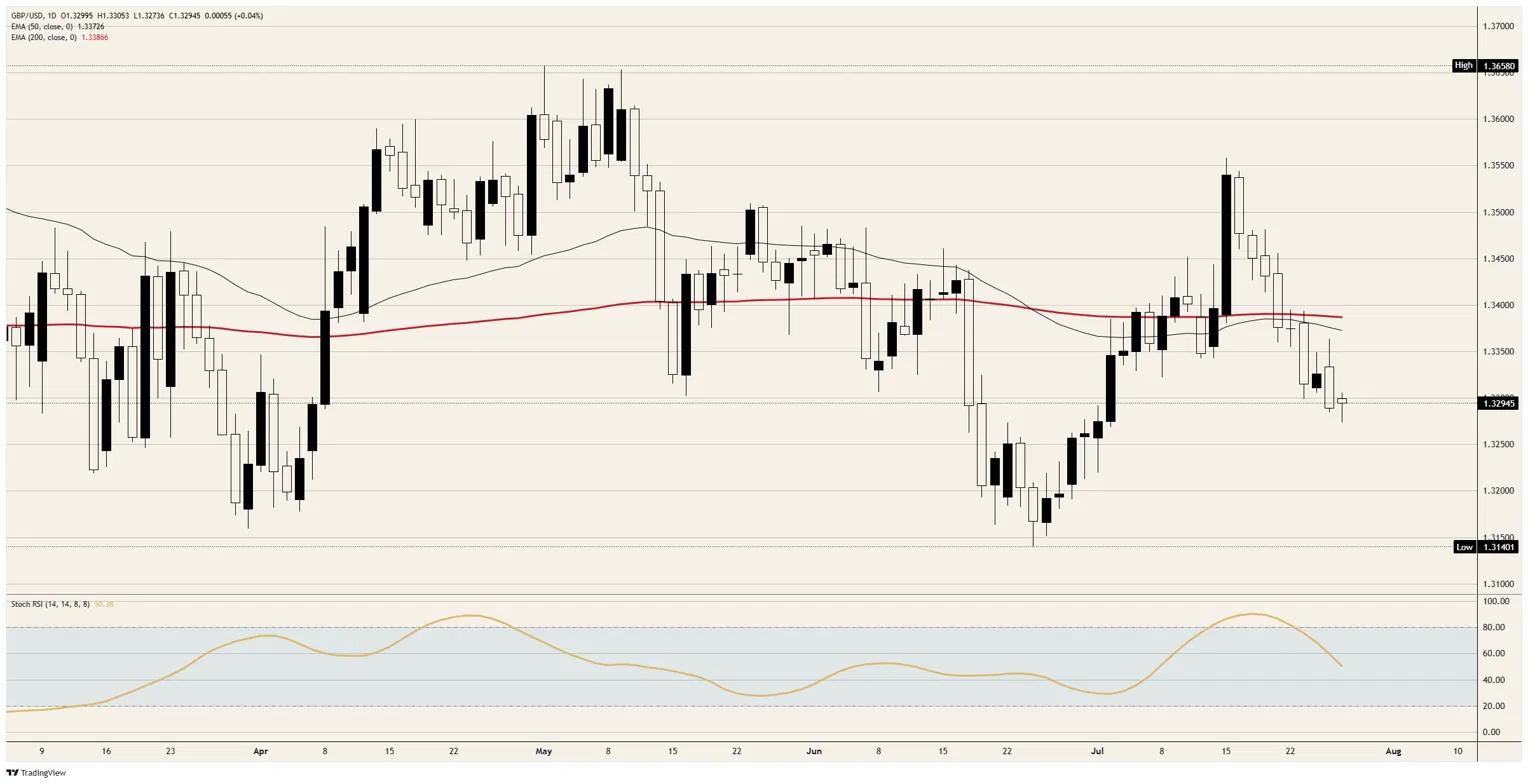
- Firmer British data has bought the currency nothing, with price still pinned beneath the converged moving average band just under 1.3400.
- The Federal Reserve reports Wednesday evening and the Bank of England follows on Thursday with a full Monetary Policy Report attached.

The Pound trades near 1.3300 in the New York morning, effectively flat on a session that has run barely 30 pips between a floor a shade above 1.3250 and a ceiling fractionally above the 1.3300 handle. That is the narrowest daily range in weeks, and it arrives a little over a day before a Federal Reserve decision and two days before a Bank of England decision carrying a fresh Monetary Policy Report.
Quiet is a position, not the absence of one
A 30-pip range on the eve of a central bank decision reads as waiting, and the more useful interpretation is that the market has already taken its side and does not need to add to it. Price sits below both the 50-day and the 200-day Exponential Moving Averages (EMA), which have converged just under 1.3400 and now cap every attempt from beneath.
Sterling has given back roughly two and a half cents since the mid-July peak near 1.3550 without a single obvious catalyst, and the retreat has been orderly rather than violent. Orderly declines beneath declining averages are how positioning gets built, not how it gets unwound. The compression is happening directly under a shelf at 1.3300 that the currency spent three weeks defending and has now lost.
The Dollar is running this exchange rate
Nothing in the day's price action originated in London, which is the first thing to notice about a currency that spent the session waiting. The Dollar Index sits near 101.50 at a one-month high, the Dollar trades just short of 164.00 against the Yen, and the American currency absorbed the safety bid out of an equity rout that took Korean shares down almost 11% and the Nikkei 225 down close to 4%.
Rate futures put the odds of a hike at Wednesday's meeting near 36%, a level that has not moved since the middle of last week despite the stand-down in the Gulf and a 7% break in Crude Oil. At least one increase is roughly 80% priced by September. A Federal Reserve that might tighten and will not ease is the single heaviest weight on this exchange rate.
Tuesday's American data was soft and the Dollar did not care, which is the tell that matters into Wednesday. The four-week average of private hiring slowed again to 15K from 16.25K, and July consumer confidence moderated to 90.8 against expectations nearer 92, with the present situation index weaker for a third consecutive month and the expectations component still beneath the 80 line historically associated with recession risk. Weak data buys rate cuts only when cuts are on the table, and they are not.
The British side has been switched off
The domestic evidence has actually improved, which makes the inability to hold 1.3300 the more interesting half of the picture. Retail sales rose 1% in June against expectations for a decline, business activity surveys returned to growth and household confidence reached a six-month high. June inflation at 2.6% YoY with services at 3.6% gave the committee cover to sit still, and sitting still is what the calendar consensus expects on Thursday.
That consensus is a seven to two vote for a hold with two members again preferring 4.00%, the same split as June, against a market that has begun pricing two increases by March. None of it has been worth a cent to the currency. A Pound that cannot rally on a hawkish central bank and improving data is telling you what it thinks of the October Budget.
Two central banks holding at the same rate with hawkish dissent on both sides should be neutral for the exchange rate, and it plainly is not. Only one of the two prints the currency the world buys when Asian equities fall 11% in a session, and only one of the two is attached to an economy the market believes can carry another increase. Symmetry in policy is not symmetry in demand.
The 48-hour docket
Wednesday's Federal Reserve decision lands at 18:00 GMT with no fresh projections attached, so the statement language and the press conference at 18:30 GMT carry the entire signal. Thursday's Bank of England announcement follows at 11:00 GMT with minutes, a full Monetary Policy Report and a press briefing half an hour later.
The American docket does not wait for either decision, and Thursday is where the risk stacks. June core Personal Consumption Expenditures prices arrive at 12:30 GMT with consensus at 0.2% MoM and 3.3% YoY, alongside the first estimate of second-quarter Gross Domestic Product at 2.1% annualized and jobless claims at 200K against 187K. Friday adds the second-quarter employment cost index at 0.8% and the final July sentiment survey.
Technical levels
Resistance: 1.3300 is the first line and the session has already failed there, with the converged 50-day and 200-day averages just under 1.3400 marking a band price has not reclaimed in a week.
Support: The 1.3250 area held the session floor, with 1.3200 beneath it and the late-June base just under 1.3150 marking the bottom of the summer range.
Bias: Bearish. Strength into 1.3300 is for selling while the averages decline overhead, with 1.3250 and then 1.3200 as objectives. A daily close above 1.3400 invalidates and reopens 1.3550.
GBP/USD daily chart
Pound Sterling FAQs
The Pound Sterling (GBP) is the oldest currency in the world (886 AD) and the official currency of the United Kingdom. It is the fourth most traded unit for foreign exchange (FX) in the world, accounting for 12% of all transactions, averaging $630 billion a day, according to 2022 data. Its key trading pairs are GBP/USD, also known as ‘Cable’, which accounts for 11% of FX, GBP/JPY, or the ‘Dragon’ as it is known by traders (3%), and EUR/GBP (2%). The Pound Sterling is issued by the Bank of England (BoE).
The single most important factor influencing the value of the Pound Sterling is monetary policy decided by the Bank of England. The BoE bases its decisions on whether it has achieved its primary goal of “price stability” – a steady inflation rate of around 2%. Its primary tool for achieving this is the adjustment of interest rates. When inflation is too high, the BoE will try to rein it in by raising interest rates, making it more expensive for people and businesses to access credit. This is generally positive for GBP, as higher interest rates make the UK a more attractive place for global investors to park their money. When inflation falls too low it is a sign economic growth is slowing. In this scenario, the BoE will consider lowering interest rates to cheapen credit so businesses will borrow more to invest in growth-generating projects.
Data releases gauge the health of the economy and can impact the value of the Pound Sterling. Indicators such as GDP, Manufacturing and Services PMIs, and employment can all influence the direction of the GBP. A strong economy is good for Sterling. Not only does it attract more foreign investment but it may encourage the BoE to put up interest rates, which will directly strengthen GBP. Otherwise, if economic data is weak, the Pound Sterling is likely to fall.
Another significant data release for the Pound Sterling is the Trade Balance. This indicator measures the difference between what a country earns from its exports and what it spends on imports over a given period. If a country produces highly sought-after exports, its currency will benefit purely from the extra demand created from foreign buyers seeking to purchase these goods. Therefore, a positive net Trade Balance strengthens a currency and vice versa for a negative balance.
Author

Joshua Gibson
FXStreet
Joshua joins the FXStreet team as an Economics and Finance double major from Vancouver Island University with twelve years' experience as an independent trader focusing on technical analysis.

















