British Pound Sterling coils before inflation and a Fed reckoning
- GBP/USD logged another flat session, coiling into a tight range before a heavy 48 hours.
- Rate markets have dropped their cut bets and now lean toward hikes on both sides of the Atlantic.
- Wednesday brings UK inflation in the morning and the Fed's decision, projections, and a new Chair in the evening.

GBP/USD spent Tuesday going almost nowhere, closing fractionally higher near the middle of a range it has refused to leave for months. The stillness is not for lack of news; it is the calm of a market that has read Wednesday's calendar and decided to wait. UK inflation prints before the London open, the Federal Reserve (Fed) hands down its decision and fresh projections after dark, and a brand new Chair takes questions for the first time. None of it rewards a directional bet a day early.
Stuck between the averages
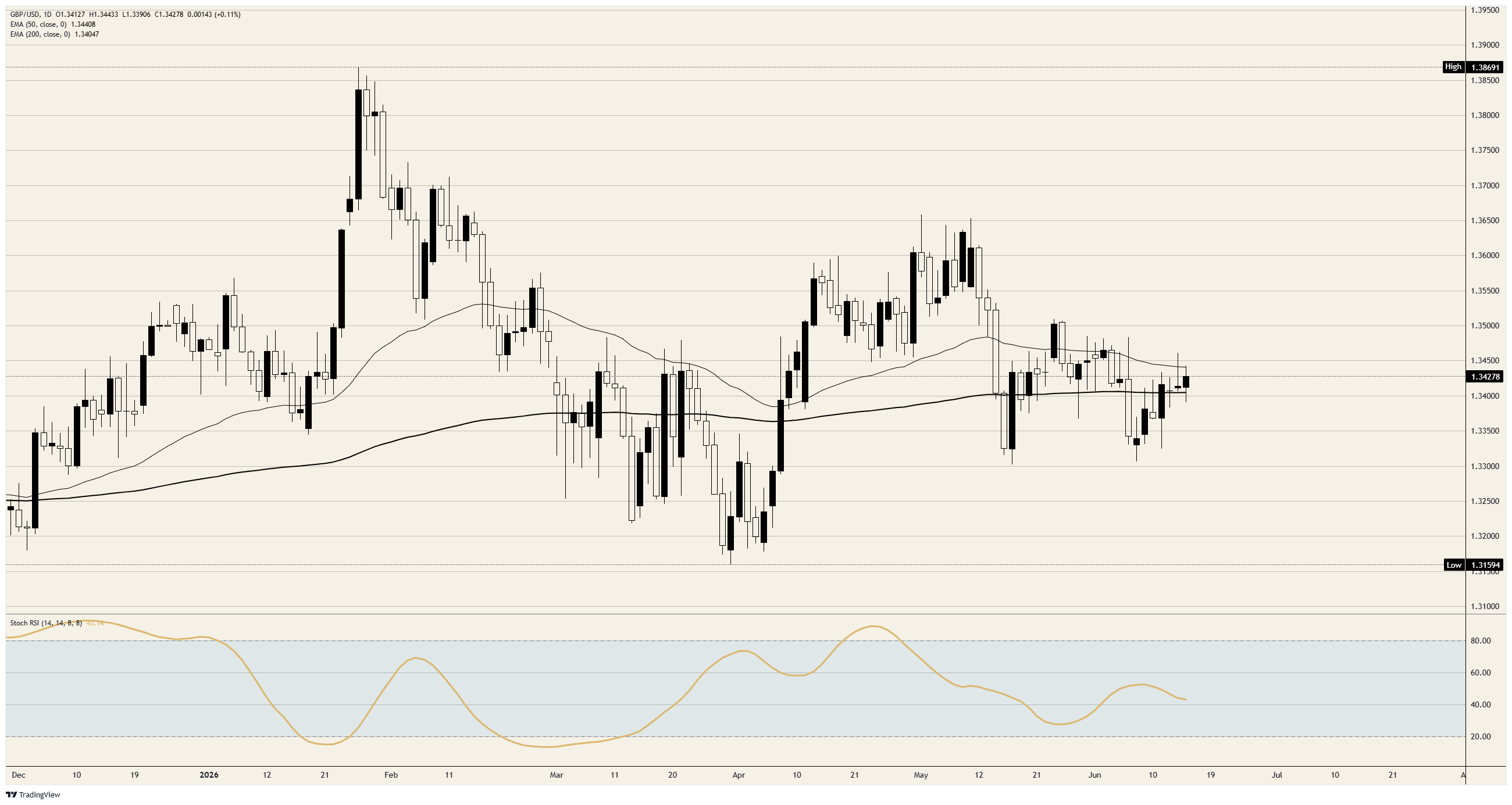
On the daily chart Cable is wedged between its 50-day Exponential Moving Average (EMA) near 1.3450 and its 200-day EMA around 1.3400, and Tuesday did nothing to settle the standoff. Price stalled close to 1.3450 before fading, then dipped just under 1.3400 before recovering, boxed inside barely fifty pips for the session. The daily Stochastic Relative Strength Index (Stoch RSI) sits mid-range, the technical signature of a market with no conviction either way.
The cut trade is dead
The real story beneath the quiet tape is what rate markets have done, and the move has been one-way. The Iran War drove energy costs higher and dragged inflation back up across both economies, and traders have responded by abandoning rate cuts and leaning toward hikes into late 2026, from the Fed and the Bank of England (BoE) alike.
The awkward part is the timing: Crude Oil has slid this week on a US-Iran peace deal, leaving both central banks set to lean hawkish against an inflation shock whose main driver is already in retreat. The BoE carries the sharper contradiction, asked to flag higher rates even as UK Gross Domestic Product (GDP) shrank in April.
A 48-hour gauntlet
UK Consumer Price Index (CPI) opens the run at 06:00 GMT, with the monthly figure seen cooling to around 0.4% but the annual rate expected to climb from April's 2.8% as the energy shock feeds through. Core inflation near 2.7% and steady producer prices would keep the hawks fed, and US Retail Sales at 12:30 GMT is a sideshow next to it.
The Fed at 18:00 GMT is the main event, with a hold all but locked and the dot plot the only number that matters. The Fed's last projections implied a cut this year while the curve now prices a hike, and the new dots show whether the committee has moved to meet the market. Chair Warsh's first press conference at 18:30 GMT is the wildcard, his tone parsed for how hard he leans on inflation. Thursday's BoE, where a wider vote for a hike is the risk, caps the week.
Levels and the lean
Resistance: The first ceiling sits at 1.3450, reinforced by the 50-day EMA; a clean break opens the 1.3500 handle.
Support: The floor is 1.3400, propped by the 200-day EMA and the round number; lose it and Tuesday's low gives way to 1.3350.
Bias: Higher while 1.3400 holds, with a break above 1.3450 the trigger. A hot UK inflation print is the cleanest fuel and a hawkish turn in the Fed's dots the clearest threat; losing 1.3400 flips the picture lower toward 1.3350.
GBP/USD daily chart
Pound Sterling FAQs
The Pound Sterling (GBP) is the oldest currency in the world (886 AD) and the official currency of the United Kingdom. It is the fourth most traded unit for foreign exchange (FX) in the world, accounting for 12% of all transactions, averaging $630 billion a day, according to 2022 data. Its key trading pairs are GBP/USD, also known as ‘Cable’, which accounts for 11% of FX, GBP/JPY, or the ‘Dragon’ as it is known by traders (3%), and EUR/GBP (2%). The Pound Sterling is issued by the Bank of England (BoE).
The single most important factor influencing the value of the Pound Sterling is monetary policy decided by the Bank of England. The BoE bases its decisions on whether it has achieved its primary goal of “price stability” – a steady inflation rate of around 2%. Its primary tool for achieving this is the adjustment of interest rates. When inflation is too high, the BoE will try to rein it in by raising interest rates, making it more expensive for people and businesses to access credit. This is generally positive for GBP, as higher interest rates make the UK a more attractive place for global investors to park their money. When inflation falls too low it is a sign economic growth is slowing. In this scenario, the BoE will consider lowering interest rates to cheapen credit so businesses will borrow more to invest in growth-generating projects.
Data releases gauge the health of the economy and can impact the value of the Pound Sterling. Indicators such as GDP, Manufacturing and Services PMIs, and employment can all influence the direction of the GBP. A strong economy is good for Sterling. Not only does it attract more foreign investment but it may encourage the BoE to put up interest rates, which will directly strengthen GBP. Otherwise, if economic data is weak, the Pound Sterling is likely to fall.
Another significant data release for the Pound Sterling is the Trade Balance. This indicator measures the difference between what a country earns from its exports and what it spends on imports over a given period. If a country produces highly sought-after exports, its currency will benefit purely from the extra demand created from foreign buyers seeking to purchase these goods. Therefore, a positive net Trade Balance strengthens a currency and vice versa for a negative balance.
Author

Joshua Gibson
FXStreet
Joshua joins the FXStreet team as an Economics and Finance double major from Vancouver Island University with twelve years' experience as an independent trader focusing on technical analysis.