British Pound sits out its own week, hostage to US payrolls
- Pound Sterling was little changed on Monday, with no first-tier UK data due all week.
- With an empty domestic calendar, GBP/USD is trading purely as a US Dollar proxy.
- Friday's US payrolls report is the only catalyst that really matters for the pair.

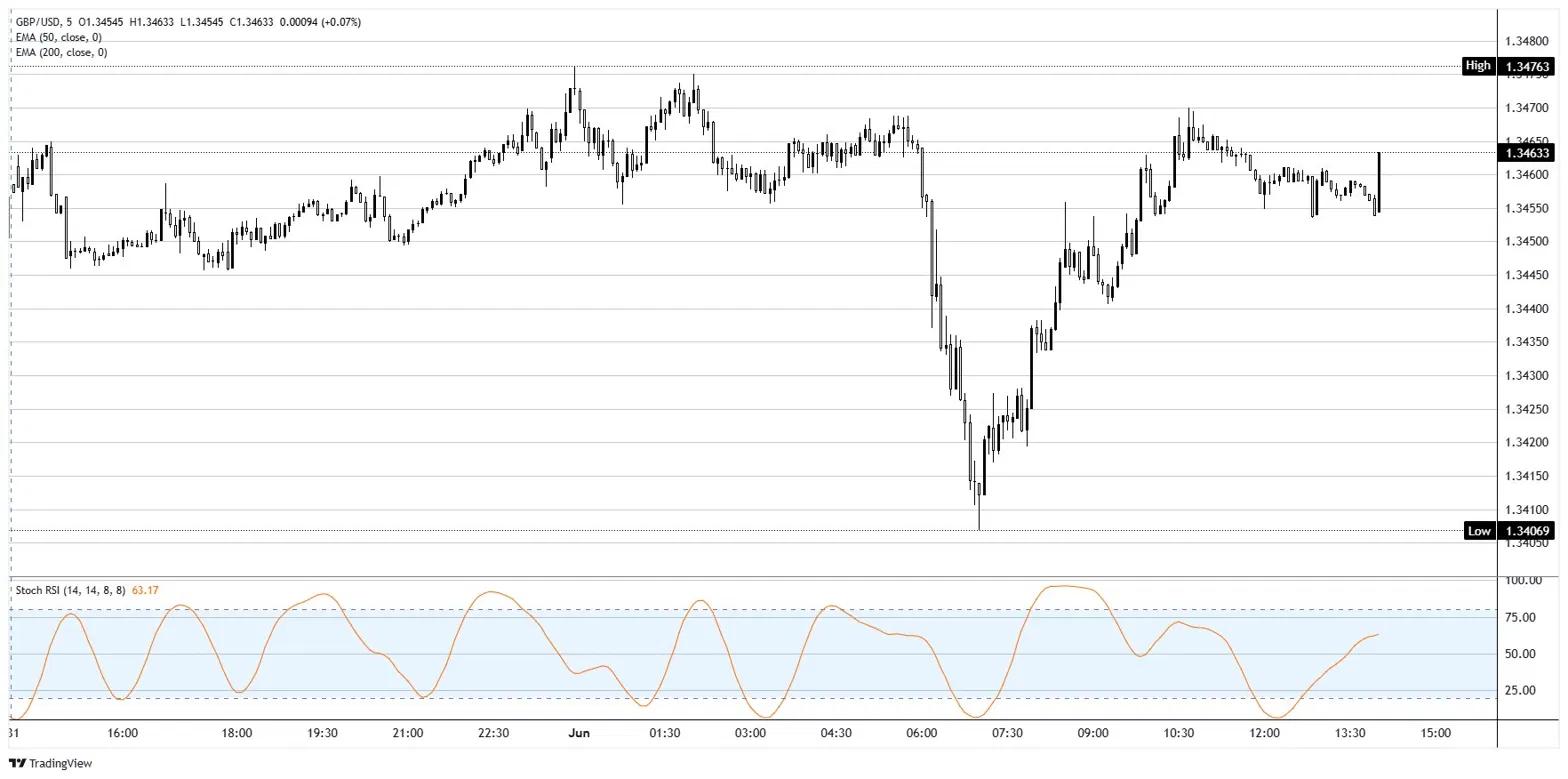
Pound Sterling has the rare luxury, or curse, of a completely blank week. There is no first-tier United Kingdom data on the docket, no Bank of England (BoE) event, nothing for the Pound to trade on its own merits. That makes GBP/USD the cleanest US Dollar expression among the major pairs right now: whatever the Dollar does into Friday's payrolls, Sterling will simply mirror it in reverse. On Monday that translated into a flat, range-bound session around 1.3450, with the pair pinned almost exactly on its daily 50-period Exponential Moving Average (EMA).
A holding pattern dressed up as calm
It is tempting to read the quiet as stability, but it is really just an absence of catalysts. GBP/USD has spent weeks chopping between the 1.3400 handle and 1.3500, and Monday did nothing to change that. The intraday dip toward 1.3400 was bought, the recovery to 1.3450 stalled, and the daily Stochastic Relative Strength Index (Stoch RSI) sits in the lower half of its range, neither oversold nor offering any signal. With the 50 EMA near 1.3450 and the 200 EMA close to 1.3400, the Pound is wedged between its own moving averages, waiting for someone else's data to break the deadlock.
The US labor week does the talking
Because there is nothing domestic to react to, every meaningful move in Sterling this week will come from the other side of the pair. The Federal Reserve (Fed) is widely expected to hold at 3.50% to 3.75% at its meeting later this month, with markets pricing only around a one-in-three chance of a cut, a number that has crept higher again as US labor data has cooled. That makes the run of jobs releases, and Friday's headline in particular, the swing factor for GBP/USD.
Levels and bias
The 1.3400 handle is the key support, doubly important because the 200 EMA is sitting right on it; a daily close below would tilt the range lower toward 1.3350. On the topside, 1.3450 and the 50 EMA mark the immediate pivot, with the 1.3500 handle the ceiling that has capped every recent attempt higher. Until US payrolls land, the honest bias is neutral: trade the range, fade the extremes, and keep position size light into Friday.
The US labor gauntlet
The Job Openings and Labor Turnover Survey (JOLTS) opens the week on Tuesday, followed by the Automatic Data Processing (ADP) employment report and the Institute for Supply Management (ISM) services survey on Wednesday, before Nonfarm Payrolls (NFP) on Friday at 12:30 GMT. Consensus looks for roughly 85K jobs against 115K previously, with the unemployment rate seen steady near 4.3% and average hourly earnings cooling to 3.4% YoY. A soft set of numbers revives Fed cut bets and lifts GBP/USD toward 1.3500; a strong set sends it back to test 1.3400. With the UK contributing nothing, it really is that simple.
GBP/USD 5-minute chart
Pound Sterling FAQs
The Pound Sterling (GBP) is the oldest currency in the world (886 AD) and the official currency of the United Kingdom. It is the fourth most traded unit for foreign exchange (FX) in the world, accounting for 12% of all transactions, averaging $630 billion a day, according to 2022 data. Its key trading pairs are GBP/USD, also known as ‘Cable’, which accounts for 11% of FX, GBP/JPY, or the ‘Dragon’ as it is known by traders (3%), and EUR/GBP (2%). The Pound Sterling is issued by the Bank of England (BoE).
The single most important factor influencing the value of the Pound Sterling is monetary policy decided by the Bank of England. The BoE bases its decisions on whether it has achieved its primary goal of “price stability” – a steady inflation rate of around 2%. Its primary tool for achieving this is the adjustment of interest rates. When inflation is too high, the BoE will try to rein it in by raising interest rates, making it more expensive for people and businesses to access credit. This is generally positive for GBP, as higher interest rates make the UK a more attractive place for global investors to park their money. When inflation falls too low it is a sign economic growth is slowing. In this scenario, the BoE will consider lowering interest rates to cheapen credit so businesses will borrow more to invest in growth-generating projects.
Data releases gauge the health of the economy and can impact the value of the Pound Sterling. Indicators such as GDP, Manufacturing and Services PMIs, and employment can all influence the direction of the GBP. A strong economy is good for Sterling. Not only does it attract more foreign investment but it may encourage the BoE to put up interest rates, which will directly strengthen GBP. Otherwise, if economic data is weak, the Pound Sterling is likely to fall.
Another significant data release for the Pound Sterling is the Trade Balance. This indicator measures the difference between what a country earns from its exports and what it spends on imports over a given period. If a country produces highly sought-after exports, its currency will benefit purely from the extra demand created from foreign buyers seeking to purchase these goods. Therefore, a positive net Trade Balance strengthens a currency and vice versa for a negative balance.
Author

Joshua Gibson
FXStreet
Joshua joins the FXStreet team as an Economics and Finance double major from Vancouver Island University with twelve years' experience as an independent trader focusing on technical analysis.