British Pound rallies to multi-month highs on reports of Mahmood appointment

The British Pound (GBP) has staged a broad-based rally across major currency pairs, hitting multi-month highs against both the US Dollar (USD) and the Euro (EUR). This surge is powered by a mix of diminishing domestic political risk, stronger-than-expected economic growth, and supportive technical flows.
With the political transition in Westminster pointing toward fiscal discipline and the UK rate market firmly pricing in additional Bank of England (BoE) rate hikes, the Pound has emerged as a standout G10 performer.
Lower political risk fuels Sterling outperformance
Fundamental analysts at MUFG highlight that the Pound's sudden strength is deeply tied to a declining UK political and fiscal risk premium. Speculation that Shabana Mahmood is poised to take over as Chancellor under Prime Minister-in-waiting Andy Burnham has reassured global investors of a commitment to sound public finances.
This view of political stability is backed by improving economic momentum. May's monthly GDP figures showed that the economy expanded 0.1%, raising Q2 growth forecasts to 0.3% and reinforcing bets of a better-than-expected performance for the UK economy in the first half of the year.
The paring back of the UK fiscal/political risk premium helped the pound to outperform over the past month (...) The UK rate market has moved to fully price back in a couple of BoE rate hikes in the year ahead.
GBP/USD poised for further technical gains
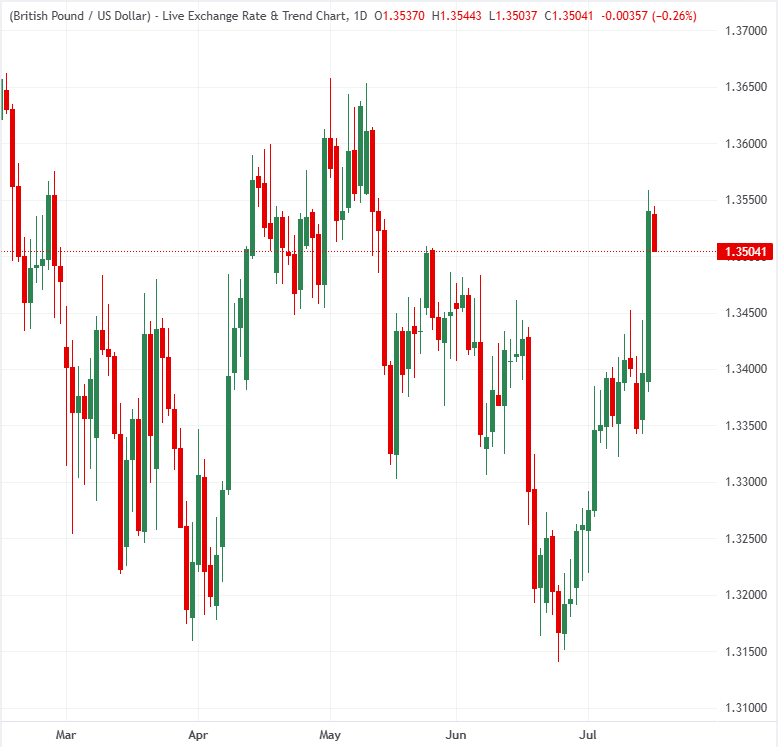
The strategy team at UOB notes that GBP/USD has burst through key resistance at 1.3445 to print a fresh two-month high of 1.3556. Although short-term conditions are deeply overbought (4-hour chart), indicating that the pace of the rally will likely slow down, the technical bias remains clearly tilted to the upside with no immediate signs of a trend pause.
The renewed upward momentum suggests that GBP has resumed its advance (...)The level to monitor is 1.3590. We will maintain a positive GBP stance as long as it holds above the ‘strong support’ level, currently at 1.3450.
Technical breakdown pushes EUR/GBP to a 0.84 handle
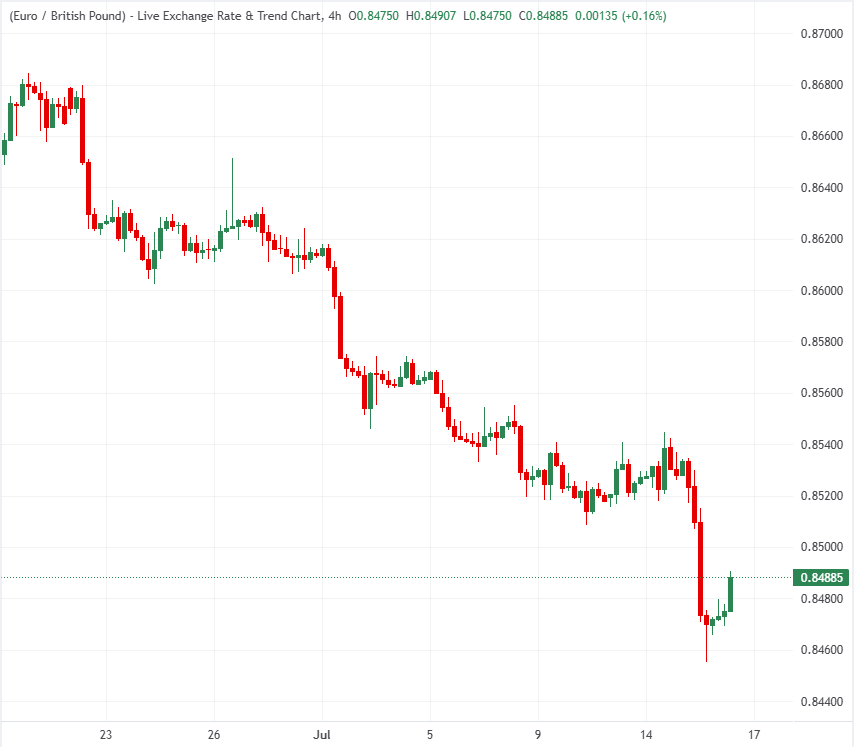
Societe Generale notes that the EUR/GBP cross has extended its decline after breaking below a Head and Shoulders neckline at 0.8610. The pair has slid to the 0.84 territory, its lowest level since June of last year.
While the scale of this move is technically overstretched and difficult to justify purely by bond yield spreads, thin market conditions and flows tied to institutional hedging or central bank reserve rebalancing have accelerated the drop.
Technically, next projections are located at 0.8435; the peak achieved earlier this week around 0.8545 may provide resistance should a brief rebound develop.
Banks anticipate a strong path for the Pound
The banks anticipate a strong near-term trajectory for the British Pound, though they advise caution as current levels are technically overextended. MUFG expects fundamental support to remain firm as fiscal de-risking and a resilient economy keep the BoE on a tightening path. UOB confirms that GBP/USD has officially resumed its broader advance, projecting a steady climb toward the 1.3590 resistance level in the weeks ahead, provided the pair remains securely above the 1.3450 support mark.
Meanwhile, Societe Generale warns that the EUR/GBP decline looks "stretched" and ripe for a minor, flow-driven technical bounce toward 0.8545. Still, the broader downward pressure should eventually carry the cross to technical targets near 0.8435 and the multi-year lows of 0.8350.
(This article was created with the help of an Artificial Intelligence tool and reviewed by an editor. Know more.)
Author

FXStreet Insights Team
FXStreet
The FXStreet Insights Team is a group of journalists that handpicks selected market observations published by renowned experts. The content includes notes by commercial as well as additional insights by internal and external analysts.

















