British Pound holds below 1.33 as Trump warns Iran, Oil jumps
- Trump warns Iran of further strikes, sending Oil sharply higher.
- Fed hike odds rise as traders weigh Gulf-driven inflation risks.
- BoE decision awaited as Burnham government faces first policy test.
The Pound Sterling holds firm on Wednesday as the US-Iran conflict escalates, with US President Donald Trump warning of further attacks on Iran in retaliation for Tehran's strikes on US forces in Jordan. The GBP/USD trades below 1.3300, barely unchanged.
GBP/USD steadies on Gulf War escalation and on uncertainty on central bank decisions
On a Fox interview earlier, Trump said that he will allow talks with Iran to continue but said that “we’ll be hitting Iran hard.” Consequently, Crude prices jumped to fresh daily highs on a week that began with a pullback in Oil prices. West Texas Intermediate (WTI), the US Crude benchmark, rises by more than 7.8% to $85 per barrel.
A scarce economic schedule in the US and the UK keeps traders focused on monetary policy decisions by the Federal Reserve (Fed) and the Bank of England (BoE).
On the Fed side, US inflation cooled in June, while the jobs market remains resilient. The swaps market expects the Fed to hold rates unchanged, with odds near 59%. However, the chances of a 25-basis-point rate hike are increasing to 41%, according to Prime Terminal data.
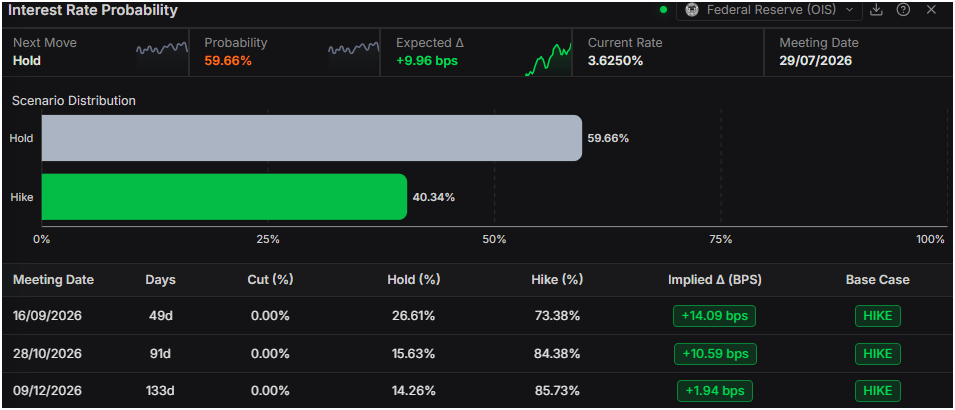
There is growing speculation that the Fed Chair, Kevin Warsh, could persuade the board to delay a rate hike as the Committee assesses whether tightening monetary policy is needed to tackle stubbornly sticky inflation. The escalation of the Iran war triggered a jump in Oil prices, which could influence some members within the Federal Open Market Committee (FOMC) to pull the trigger, following hard lessons during the COVID pandemic.
After the Fed’s decision, the US schedule will be busy with the release of final second-quarter GDP figures and the Fed’s preferred inflation gauge, the Core Personal Consumption Expenditures (PCE) Price Index.
In the UK, traders are bracing for the BoE monetary policy decision, in which the central bank is projected to hold rates unchanged, though the vote split will be keenly scrutinised by investors.
The BoE’s decision will be the first one taken with new Prime Minister Andy Burnham in the job. Burnham has pledged to stick to Starmer’s fiscal rules, though he said that he would look to use any flexibility within them.
GBP/USD price forecast: Technical outlook
In the daily chart, GBP/USD trades at 1.3282, extending a corrective pullback beneath its key Simple Moving Average (SMA) cluster around 1.3361 and staying under the descending trendline barrier near 1.3375, which together suggest a capped, bearish near-term tone. The Relative Strength Index (14) hovers in the low-40s, hinting at subdued upside momentum as the pair struggles to reclaim the broken uptrend line now turned resistance around 1.3289.
On the topside, initial resistance emerges at the former rising trendline support now acting as a pivot around 1.3289, ahead of the SMA cluster near 1.3361 and the broader descending trendline cap around 1.3375. A sustained break above these consecutive barriers would be needed to ease the current downside pressure, while failure to overcome them leaves the pair vulnerable to renewed selling toward lower levels not yet clearly defined by nearby structural supports.
(The technical analysis of this story was written with the help of an AI tool. Know more.)
Pound Sterling FAQs
The Pound Sterling (GBP) is the oldest currency in the world (886 AD) and the official currency of the United Kingdom. It is the fourth most traded unit for foreign exchange (FX) in the world, accounting for 12% of all transactions, averaging $630 billion a day, according to 2022 data. Its key trading pairs are GBP/USD, also known as ‘Cable’, which accounts for 11% of FX, GBP/JPY, or the ‘Dragon’ as it is known by traders (3%), and EUR/GBP (2%). The Pound Sterling is issued by the Bank of England (BoE).
The single most important factor influencing the value of the Pound Sterling is monetary policy decided by the Bank of England. The BoE bases its decisions on whether it has achieved its primary goal of “price stability” – a steady inflation rate of around 2%. Its primary tool for achieving this is the adjustment of interest rates. When inflation is too high, the BoE will try to rein it in by raising interest rates, making it more expensive for people and businesses to access credit. This is generally positive for GBP, as higher interest rates make the UK a more attractive place for global investors to park their money. When inflation falls too low it is a sign economic growth is slowing. In this scenario, the BoE will consider lowering interest rates to cheapen credit so businesses will borrow more to invest in growth-generating projects.
Data releases gauge the health of the economy and can impact the value of the Pound Sterling. Indicators such as GDP, Manufacturing and Services PMIs, and employment can all influence the direction of the GBP. A strong economy is good for Sterling. Not only does it attract more foreign investment but it may encourage the BoE to put up interest rates, which will directly strengthen GBP. Otherwise, if economic data is weak, the Pound Sterling is likely to fall.
Another significant data release for the Pound Sterling is the Trade Balance. This indicator measures the difference between what a country earns from its exports and what it spends on imports over a given period. If a country produces highly sought-after exports, its currency will benefit purely from the extra demand created from foreign buyers seeking to purchase these goods. Therefore, a positive net Trade Balance strengthens a currency and vice versa for a negative balance.
Author

Christian Borjon Valencia
FXStreet
Markets analyst, news editor, and trading instructor with over 14 years of experience across FX, commodities, US equity indices, and global macro markets.

















