British Pound extends rally as Republicans lose both US Houses
- The British Pound refreshes seven-week high at around 1.3500 against the US Dollar.
- Democrats’ victory in both US houses reflects clear discontent of Republican policies by public.
- The BoE is widely anticipated to hike interest rates on Thursday.

The British Pound (GBP) posts a fresh seven-week high at around 1.3500 against the US Dollar (USD) in the European trade on Wednesday. The GBP/USD pair strengthens as the victory of United States (US) Democrats in both houses of Federal law has weighed heavily on the US Dollar.
As of writing, the US Dollar Index (DXY), which gauges the Greenback’s value against six major currencies, trades 0.47% lower to near 101.40.
The victory of Democrats in both the Senate and the House of Representatives has prompted fears of decision-making gridlock around issues such as government funding and the debt ceiling, and tougher restrictions on Artificial Intelligence (AI) spending, ING reported.
On the economic front, investors shift their focus to the US ADP Employment Change and the ISM Services PMI data for September, which will be published in the North American session.
On the United Kingdom (UK) front, investors await the Bank of England’s (BoE) monetary policy announcement on Thursday.
BoE seen kicking off tightening cycle with modest hike as UK data firms
Strategists at Brown Brothers Harriman highlight Thursday’s Bank of England policy decision and accompanying Monetary Policy Report, noting that the BoE is “widely expected to start tightening with a 25bps hike to 4.00% after standing pat all year.” They point out that “firmer UK inflation and economic activity back the move,” while the anticipated vote split is “seen at 7-2 with doves Alan Taylor and Swati Dhingra supporting a hold,” underscoring that not all policymakers are yet convinced of the need to begin a new tightening phase.
GBP/USD Technical Analysis
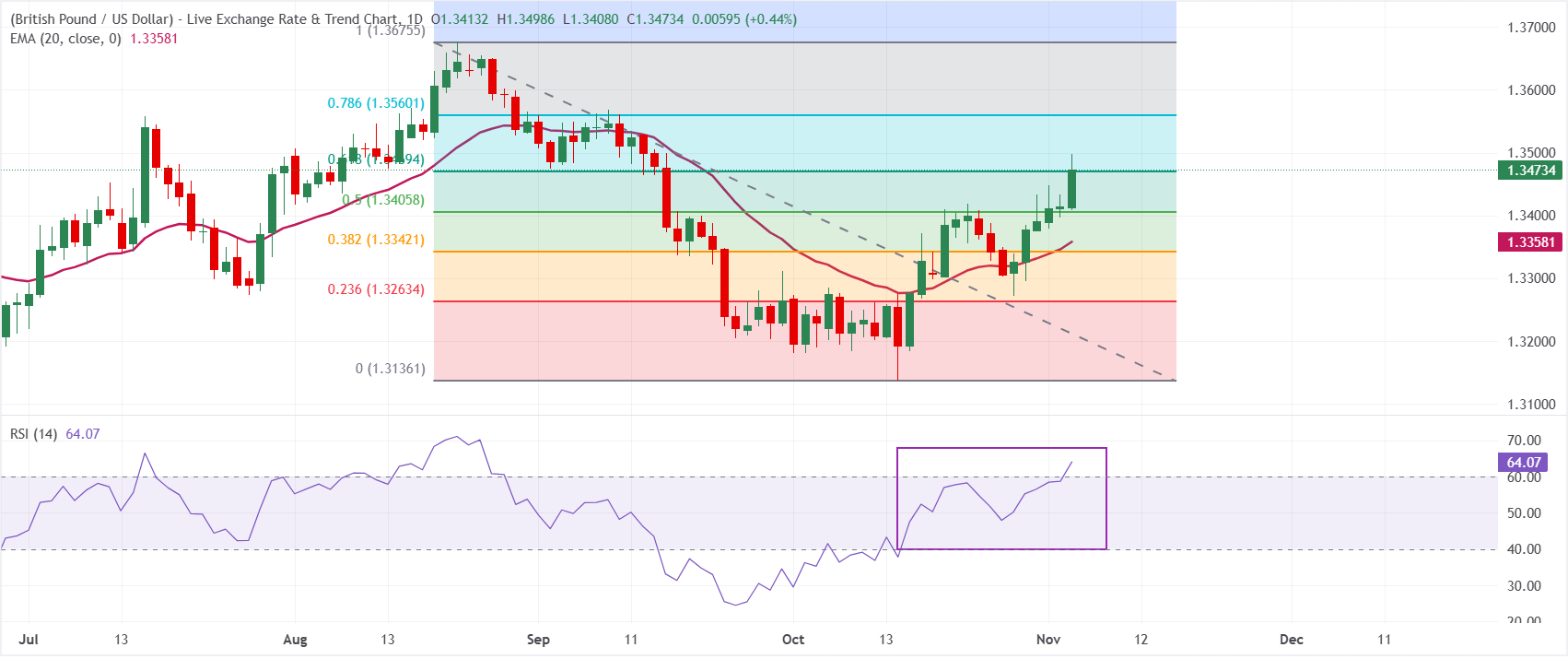
In the daily chart, GBP/USD trades at 1.3473, holding a constructive bullish bias as it extends the rebound above the 20-period exponential moving average (EMA) at 1.3358 and the 50% Fibonacci retracement at 1.3406. Price is now trading just over the 61.8% retracement at 1.3469, hinting at an attempt to reclaim higher ground, while the Relative Strength Index (RSI) at 64 suggests firm but not yet extreme upward momentum.
On the topside, immediate resistance is aligned at the 61.8% Fibonacci retracement at 1.3469, with further barriers at the 78.6% level at 1.3560 and the prior swing high near the 100% retracement at 1.3676. On the downside, initial support is seen at the same 61.8% Fibonacci level at 1.3469, followed by the 50% retracement at 1.3406 and the 20-period EMA at 1.3358; a deeper pullback would expose the 38.2% retracement at 1.3342 ahead of the 23.6% level at 1.3263, while the cycle low around 1.3136 acts as a more distant structural floor.
(The technical analysis of this story was written with the help of an AI tool. Know more.)
Economic Indicator
BoE Interest Rate Decision
The Bank of England (BoE) announces its interest rate decision at the end of its eight scheduled meetings per year. If the BoE is hawkish about the inflationary outlook of the economy and raises interest rates it is usually bullish for the Pound Sterling (GBP). Likewise, if the BoE adopts a dovish view on the UK economy and keeps interest rates unchanged, or cuts them, it is seen as bearish for GBP.
Read more.Next release: Thu Nov 05, 2026 12:00
Frequency: Irregular
Consensus: 4%
Previous: 3.75%
Source: Bank of England
Author

Sagar Dua
FXStreet
Sagar Dua is associated with the financial markets from his college days. Along with pursuing post-graduation in Commerce in 2014, he started his markets training with chart analysis.