British Pound extends 4-day slide as Fed decision, UK budget loom
- GBP/USD slips 0.14% to 1.3321, extending its four-day losing streak.
- US Consumer Confidence jumps to 91.7, while Durable Goods rise 1.6%.
- Fed decision and UK Autumn Budget take center stage on Wednesday.

The Pound Sterling dives for the fourth straight day against the US Dollar, down 0.14% as the Greenback registers mild gains ahead of the Federal Reserve’s monetary policy decision on Wednesday. GBP/USD trades at 1.3321 and remains capped within the 1.3307-1.3349 range on Tuesday.
GBP/USD struggles near 1.3300 as resilient US data supports the Dollar ahead of crucial policy decisions
Market sentiment is positive, even though hostilities in the Middle East continued. News revealed that debris is falling over Saudi Arabia´s Riyadh, which, according to SPA, caused damage. Meanwhile, Iran’s supreme leader Mojtaba Khamenei reiterated the country’s conditions for ending the war with the US. Tehran has called for the lift of the US naval blockade and also the removal of sanctions as preconditions for peace talks.
In the US, the economic docket featured housing data, with New Home Sales diving -0.6% MoM in September, down from August’s 6.4% print.
The Conference Board (CB) reported that Consumer Sentiment unexpectedly rose in October, from 84.2 to 91.7 as households grew optimistic about the job market and business conditions. Digging into the survey, inflation expectations for 12 months remained unchanged at 5.8%, well above the Fed’s target.
Other data showed that Durable Goods Orders jumped in September by 1.6%, up from 0.1%, as business spending remains robust amid the build-out of AI infrastructure. Earlier, the ADP Employment Change 4-week average showed that the labour market is modestly slowing down; it came in at 16.8K, down from the previous print of 18.5K.
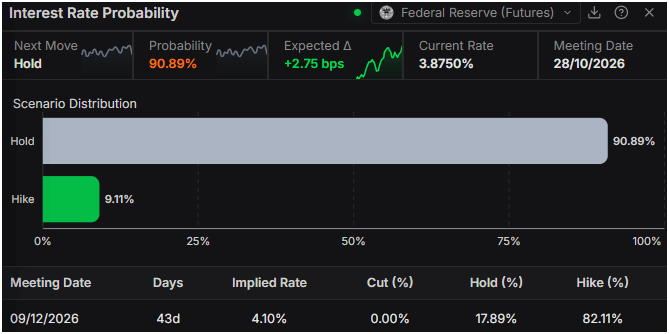
Meanwhile, money markets indicate the Fed will hold rates unchanged on Wednesday, with odds of a hike at 19%. For December, the chances continued to aim lower, from around 90% last week to 82%, according to Prime Terminal.
In the UK, Sterling advances against the Euro, which is dealing with France’s fiscal issues, but falls against the Greenback.
Focus is on the release of the UK Autumn Budget, in which Chancellor Healey is expected to present a sustainable budget that doesn’t distress the bond market and fulfils some promises of Andy Burnham’s government. According to the Financial Times, John Healey is poised to announce an increase of 4% for low-wage workers.
Ahead, traders brace for the Fed’s meeting on Wednesday. The UK economic docket will feature the UK’s budget.
GBP/USD Price Forecast: Technical outlook
In the daily chart, GBP/USD trades at 1.3314, keeping a bearish near-term tone as it holds beneath the latest simple moving average cluster around 1.3396 and the descending resistance trend line that now comes in near the same area. The pair has slipped away from former trend-line resistance turned support at 1.3257, but price remains only modestly above that level, hinting that sellers still control the broader structure, while the 14-period Relative Strength Index around 48 suggests momentum has cooled back toward neutral rather than driving a strong recovery.
On the topside, initial resistance is seen at the 1.3396 area, where the 50-, 100- and 200-day simple moving averages converge, with further barriers at the upward-sloping trend supports now acting as resistance near 1.3644 and 1.3823. On the downside, the first noteworthy underpinning sits at the broken trend-line level around 1.3257, and a daily close below that floor would likely open the door to a deeper pullback as the pair extends its rejection from the heavy resistance band overhead.
(The technical analysis of this story was written with the help of an AI tool. Know more.)
Pound Sterling FAQs
The Pound Sterling (GBP) is the oldest currency in the world (886 AD) and the official currency of the United Kingdom. It is the fourth most traded unit for foreign exchange (FX) in the world, accounting for 12% of all transactions, averaging $630 billion a day, according to 2022 data. Its key trading pairs are GBP/USD, also known as ‘Cable’, which accounts for 11% of FX, GBP/JPY, or the ‘Dragon’ as it is known by traders (3%), and EUR/GBP (2%). The Pound Sterling is issued by the Bank of England (BoE).
The single most important factor influencing the value of the Pound Sterling is monetary policy decided by the Bank of England. The BoE bases its decisions on whether it has achieved its primary goal of “price stability” – a steady inflation rate of around 2%. Its primary tool for achieving this is the adjustment of interest rates. When inflation is too high, the BoE will try to rein it in by raising interest rates, making it more expensive for people and businesses to access credit. This is generally positive for GBP, as higher interest rates make the UK a more attractive place for global investors to park their money. When inflation falls too low it is a sign economic growth is slowing. In this scenario, the BoE will consider lowering interest rates to cheapen credit so businesses will borrow more to invest in growth-generating projects.
Data releases gauge the health of the economy and can impact the value of the Pound Sterling. Indicators such as GDP, Manufacturing and Services PMIs, and employment can all influence the direction of the GBP. A strong economy is good for Sterling. Not only does it attract more foreign investment but it may encourage the BoE to put up interest rates, which will directly strengthen GBP. Otherwise, if economic data is weak, the Pound Sterling is likely to fall.
Another significant data release for the Pound Sterling is the Trade Balance. This indicator measures the difference between what a country earns from its exports and what it spends on imports over a given period. If a country produces highly sought-after exports, its currency will benefit purely from the extra demand created from foreign buyers seeking to purchase these goods. Therefore, a positive net Trade Balance strengthens a currency and vice versa for a negative balance.
Author

Christian Borjon Valencia
FXStreet
Markets analyst, news editor, and trading instructor with over 14 years of experience across FX, commodities, US equity indices, and global macro markets.