British Pound breaks below 1.3400 as blowout NFP ignites US Dollar rally
- GBP/USD weakens to 1.3376, poised to end the week in the red.
- US Nonfarm Payrolls double forecasts, reinforcing full-employment Fed narrative.
- The US Dollar jumps as markets price December Fed hike odds.
- UK leadership risks threaten Sterling despite BoE tightening bets.

The Pound Sterling (GBP) falls below the 1.3400 figure on Friday, registering losses of 0.37% against the US Dollar (USD) after the latest Nonfarm Payrolls report in the US crushed estimates, backing the narrative that the economy may be close to full employment. Meanwhile, Iran backed Hezbollah’s decision about the ceasefire proposal by the US regarding Israel and Lebanon, which could stall negotiations between Tehran and Washington.
US Dollar underpinned by stellar NFP
US Nonfarm Payrolls for May crushed estimates, rising by 172K, doubling and a tick more than the expected 85K increase, which has reinforced the thesis that the Federal Reserve’s (Fed) focus should be on tackling inflation, due to the solidity of the labor market. Further data showed that the Unemployment Rate remained at 4.3%, providing strong justification for Fed officials to raise interest rates.
Consequently, the Greenback rose on prospects of higher US interest rates. The US Dollar Index (DXY), which tracks the buck’s performance against a basket of six currencies, is up 0.38% at 99.80, after bouncing off daily lows near 99.15.
Investors expect a Fed rate hike by the end of 2026
Beth Hammack of the Cleveland Fed was utterly hawkish, saying that it is “reasonable to keep rates steady for now, but if recent trades continue, it may soon be appropriate to act against high inflation.”
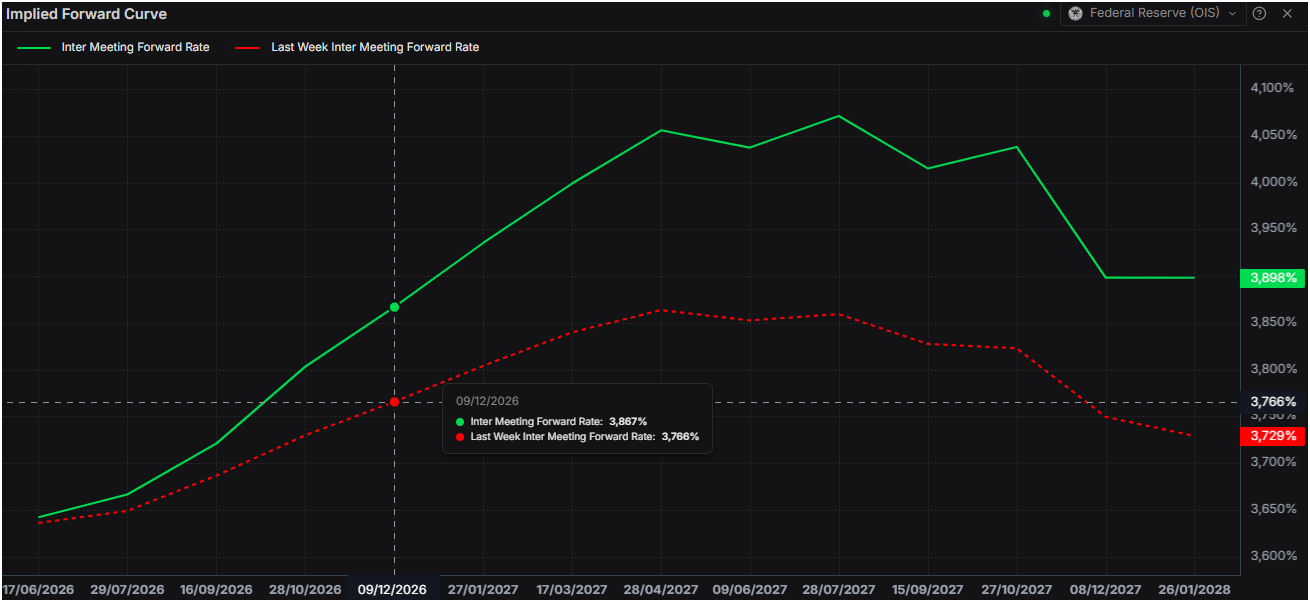
Money markets have priced in a 67% chance of a Federal Reserve rate hike at the December meeting, according to Prime Terminal data. For June, traders expect the US central bank to keep rates unchanged.
GBP/USD capped by UK politics
In the UK, the docket was absent, yet Cable has been supported by speculation that the Bank of England (BoE) will raise rates sooner than the Fed, with the swaps market implying 45 basis points of tightening towards the end of the year. Nevertheless, political turmoil could weigh on Sterling after Labour mayor Andy Burnham hinted that he would challenge Prime Minister Keir Starmer's leadership, saying that if he wins the election this month, he would like to see Starmer removed.
Recently, newswires reported that Burnham is considering retaining Chancellor Rachel Reeves if he becomes PM, citing iPaper sources.
What’s in the schedule for next week
The US docket will feature inflation data on the consumer and producer sides, as well as jobless claims. In the UK, the calendar will feature retail sales for May, as well as Gross Domestic Product (GDP) and Industrial Production data.
GBP/USD Technical Levels
In the daily chart, GBP/USD trades at 1.3375, keeping a bearish near-term tone as spot holds under a dense cluster of the 50-, 100- and 200-day Simple Moving Averages (SMAs) around 1.3454. Price is oscillating near a prior confluence of downtrend resistance and uptrend support, suggesting an ongoing battle around a pivotal area, while the Relative Strength Index (14) at about 42 leans slightly to the downside without entering oversold territory.
On the topside, initial resistance is defined by that grouped SMA band near 1.3454, and a daily close above it would be needed to ease the current downside pressure and open the way to a more constructive recovery. On the downside, the lack of clearly defined sub-market structural levels on this dataset leaves the pair vulnerable to further slippage should sellers extend control from current levels, with the broader technical picture favoring sellers as long as GBP/USD remains capped beneath the multi-period SMA cluster.
(The technical analysis of this story was written with the help of an AI tool.)
Pound Sterling Price This week
The table below shows the percentage change of British Pound (GBP) against listed major currencies this week. British Pound was the strongest against the New Zealand Dollar.
| USD | EUR | GBP | JPY | CAD | AUD | NZD | CHF | |
|---|---|---|---|---|---|---|---|---|
| USD | 0.94% | 0.62% | 0.58% | 0.89% | 1.44% | 2.66% | 1.73% | |
| EUR | -0.94% | -0.33% | -0.37% | -0.05% | 0.48% | 1.72% | 0.79% | |
| GBP | -0.62% | 0.33% | -0.02% | 0.28% | 0.81% | 2.06% | 1.11% | |
| JPY | -0.58% | 0.37% | 0.02% | 0.35% | 0.91% | 2.09% | 1.16% | |
| CAD | -0.89% | 0.05% | -0.28% | -0.35% | 0.52% | 1.73% | 0.82% | |
| AUD | -1.44% | -0.48% | -0.81% | -0.91% | -0.52% | 1.24% | 0.31% | |
| NZD | -2.66% | -1.72% | -2.06% | -2.09% | -1.73% | -1.24% | -0.93% | |
| CHF | -1.73% | -0.79% | -1.11% | -1.16% | -0.82% | -0.31% | 0.93% |
The heat map shows percentage changes of major currencies against each other. The base currency is picked from the left column, while the quote currency is picked from the top row. For example, if you pick the British Pound from the left column and move along the horizontal line to the US Dollar, the percentage change displayed in the box will represent GBP (base)/USD (quote).
Author

Christian Borjon Valencia
FXStreet
Markets analyst, news editor, and trading instructor with over 14 years of experience across FX, commodities, US equity indices, and global macro markets.