Here's where the Canadian Dollar is headed next: 4 bearish scenarios and a bullish one
The Canadian Dollar (CAD) has ridden a volatile first half of the year, with Oil prices surging and then falling as markets danced to the Middle East’s tune. Neither the Bank of Canada nor the Federal Reserve has changed rates so far this year, and the USD/CAD's next move may depend on which of the two banks fails to deliver what markets expect. All paths but one point to weakness ahead for the Loonie.
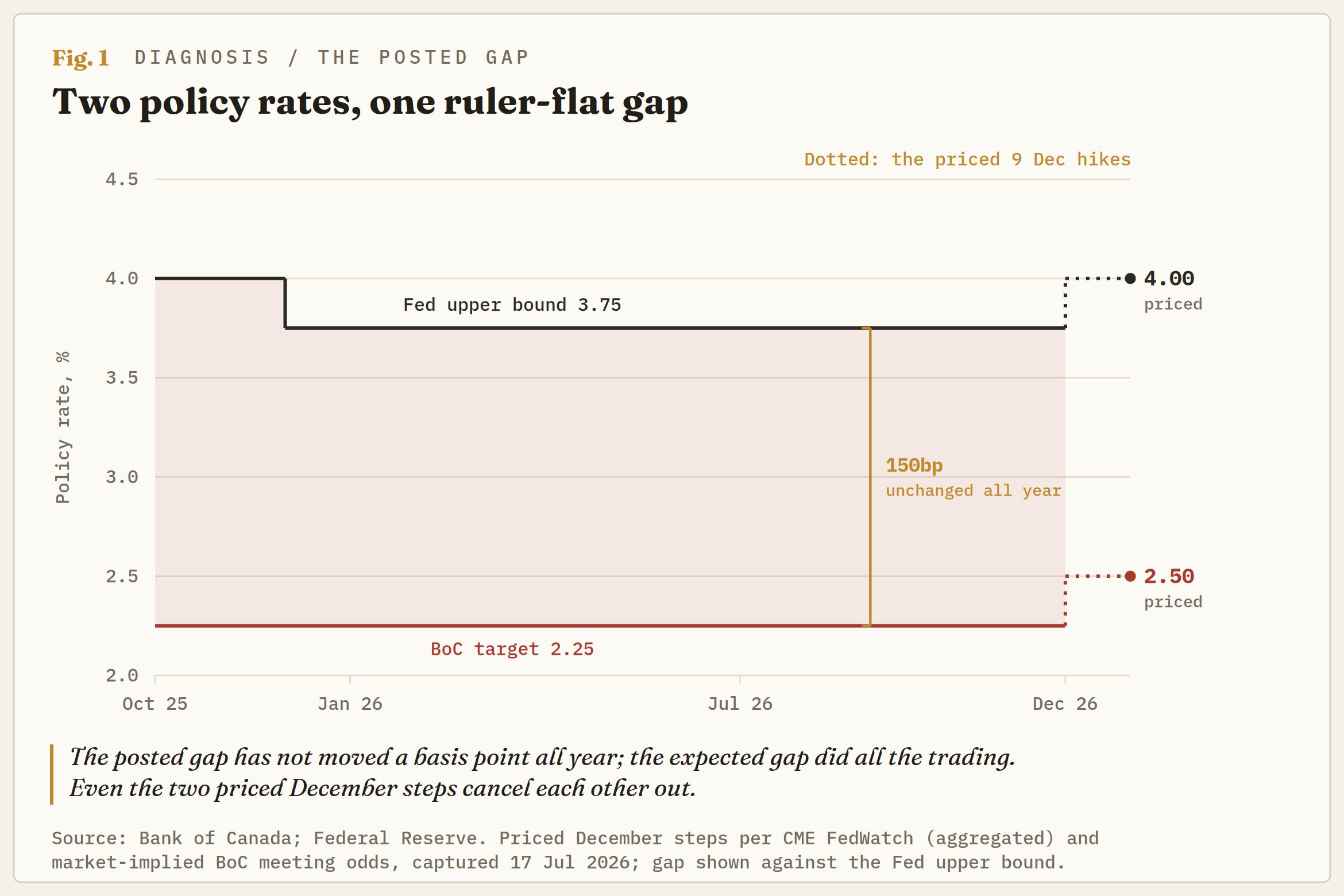
USD/CAD spent the first half of 2026 repricing two central banks that never moved. The Bank of Canada (BoC) has held 2.25% since October. A December BoC hike went from afterthought to fully priced anyway. The Federal Reserve (Fed) has held 3.50%-3.75% since December. Its 2026 hike moved down the calendar to certainty anyway, with a 22.5% chance of a second. The posted gap between them has not moved a basis point.
The pair ran nearly 6% from its late-January low to a July peak just under 1.4250 anyway. The barrel round-tripped a war. The discount on Canadian crude widened to its war extreme anyway. Nothing official moved. Everything tradeable did.
The pair sits on the 1.4000 handle, testing the 50-day EMA for the first time since the June breakout, with momentum washed out. What follows is built for the second half: a short review of the half that just traded, the script the market has written for both central banks, the rewrites that could replace it, a countdown of the dates and data that can actually move the pair, and five zones where the year can end. Four of the five sit at or above spot. That skew is the forecast.
The first half in three acts
Act one was a false start. A January rally toward 1.3900 collapsed into a low just under 1.3500. The war between the US and Iran soon made that 400-pip round trip a footnote.
Act two was the test that mattered. From March through May the Hormuz supply shock sent West Texas Intermediate (WTI) monthly averages from the mid-$60s to above $100, with Brent past $110 at the peak. The Loonie refused the bid. USD/CAD sat inside a 1.3550-1.4000 band for the entire spike and pressed no higher than the 1.3950 area in April, right as crude peaked.
Act three gave the game away. Crude fell roughly 40% into the June ceasefire arc and the Loonie fell with it. The pair broke the 200-day EMA, then 1.4000, then the November 2025 peak at 1.4150, and printed just under 1.4250 in early July with the Dollar broadly bid. Oil up, Loonie flat. Oil down, Loonie down. Whatever drives this pair, it is not the barrel.
It was expectations all along. Kevin Warsh's debut Summary of Economic Projections (SEP) put nine of 18 dots on a 2026 hike, inside a no-guidance regime that turns every data print into a repricing event. The BoC sat pinned to the floor of its neutral range by a technical recession. The posted gap held at 125bp-150bp. The expected gap did all the trading.
What the tape was actually trading
The BoC's own July Monetary Policy Report (MPR) does the attribution. It assumes the Loonie averages about 71 cents US across the projection and pins the depreciation partly on the widening US-Canada government yield spread. That is the BoC formally endorsing the desk view: the Loonie is plugged into where the rate gap is expected to go, not where it stands.
The endorsement carries a loop. Every cent the Loonie trades below the 71-cent assumption imports inflation. Imported inflation hardens the hike case, and the hike case is the very repricing that lifts the Loonie. The currency is inside the reaction function now, not outside it.
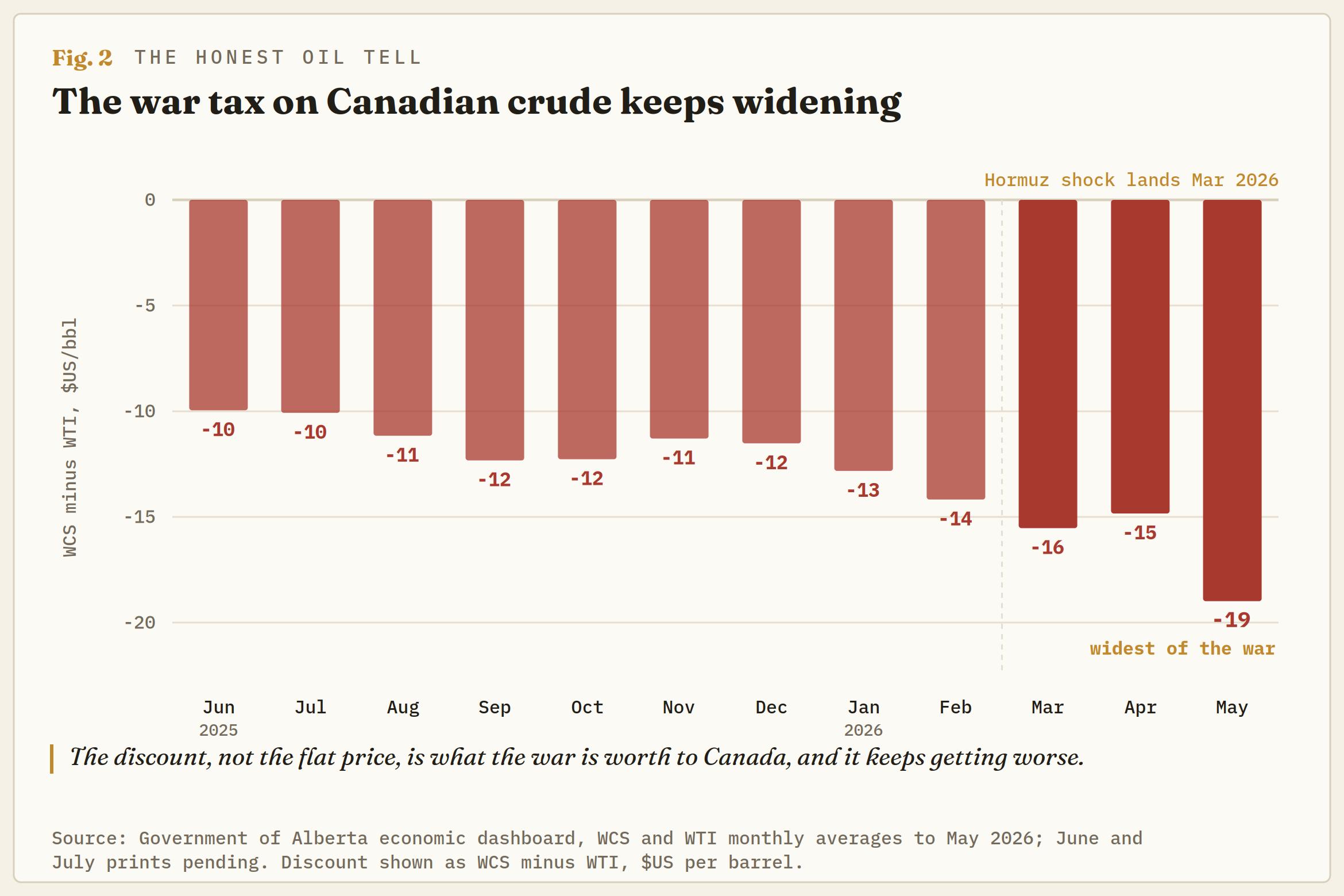
Oil still matters, but the transmission changed. The honest tell was never the crack spread. It is the discount on Western Canadian Select (WCS) against WTI, the price Canadian producers actually eat. On Alberta's own monthly data it widened from under $13 in January to nearly $19 in May, the widest of the war. June and July prints are pending.
The new route into the currency is the central bank itself. Break three shut Hormuz on 8-9 July and Brent jumped 8.7% intraday through $80. The Loonie strengthened, sliding the pair from just under 1.4250 to the 1.4000 handle while a December BoC hike went from a lean to fully priced. Oil up, Loonie up: the old petro sign, re-derived through the rate channel.
Then the documents started expiring on arrival. The June Federal Open Market Committee (FOMC) minutes rested their disinflation case on Hormuz disruptions diminishing. The MPR was conditioned on $75 Brent and conceded stale at its own press conference. And the June US Consumer Price Index (CPI) was the softest monthly print since April 2020, -0.4% MoM with the headline down to 3.5% YoY from 4.2%, measured in a peace-dividend month and released five days after the peace stopped existing. The market looked straight through it.
The July hike tail collapsed from roughly 30% to under 15% on CME FedWatch while December stayed certain. Honesty on the other side: core was flat on the month at 2.6% YoY and shelter posted its coolest reading since early 2021. The hawkish case was still a forecast about passthrough, not a fact about core.
The June import price release printed the index up 7.1% over the year, the largest 12-month rise since August 2022. Nonfuel import prices rose 4.2%, the biggest annual advance in four years. The capital-goods gain was driven by computers, peripherals and semiconductors, and consumer goods ex-autos rose a fifth straight month. A category that spent two decades deflating is inflating at pace, before duties are even applied, with a strong Dollar removing the usual currency excuse. Core is soft today. The pipeline that feeds core goods a quarter or two from now indicates otherwise.
The script as written
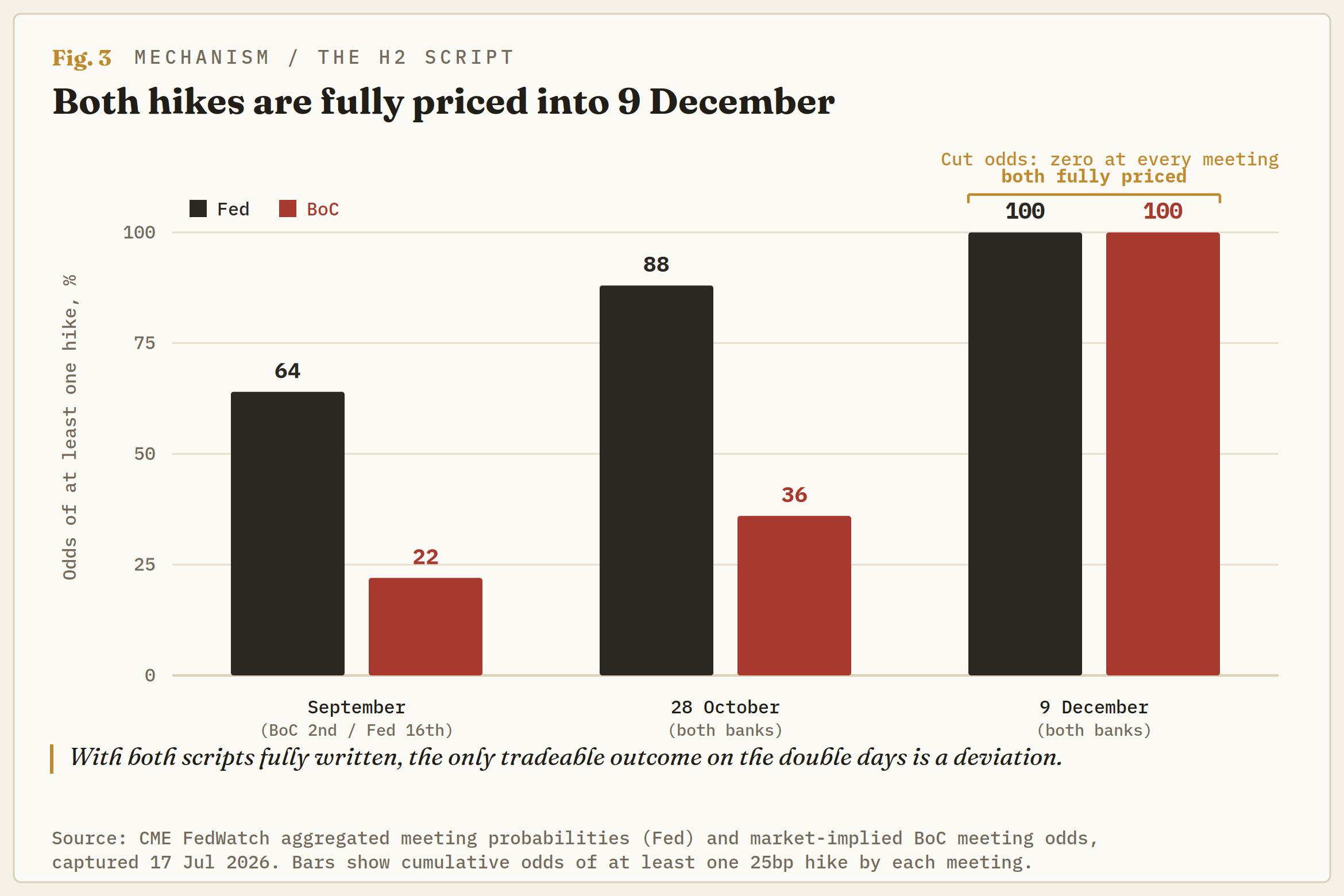
Money markets have written both parts already. The Fed's 2026 hike is priced at 64% by September 16, 88% by October 28, and certain by December 9, with a 22.5% chance of a second stacked on top. That is not a December story. It is a delivery due at any meeting from September, most likely the one carrying the returning SEP.
The BoC's hike reads differently: 22% for September 2 and 36% by October 28 before jumping to fully priced at December 9. That is a move the market dates to a single Wednesday, waiting on the October MPR re-mark. Zero cut probability is priced at any meeting on either side of the border, in the year the White House installed a Fed chair expressly to deliver cuts.
The BoC's trigger is on record. Governor Tiff Macklem has pledged the BoC will not let higher Oil prices become persistent inflation, and the MPR quantifies it: Brent holding $80-$85 in the coming months adds 0.1%-0.3% to Canadian inflation. Brent is already through $80 with the Strait shut. Keep it there into the autumn and the MPR's disinflation path, 2.5% this quarter and 2.4% by year-end, stops being a forecast and starts being fiction.
The Q2 growth estimate near +2.5% annualised supplies the cover. Follow the arithmetic to its quiet conclusion: if both banks deliver as written, the gap that started the year at 125bp-150bp leaves December at 125bp-150bp. The base case is a round trip. Everything tradeable in the second half lives in the rewrites.
The rewrites
Rewrite one, peace – It would require the one thing 2026 has refused to produce: a ceasefire that survives, and it disarms only one side. Brent back at the $75 conditioning revives the disinflation path and leaves the BoC staring at numbers that never needed a hike: CPI ex-gasoline at 2.2%, core near 2%, wage growth fading, an economy marked down to 0.7% growth for the year. A central bank on the floor of its own 2.25%-3.25% neutral range does not tighten into that picture.
But peace no longer disarms the Fed. Its pipeline runs on chips, tariffs, and the food lag, and none of those die with a treaty. A BoC hold into a delivered Fed hike is the widening-gap outcome: the peace branch is bear CAD, not neutral. The market prices the BoC holding at zero percent odds. Zero is a strong number for a scenario that merely requires peace to last four months.
Rewrite two, the Canadian break – The Q2 rebound is scaffolding, built of one-time transfers, government spending, and auto retooling, which the BoC itself labels temporary. The third quarter inherits a cliff, with the tariff drag, unemployment at 6.5%, a firmly negative output gap, and a $19 discount taxing the windfall stacked on top. The market's own base case is an accelerant because a December hike lands on renewal-heavy household balance sheets. A BoC blink or cut into a hiking Fed is the widest-gap outcome on the board. Nobody prices it. Low is fair. Zero is not.
Rewrite three, the Fed blink, the only bull-CAD script – It needs the Q4 inflation data to roll over so the fully priced hike slips while the BoC delivers. The latest US import price pipeline, with four more prints before December, argues directly against it. Low, and shrinking.
Rewrite four, escalation – Ranked honestly against the other potential year-end outcomes, it is the trend, not the hypothetical. Every ceasefire this year has broken, three for three. The Strait is already shut yet again. A war that keeps finding new floors does not owe anyone a ceiling. A genuinely wider conflict, or American boots on Iranian soil, sends Oil to the $110-$120 conflict peak quickly and holds roughly 15 million barrels a day of Gulf crude hostage, against a US strategic reserve at its lowest since 1983. It runs through the Loonie in two phases with opposite signs.
First comes the repricing channel at scale, CAD bid into the 1.4000 floor. Then, if escalation becomes a global crisis, comes the flip: the Dollar turns crisis currency, the discount taxes whatever windfall exists, and demand destruction turns the BoC from hiker to protector. The 2022 precedent is blunt on how that trades. Watch the flip markers: equity markets fracturing, 2027 BoC cuts creeping into the curve, and the crude crack spread backing its way into the $30-$40 stress band.
The likeliest route to the Canadian break also runs through this rewrite: demand destruction plus a December hike landing on stretched households. The wider war is by far the likelier tail. Respect the second, but position for the first.
The countdown, kept honest
The no-guidance regime built by Warsh means the meetings can be skippable, and the tape has honoured the design: every repricing that mattered this year came from data or the war, none from a decision. So the countdown is a data calendar, with exactly two meetings that earn their place.
- August 18: the US import price series prints July’s import costs, the first read on whether the border pipeline compounds. Three more prints follow before December.
- Mid-month, monthly: US CPI. Each release carries the Fed tail, and the July print is the first one measured with Hormuz shut again.
- First Fridays: Nonfarm Payrolls (NFP), the series that took September off the table once already.
- Late August: Canadian Q2 Gross Domestic Product (GDP), the first hard read on whether +2.5% annualised was a bounce or a mirage. The monthly prints after it decide whether 0.7% growth for the year is a floor or a ceiling.
- September 16: the one Fed meeting that matters. The SEP (possibly) returns, and the market's modal delivery date arrives.
- December 9: the BoC's dated Wednesday, with the Fed certain by then whatever the path.
Between the dates, four gauges run continuously. Brent against the $80-$85 band is the master switch. Canadian CPI ex-gasoline at 2.2% is the persistence gauge. The WCS-WTI discount near $19 measures what the war is actually worth to Canada. And the Loonie itself, against the 71-cent assumption, closes the loop. The three meetings left off the list, 29 July, 2 September and 28 October, are the regime's own designed non-events. Treat them as such unless the war disagrees.
Closing night: Where the year can end
Zones, not point targets. The year ends on a deviation coin and the map should say so. Five endings, bounded by the levels on the chart.
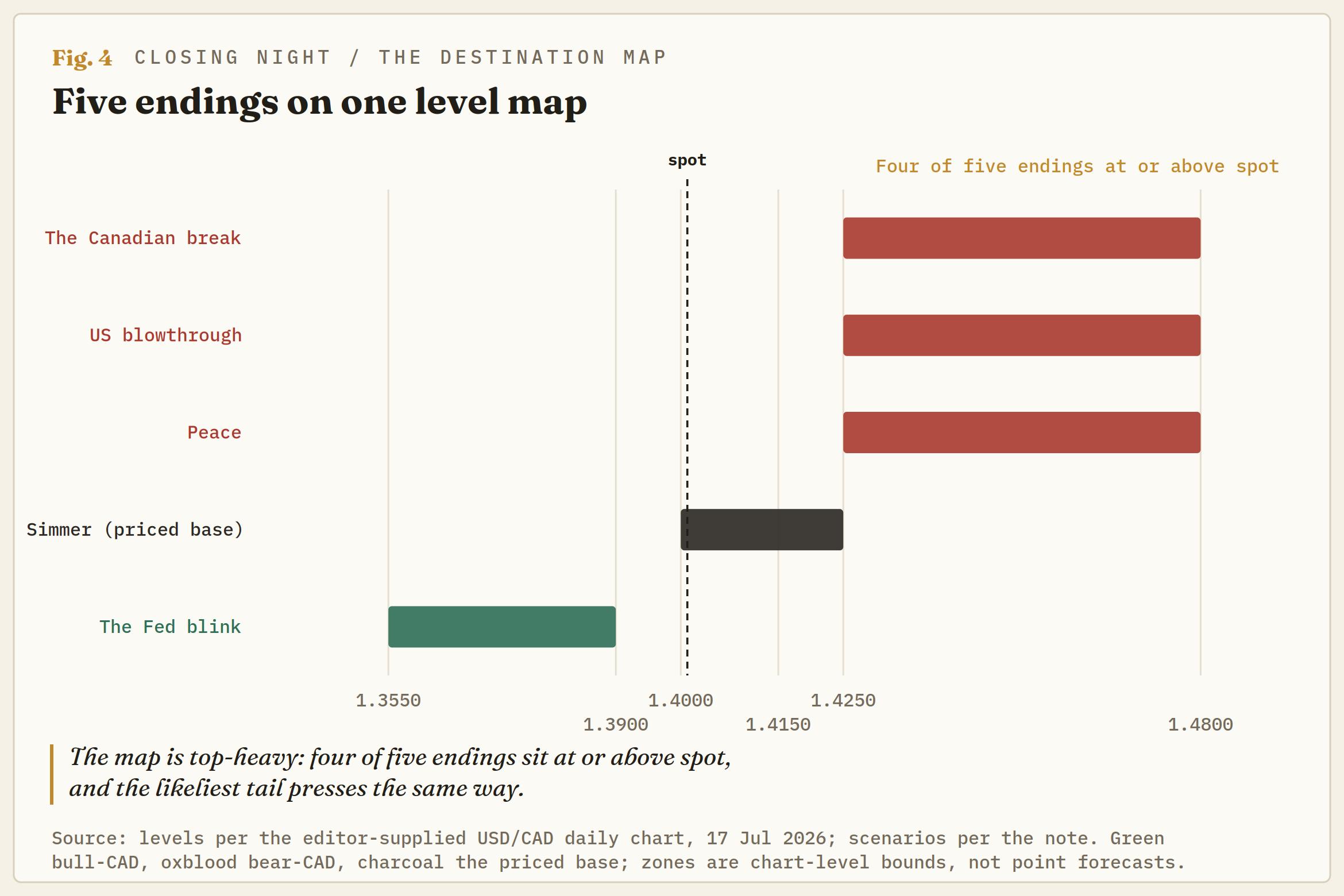
- Simmer, the priced-in base case: the war stays episodic, Brent holds the $80s, both banks deliver as written. Year-end inside 1.4000-1.4250 with the 1.4150 shelf as the magnet.
- Peace: the BoC disarmed and holding, the Fed delivering anyway. Above 1.4250, working into the vacuum toward the February 2025 extreme just under 1.4800. Low weight, decided sign: bear CAD.
- US blowthrough: the import pipeline lands on Q4 core goods, the Fed doubles, the BoC delivers once and falls behind. Through 1.4250 with the upper half of the run in play. This is the only tail carrying a market number, the 22.5%, and the pipeline is feeding it.
- The Canadian break: the cliff converts into a labour-deep downturn and the BoC blinks or cuts into a delivered Fed hike. The widest gap on the board, and the 1.4800 extreme genuinely reachable. The lesser tail in this desk's ranking, and its likeliest route runs through the war.
- The Fed blink: the lone bull-CAD ending. Q4 inflation rolls over, the hike slips, the BoC delivers. Year-end 1.3550-1.3900. Low, and shrinking against recent data.
Read the map before the levels. Four of the five endings sit at or above spot, and escalation, the likeliest tail of all, presses toward 1.4000 in its first phase and toward 1.4800 if it goes global. The destination map is top-heavy. Only a Fed blink points the other way.
Tactically, the decision is being made now. The pair sits on the 1.4000 handle and the 50-day EMA together, with the daily Stochastic RSI pinned near 5 after the slide from just under 1.4250. It is the first genuine dip-buying question of the trend. The range holds as long as the script does, 1.4000-1.4250, with 1.4150 the line separating drift from trend. A daily close below 1.4000 opens the 200-day EMA just below 1.3900, then the 1.3550 launchpad.
That is the Fed-blink path, the same door escalation's first phase presses, and the path the import pipeline argues against. A reclaim of 1.4150 and a break of 1.4250 needs a BoC blink, a second Fed hike or the phase-two flip. The air beyond runs to just under 1.4800. The lean into the autumn: fade the edges, respect the oversold tape here at 1.4000.
Both hikes are written. The Loonie's is dated December 9. The Dollar's is due at any meeting from September. Six months of movement came out of a gap that never moved, and the next six are priced so completely that only a mistake can move them. The only news left is somebody missing their line.
Author

Joshua Gibson
FXStreet
Joshua joins the FXStreet team as an Economics and Finance double major from Vancouver Island University with twelve years' experience as an independent trader focusing on technical analysis.