|

Breaking: NATO has officially told Reuters that an official invasion of Ukraine has begun

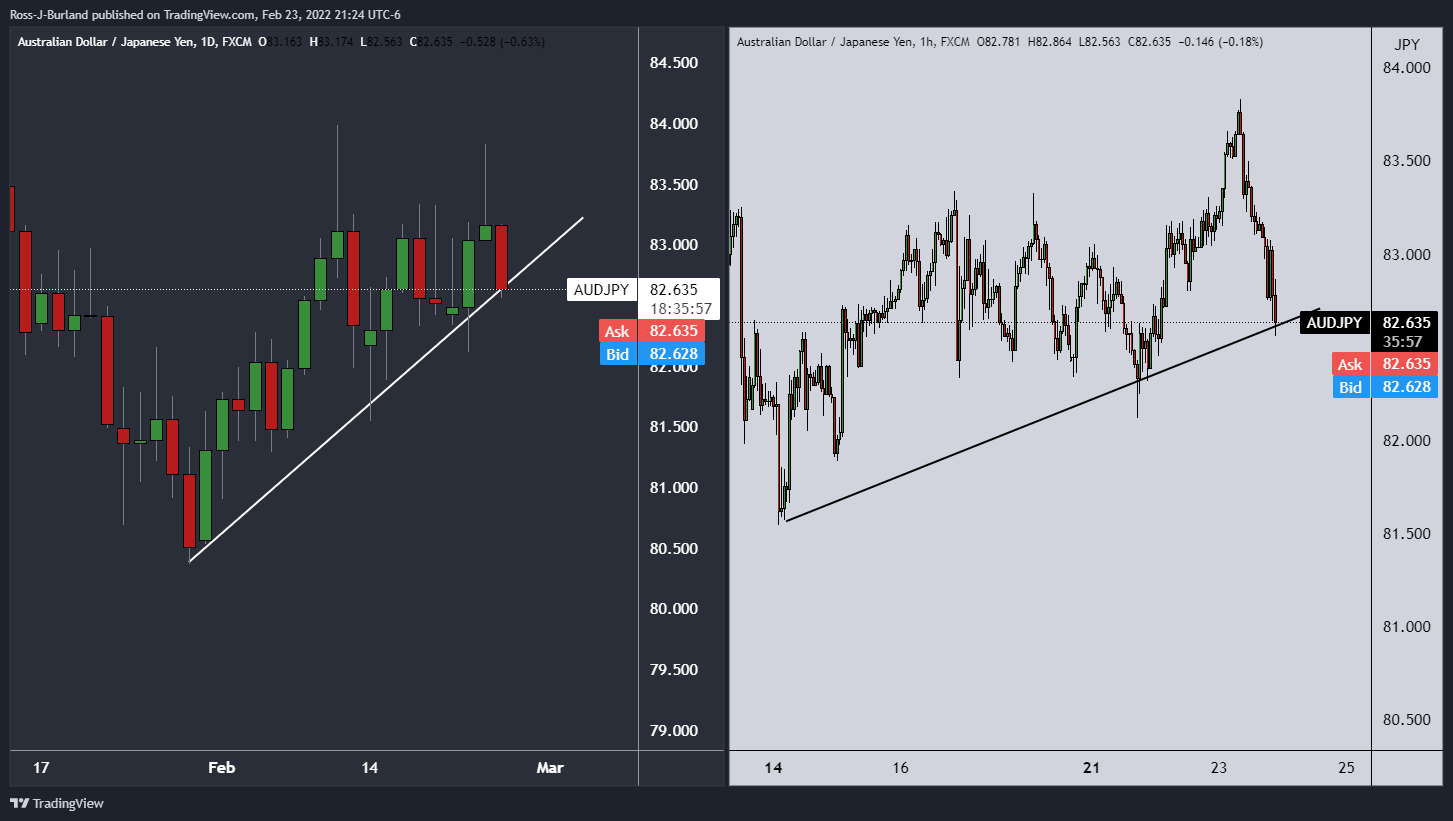
NATO has officially told Reuters that an official invasion of Ukraine has begun. So far, however, risk currencies in forex are holding their own battle lines, with AUD/JPY at daily trendline support:

NATO's General Stoltenberg said, "We stand with the people of Ukraine at this terrible time,” adding that “NATO will do all it takes to protect and defend all allies.”

AUD/JPY daily / H1 charts
Reuters has reported that Russian President Vladimir Putin authorised a military operation in eastern Ukraine on Thursday in what could be the start of the war in Europe over Russia's demands for an end to NATO's eastward expansion.

"The goal is to defend people who have been victims of abuse and genocide from the Kyiv regime. And we will strive to demilitarize and de-Nazify Ukraine. We will also hand over everyone who committed bloody crimes against civilians, including Russian citizens, to court," said the Russian President. 

''I am sure Russia's armed forces will fulfil their duty professionally and bravely. I have no doubt that all levels of government will work effectively together: the specialists in charge of economic stability, the financial and social system, and our business."

Meanwhile, US president Joe Biden has said Putin is responsible for the human suffering as a consequence to come and he will speak to the American population tomorrow. US President Biden promises "further consequences" for Russia.

This comes as Reuters witnesses are reporting explosions head in Kiev and in the Belgorod Province of Russia.

Author

FXStreet Team

Composed of a group of economic journalists and FX experts, the FXStreet content team produces and oversees all content published on FXStreet. It provides a purely journalistic approach to the Forex market.


More from FXStreet Team
Share:

Editor's Picks

AUD/USD hits eight-month lows below 0.6850 amid bullish USD

AUD/USD stays defensive below 0.6850, hitting an eight-month low in the Asian session on Thursday as the possibility of a steeper Fed rate hike in December helps the US Dollar hold near its highest level since April 2025. Geopolitical uncertainty also supports the safe-haven buck, while the RBA’s cautious, on-hold stance limits the Aussie.

USD/JPY eases from near 160.00 amid looming intervention risks, BoJ hike bets

USD/JPY retreats slightly from an over two-month high as the recent surge back to the 160.00 psychological mark prompted verbal warnings from Japanese authorities and sparked fears of direct FX intervention. Moreover, data showed that Japan’s wholesale inflation picked up again in October, strengthening the case for a BoJ hike in December and lifting the Japanese Yen. However, a bullish US Dollar, bolstered by odds of a jumbo Fed rate hike in December, could cap the pair's downside.


Gold falls below $4,000 as traders weigh a half-point Fed rate hike

Gold (XAU/USD) slips back below $4,000 on Thursday, giving up most of last week’s gains as bets on more aggressive Federal Reserve (Fed) interest rate hikes lift the US Dollar (USD) to a fresh year-to-date high.

MSCI drops Strategy from indexes: What it means for Bitcoin

Strategy and Bitcoin (BTC) came under fresh pressure late Wednesday after MSCI finalized its decision to remove the Bitcoin treasury company from its global indexes, raising concerns about potential selling pressure on MSTR shares and its future Bitcoin purchases.

Why the US Dollar's rally isn't as strong as it looks

The US Dollar Index (DXY) is back at an 18-month high, but most of its climb since August is the Euro falling. Against a wider group of trading partners, the Dollar has gained half as much, and the Federal Reserve has raised rates once this year. The US Dollar Index, which measures the Dollar against six other currencies, is trading near 103.

What the US CPI headline doesn’t tell you about inflation

Brent crude has fallen about a third since mid-October on hopes the Iran war is ending, but diesel, freight and fertiliser costs haven't followed. Those costs reach US consumer prices in stages through 2027 and could keep inflation high after gasoline gets cheaper.