BoC's Macklem: The economy is not in recession

Bank of Canada (BoC) Governor Tiff Macklem took questions from reporters, offering markets a clearer sense of how the central bank was thinking. His remarks followed the widely expected decision to keep the policy rate on hold at 2.25%.
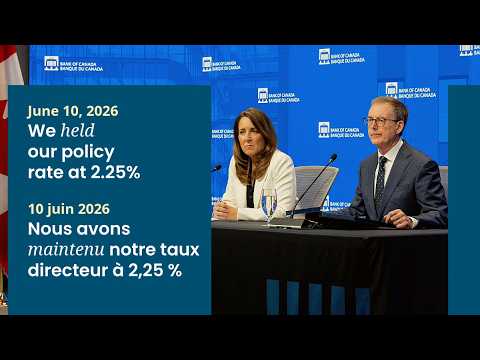
BoC Macklem press conference key highlights
Core inflation has ticked down.
Food inflation remains high, while shelter prices have moderated.
We’ve got the rate where we think it needs to be right now.
There is no evidence of a broader pass-through of higher energy prices.
Uncertainty around the US trade policy remains.
Consumer spending continues to expand.
There are no shifts in government spending.
Economy is weak but clearly not in recession.
This section below was published at 13:45 GMT to cover the Bank of Canada's policy announcements and the initial market reaction.
The Bank of Canada (BoC) left its policy rate unchanged at 2.25% on Wednesday, in line with market expectations. Attention now shifts to Governor Tiff Macklem's press conference at 14:30 GMT, where investors will be looking for additional colour on the decision and any clues about the future path of monetary policy.
BoC policy statement key highlights
The Bank of Canada said it is continuing to look through the Middle East war's near-term impact on headline inflation.
Policymakers noted there has been limited evidence so far of a broad-based pass-through of higher energy prices to other consumer prices.
The Bank expects total inflation to hover around 3% in the near term before gradually easing back towards its 2% target.
Officials also said recent data suggest economic growth will resume in the second quarter.
At the same time, the Bank acknowledged that economic activity in Canada has been weak and uncertainty surrounding US trade policy persists.
The Governing Council stressed that it will not allow higher energy prices to become a source of persistent inflation.
Even with some improvement in activity, policymakers expect the economy to remain in excess supply.
Market reaction
The Canadian Dollar (CAD) trades with marked gains vs. the Greenback on Wednesday, prompting USD/CAD to confront the key 1.3900 contention zone in the wake of the central bank’s interest rate decision.
Canadian Dollar Price Today
The table below shows the percentage change of Canadian Dollar (CAD) against listed major currencies today. Canadian Dollar was the strongest against the US Dollar.
| USD | EUR | GBP | JPY | CAD | AUD | NZD | CHF | |
|---|---|---|---|---|---|---|---|---|
| USD | -0.25% | -0.30% | -0.03% | -0.36% | -0.09% | -0.26% | -0.20% | |
| EUR | 0.25% | -0.06% | 0.24% | -0.14% | 0.11% | -0.00% | 0.05% | |
| GBP | 0.30% | 0.06% | 0.28% | -0.06% | 0.19% | 0.06% | 0.11% | |
| JPY | 0.03% | -0.24% | -0.28% | -0.35% | -0.11% | -0.25% | -0.20% | |
| CAD | 0.36% | 0.14% | 0.06% | 0.35% | 0.24% | 0.11% | 0.15% | |
| AUD | 0.09% | -0.11% | -0.19% | 0.11% | -0.24% | -0.14% | -0.08% | |
| NZD | 0.26% | 0.00% | -0.06% | 0.25% | -0.11% | 0.14% | 0.04% | |
| CHF | 0.20% | -0.05% | -0.11% | 0.20% | -0.15% | 0.08% | -0.04% |
The heat map shows percentage changes of major currencies against each other. The base currency is picked from the left column, while the quote currency is picked from the top row. For example, if you pick the Canadian Dollar from the left column and move along the horizontal line to the US Dollar, the percentage change displayed in the box will represent CAD (base)/USD (quote).
This section below was published as a preview of the Bank of Canada's (BoC) monetary policy announcements at 09:00 GMT.
- The Bank of Canada is expected to keep its interest rate at 2.25%.
- The Canadian Dollar remains weak, with USD/CAD near 1.4000.
- Markets pencil in around 36 bps of hiking by the BoC this year.
The Bank of Canada (BoC) is widely expected to keep its policy rate unchanged at 2.25% on Wednesday. This would be the fifth consecutive gathering with the bank keeping its hand steady.
At its April event, the BoC left rates unchanged at 2.25%, as expected, but the overall message was far from dovish.
While policymakers see some softness in near-term growth, inflation is proving a little more stubborn than anticipated, with wage growth still running in the 3% to 3.5% range. In other words, the economy is slowing, but not enough to completely remove inflation concerns.
Governor Tiff Macklem reiterated that there is no preset path for rates and stressed that policymakers remain guided by incoming data. Importantly, he refused to rule out further tightening, noting that persistently high energy prices could eventually require a policy response. At the same time, he said, existing economic slack should help to contain the inflationary impact of higher energy prices.
Macklem also warned that inflation expectations may be less firmly anchored than they were before the pandemic, while Deputy Governor Carolyn Rogers highlighted trade tensions as a longer-term risk to the outlook.
All in all, the bank remains firmly in wait-and-see mode, but it is not signalling rate cuts anytime soon. Inflation risks still lean modestly to the upside, allowing for further tightening if price pressures prove more persistent than expected.
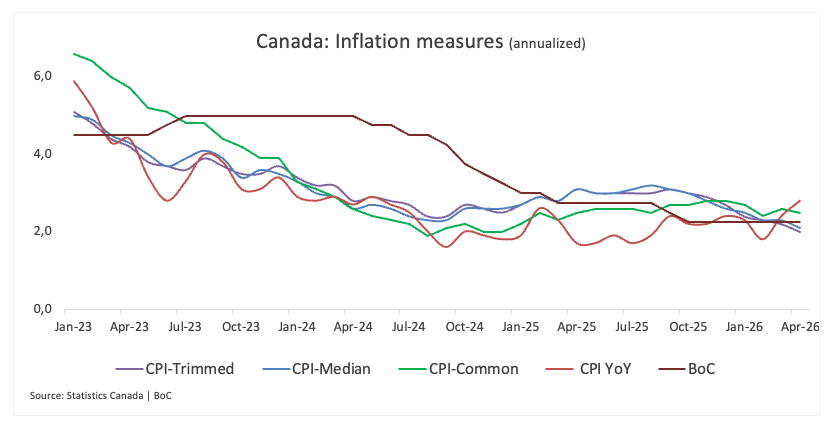
Inflation, however, remains the key watch point after the headline CPI rose by 2% in the year to April, below the previous month’s print of 2.2% and matching the bank’s target. In the same direction, the BoC’s core inflation eased to 2.1% from a year earlier. The bank’s preferred measures, CPI-Common, Trimmed and Median, also ticked lower, but at 2.5%, 2% and 2.1%, respectively, they still remain above target.
When will the BoC release its monetary policy decision, and how could it affect USD/CAD?
The Bank of Canada will announce its policy decision on Wednesday at 13:45 GMT, followed by a press conference with Governor Tiff Macklem at 14:30 GMT.
Markets anticipate the central bank maintaining its current stance, with a projected tightening of just over 35 basis points by the end of 2026.
Pablo Piovano, Senior Analyst at FXStreet, points out that the Canadian Dollar (CAD) has been depreciating steadily against the Greenback since May, lifting USD/CAD to an area close to the psychological 1.4000 barrier earlier this week.
Piovano says the continuation of the ongoing bullish momentum could prompt the spot to initially reclaim the 2026 ceiling at 1.3966 (March 31). Up from here comes the key 1.4000 threshold, seconded by the November top at 1.4140 (November 5).
On the downside, he adds, "The loss of the 200-day SMA at 1.3813 could pave the way for extra weakness, targeting the weekly floor at 1.3770, which appears reinforced by the provisional 55-day SMA. Down from here emerges the May base at 1.3949 (May 29), ahead of the March trough at 1.3525 (March 9) and the February valley at 1.3504 (February 11).
“Momentum favours extra gains,” he suggests, noting that the Relative Strength Index (RSI) hovers near the 68 level, while the Average Directional Index (ADX) just past 30 is indicative of a strong trend.
Economic Indicator
BoC Press Conference
After Bank of Canada (BoC) meetings and the release of the Monetary Policy Report, the BoC Governor and Senior Deputy Governor hold a press conference at which they field questions from the media. The press conference has two parts – first a prepared statement is read out, then the conference is open to questions from the press. Hawkish comments tend to boost the Canadian Dollar (CAD), while a dovish message tends to weaken it.
Read more.Next release: Wed Jun 10, 2026 14:30
Frequency: Irregular
Consensus: -
Previous: -
Source: Bank of Canada
Bank of Canada FAQs
The Bank of Canada (BoC), based in Ottawa, is the institution that sets interest rates and manages monetary policy for Canada. It does so at eight scheduled meetings a year and ad hoc emergency meetings that are held as required. The BoC primary mandate is to maintain price stability, which means keeping inflation at between 1-3%. Its main tool for achieving this is by raising or lowering interest rates. Relatively high interest rates will usually result in a stronger Canadian Dollar (CAD) and vice versa. Other tools used include quantitative easing and tightening.
In extreme situations, the Bank of Canada can enact a policy tool called Quantitative Easing. QE is the process by which the BoC prints Canadian Dollars for the purpose of buying assets – usually government or corporate bonds – from financial institutions. QE usually results in a weaker CAD. QE is a last resort when simply lowering interest rates is unlikely to achieve the objective of price stability. The Bank of Canada used the measure during the Great Financial Crisis of 2009-11 when credit froze after banks lost faith in each other’s ability to repay debts.
Quantitative tightening (QT) is the reverse of QE. It is undertaken after QE when an economic recovery is underway and inflation starts rising. Whilst in QE the Bank of Canada purchases government and corporate bonds from financial institutions to provide them with liquidity, in QT the BoC stops buying more assets, and stops reinvesting the principal maturing on the bonds it already holds. It is usually positive (or bullish) for the Canadian Dollar.
Author

FXStreet Team
FXStreet
Composed of a group of economic journalists and FX experts, the FXStreet content team produces and oversees all content published on FXStreet. It provides a purely journalistic approach to the Forex market.

















