The Japanese Yen spikes and unwinds on the best pay data in decades
- USD/JPY holds just below 154.50, unchanged after a 153-pip round trip.
- July nominal pay rose 4.7% against a 3.9% consensus, the fastest since 1997.
- No Japanese release left this week, with four American prints ahead.

USD/JPY holds just below 154.50 on Tuesday, unchanged on the day after a 153-pip round trip. The pair traded well over a Yen lower on the strongest Japanese pay data since 1997 and has bought back all of it. Nothing about the wage number disappointed, and everything about it was already in the price. The four sessions left in this week carry no Japanese release at all.
The best pay print since 1997 changed nothing
Nominal cash earnings rose 4.7% in July against a 3.9% consensus, the fastest since January 1997 and a sixth consecutive month above 3%, the longest such run in 34 years. Base pay rose 4.1%, the quickest since April 1992, and real wages gained 2.4%, a seventh straight month of growth and the best in five years. The spring negotiating round landed at 5.01% on the largest federation's count, a third consecutive year above 5%.
A quarter point on September 18 was largely priced before any of that landed, and the Governor said last week that a September move was on the table. The revised second-quarter figures arrived in the same batch, with annualized growth lifted to 1.4% against a 1.1% consensus and the deflator steady at 2.6%. Bonuses did much of the lifting in the pay figure, jumping 6.3% after a revised 4.7%, while overtime slowed to 3.1%. The steadier full-time measure, which strips bonuses and overtime out, rose 2.7%. Private consumption did not move in the quarter. Six months of pay rises above 3% have produced a household sector that spends what it spent before.
The current account swung to a ¥2.988 trillion surplus in July from a ¥92.3 billion deficit, and the inflation gauge the labour ministry uses rose to 2.2% from 1.9%. Both of those are July numbers. Crude Oil has risen for six straight sessions since, and Japan buys every barrel of it from somebody else.
What a record reserve drawdown bought
Japan's foreign reserves fell 6.2% in August to $1.208 trillion, with securities holdings down $87.8 billion, the first public measure of the joint operation Tokyo and Washington ran at the end of July. That operation took USD/JPY from just under 164.00 down toward 157.50 inside two sessions, with a spike beneath 155.50 on the way. By September 1, the pair had traded back near 160.00.
It has fallen more than seven Yen in the five sessions since, and nobody was billed for those. Tokyo has no level it wants back at these prices, which is why 154.00 keeps giving way and keeps being recovered rather than defended. The positioning read through September 1 has Yen shorts rebuilding after the July operation, and a book that size supplies a buyer on every dip and a seller on every bounce.
Forecasts have followed the tape rather than led it. The published projections now cluster in the low 150s over the coming months on the assumption of moves in September and January, and the Yen is the best-performing major of the year with the pair beneath where it began 2026.
Nothing Japanese prints again until September 18
The calendar's Japanese column ends with Monday's releases. The four-week average of American private payrolls lands Wednesday at 12:15 GMT after 11.75K, and the Producer Price Index (PPI) follows Thursday at 12:30 GMT, seen at 0.4% on the month after a flat July and 5.3% YoY after 4.7%, with the core measure at 0.3% and 4.6%. Jobless claims print alongside it at 205K after 206K, and existing home sales follow at 14:00 GMT after a 1.7% decline.
Friday carries the Consumer Price Index (CPI) at 12:30 GMT, seen at 0.4% on the month, 3.4% YoY and 2.4% on the core, the last inflation reading before the Federal Reserve meets September 15-16 with a quarter point priced near 58%. The Michigan survey follows at 14:00 GMT, with sentiment seen at 51 after 51.7 and one-year inflation expectations last at 4%. The Bank of Japan decides two days after the Federal Reserve, so the pair gets four American prints and no Japanese ones before either meeting.
Levels and bias
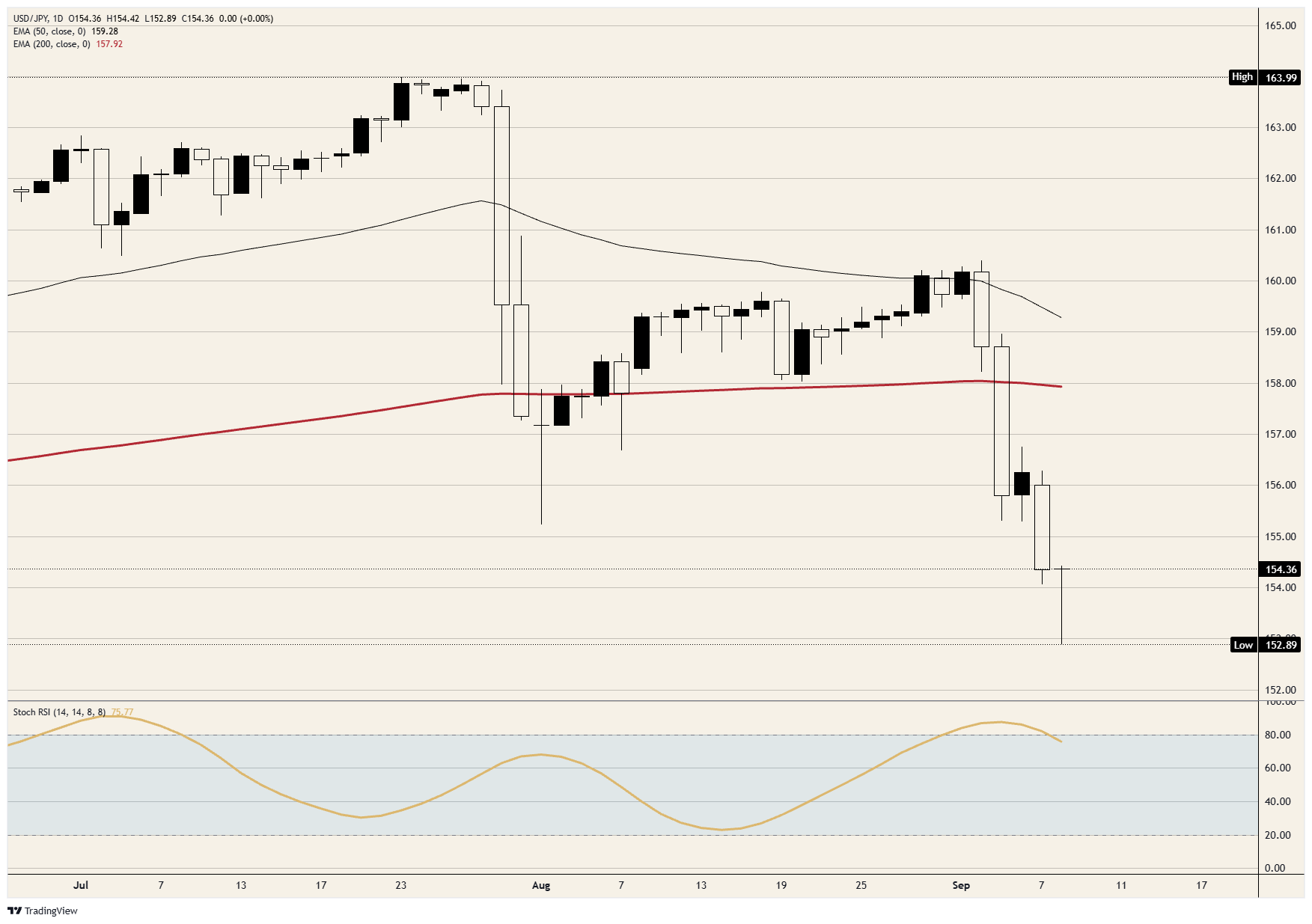
Resistance: The 154.50 handle is the first hurdle and the session high stopped short of it. Above that sit 155.00 and 155.50, then the 156.00 area where last week's breakdown paused, and the 200-day Exponential Moving Average (EMA) just below 158.00. The 50-day EMA near 159.50 sits above that, with the late-July peak just under 164.00 out of reach.
Support: The 154.00 handle is the pivot the pair keeps returning to, and it did not hold this morning. The session low just under 153.00 is the first floor beneath it. Under that, 152.50 and the 152.00 handle are round figures rather than traded structure, because the daily chart carries no history there in its displayed range.
Bias: Bearish while 154.50 caps, with the 153.00 area the first objective and the 152.00 handle behind it. The daily Stochastic Relative Strength Index (Stoch RSI) near 76 is only now rolling over from the top of its range after a seven Yen fall, so there is no oversold reading anywhere to bounce from, and the five-minute reading near 75 says the intraday recovery is already mature. A daily close above 155.50 voids the case and puts 156.00 back in play.
USD/JPY daily chart
Japanese Yen FAQs
The Japanese Yen (JPY) is one of the world’s most traded currencies. Its value is broadly determined by the performance of the Japanese economy, but more specifically by the Bank of Japan’s policy, the differential between Japanese and US bond yields, or risk sentiment among traders, among other factors.
One of the Bank of Japan’s mandates is currency control, so its moves are key for the Yen. The BoJ has directly intervened in currency markets sometimes, generally to lower the value of the Yen, although it refrains from doing it often due to political concerns of its main trading partners. The BoJ ultra-loose monetary policy between 2013 and 2024 caused the Yen to depreciate against its main currency peers due to an increasing policy divergence between the Bank of Japan and other main central banks. More recently, the gradually unwinding of this ultra-loose policy has given some support to the Yen.
Over the last decade, the BoJ’s stance of sticking to ultra-loose monetary policy has led to a widening policy divergence with other central banks, particularly with the US Federal Reserve. This supported a widening of the differential between the 10-year US and Japanese bonds, which favored the US Dollar against the Japanese Yen. The BoJ decision in 2024 to gradually abandon the ultra-loose policy, coupled with interest-rate cuts in other major central banks, is narrowing this differential.
The Japanese Yen is often seen as a safe-haven investment. This means that in times of market stress, investors are more likely to put their money in the Japanese currency due to its supposed reliability and stability. Turbulent times are likely to strengthen the Yen’s value against other currencies seen as more risky to invest in.
Author

Joshua Gibson
FXStreet
Joshua joins the FXStreet team as an Economics and Finance double major from Vancouver Island University with twelve years' experience as an independent trader focusing on technical analysis.

















