Australia's AAA credit was just reaffirmed: Why the Australian Dollar still faces growth headwinds

The Australian Dollar (AUD) is balancing solid long-term fiscal fundamentals against near-term growth headwinds and shifting central bank expectations. While rating agency S&P has reaffirmed Australia's pristine AAA credit rating — underpinned by low public debt and robust institutions — sluggish GDP expansion and persistent inflation present underlying risks for the domestic economy. Meanwhile, a softer US Dollar (USD) and the lingering prospect of a November Reserve Bank of Australia (RBA) rate hike have provided the currency cross with a steady upward trajectory.
Institutional Breakdown: BNY vs. Rabobank
To compare how key market analysts view the drivers shaping the Aussie Dollar, we highlight the core perspectives from BNY and Rabobank:
- Sovereign Credit & Fiscal Profile: BNY emphasizes S&P's affirmation of Australia's AAA rating with a stable outlook, supported by modest public debt, a projected deficit of 1.6% of GDP over two years, and net debt stabilizing near 28% by fiscal 2029.
- Domestic Macro Headwinds: BNY notes that economic growth is easing to 1.5% in fiscal 2027, alongside weak productivity and persistent above-target inflation, with per capita GDP falling in ten of the last 15 quarters.
- RBA Rate Hike Potential: Rabobank views the RBA's upcoming August 11 meeting as a key catalyst, maintaining that strong labor data leaves room for one final rate hike in November.
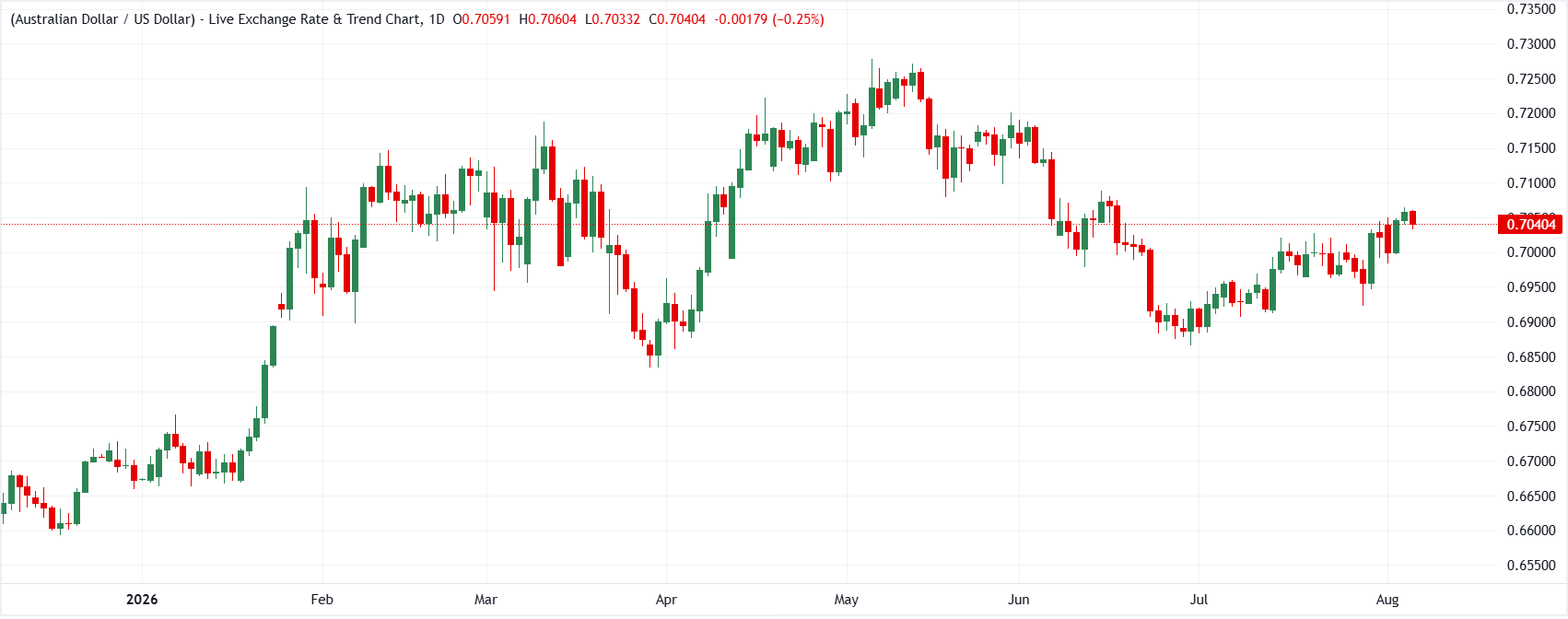
- AUD/USD Price Targets: Rabobank has upgraded its 3-month AUD/USD forecast to 0.71 (up from 0.70), maintaining a modest upside bias out to 12 months driven primarily by broader US Dollar softening.
AAA rating affirmation provides structural backstop against economic drag
Geoff Yu at BNY reports that S&P's stable AAA rating affirmation reflects Australia's wealthy economy, credible monetary policy, and resilient policy frameworks. However, the rating agency's report highlights significant economic friction under the surface. Higher interest rates continue to weigh on domestic demand, with real GDP growth projected to slow to 1.5% in fiscal 2027. Combined with weak productivity and shrinking per capita output, these factors act as a persistent counterweight to fundamental currency appreciation.
"The agency expects the general government deficit to remain around 1.6% of GDP over the next two years, while net debt stabilizes near 28% of GDP by fiscal 2029... Inflation remains above target, productivity is weak and per capita GDP has declined in ten of the past 15 quarters."
Shifting RBA expectations and USD weakness lift AUD/USD target to 0.71
Taking a tactical trading view, Jane Foley at Rabobank points out that AUD/USD has maintained a gentle upward trend since July, placing the Aussie in the middle of the G10 performance pack. While recent trade balance data underscored structural trade strength, Foley asserts that near-term price action will be driven by RBA policy guidance. With market expectations over Fed rate hikes seen as overextended, Rabobank foresees further modest gains for the currency pair.
"In Rabo’s view there is still risk of one more rate hike this year in November. The market will be hoping that the RBA’s August 11 policy meeting will provide more clarity on rate hike risks... We have raised our 3-month forecast to AUD/USD 0.71 from 0.70."
Banks see modest upside for the Australian Dollar
Based on the joint analysis of both institutions, the banks project a moderately positive trajectory for the Australian Dollar, led by external USD dynamics rather than aggressive domestic growth. BNY notes that while fiscal metrics remain among the strongest in the G10, softer per capita growth and weak productivity will temper rapid upside momentum. Conversely, Rabobank expects AUD/USD to climb toward 0.71 over a 3-month horizon, buoyed by broader US Dollar weakness and the lingering possibility of an RBA rate increase before the end of the year.
(This article was created with the help of an Artificial Intelligence tool and reviewed by an editor. Know more.)
Author

FXStreet Insights Team
FXStreet
The FXStreet Insights Team is a group of journalists that handpicks selected market observations published by renowned experts. The content includes notes by commercial as well as additional insights by internal and external analysts.