Australian Dollar remains firm on firm RBA interest rate hike prospects
- The Australian Dollar continues to capitalize on fresh escalation in hawkish RBA bets.
- A faster-than-expected Australian CPI growth has prompted hawkish RBA bets.
- The US Dollar trades higher, while investors await Fed Warsh’s speech.
The Australian Dollar (AUD) is up 0.1% at around 0.7180 against the US Dollar (USD) during the European trading session on Thursday. The Aussie pair remains firm this week due to continued outperformance by the antipodean.
Australian Dollar Price This week
The table below shows the percentage change of Australian Dollar (AUD) against listed major currencies this week. Australian Dollar was the strongest against the Swiss Franc.
| USD | EUR | GBP | JPY | CAD | AUD | NZD | CHF | |
|---|---|---|---|---|---|---|---|---|
| USD | 0.31% | 0.41% | 0.40% | 0.56% | -0.23% | 0.48% | 0.54% | |
| EUR | -0.31% | 0.11% | 0.02% | 0.24% | -0.54% | 0.17% | 0.23% | |
| GBP | -0.41% | -0.11% | -0.19% | 0.14% | -0.62% | 0.06% | 0.13% | |
| JPY | -0.40% | -0.02% | 0.19% | 0.21% | -0.54% | 0.18% | 0.22% | |
| CAD | -0.56% | -0.24% | -0.14% | -0.21% | -0.73% | -0.03% | -0.03% | |
| AUD | 0.23% | 0.54% | 0.62% | 0.54% | 0.73% | 0.71% | 0.77% | |
| NZD | -0.48% | -0.17% | -0.06% | -0.18% | 0.03% | -0.71% | 0.06% | |
| CHF | -0.54% | -0.23% | -0.13% | -0.22% | 0.03% | -0.77% | -0.06% |
The heat map shows percentage changes of major currencies against each other. The base currency is picked from the left column, while the quote currency is picked from the top row. For example, if you pick the Australian Dollar from the left column and move along the horizontal line to the US Dollar, the percentage change displayed in the box will represent AUD (base)/USD (quote).
The Australian currency strengthened as financial markets increase hawkish Reserve Bank of Australia (RBA) bets, following the release of the hotter-than-expected Australian Consumer Price Index (CPI) report for July.
RBA hike risk lingers as Australia inflation beats forecasts, lifting AUDUSD
Strategists at OCBC Bank highlight that the latest Australian inflation data were firmer than anticipated, with "Australian headline inflation eased from 3.8% YoY in June to 3.5% YoY in July, while trimmed mean inflation held steady at 3.6% YoY." They note that "both measures came in above market expectations," and point out that "the RBA is targeting an average trimmed mean inflation rate of 3.3% YoY in 2H26, making July's reading an unhelpful start to the second half of the year."
Against this backdrop, persistently firm inflation continues to keep the risk of another rate hike on the table." Market pricing has shifted accordingly: "following the inflation release, markets fully priced an additional 25bp hike by February 2027, up from around a 70% probability beforehand." OCBC adds that this repricing "has helped AUDUSD retest resistance in the 0.7180-0.7200 range."
However, the bank OCBC holds a contrary view to market expectations. “Our base case remains that the RBA has reached the end of its tightening cycle,” OCBC added.
Meanwhile, the US Dollar also trades higher, with investors turning cautious ahead of Federal Reserve (Fed) Chairman Kevin Warsh’s speech at the Jackson Hole Symposium on Friday.
At press time, the US Dollar Index (DXY), which gauges the Greenback’s value against six major currencies, trades 0.1% higher to near 98.22.
AUD/USD Technical Analysis
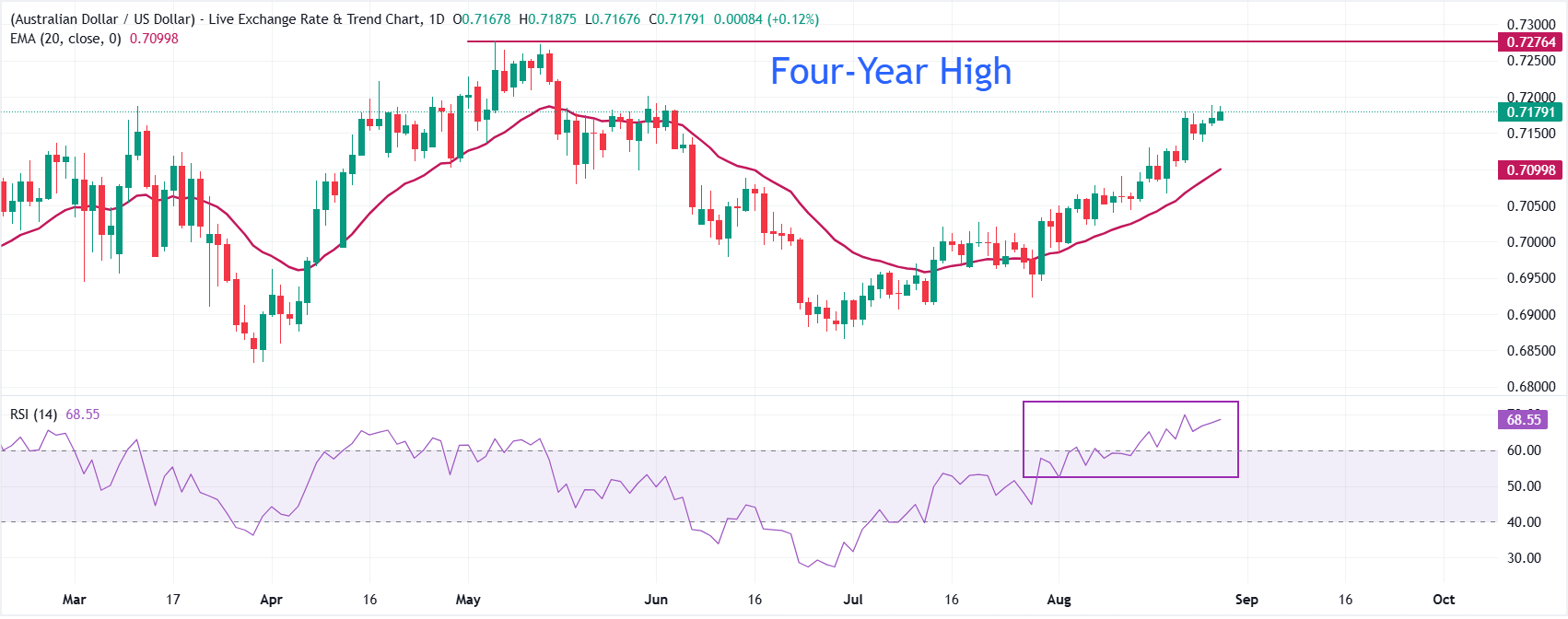
In the daily chart, AUD/USD trades around 0.7179, extending its advance above the 20-day exponential moving average (EMA) at 0.7100, which now underpins a constructive near-term bias. The rising EMA suggests the short-term trend remains pointed higher, while the Relative Strength Index (14) at 68.5 hovers just below overbought territory, hinting that bullish momentum is strong but approaching stretched conditions.
On the downside, immediate support is located at the 20-day EMA near 0.7100, where a deeper pullback would be expected to attract buying interest while the broader bullish structure holds. With no nearby technical resistance levels from this dataset, the pair’s topside remains open, although the elevated RSI warns that fresh gains could become more measured as the rally matures.
(The technical analysis of this story was written with the help of an AI tool. Know more.)
(This story was corrected on August 27 at 17:12 GMT to say RBA instead of Fed in the second bullet point.)
Economic Indicator
Fed's Chair Warsh speech
Kevin Warsh took office as chairman of the Board of Governors of the Federal Reserve in May 2026, for a four-year term ending in 2030. His term as a member of the Board of Governors will expire in May 2040. Warsh, born in Albany (New York) on April 13, 1970, is an American financier and attorney who already served as a member of the Fed Board of Governors from 2006 to 2011 and was significantly involved in the central bank's response to the financial crisis.
Read more.Next release: Fri Aug 28, 2026 14:00
Frequency: Irregular
Consensus: -
Previous: -
Source: Federal Reserve
Author

Sagar Dua
FXStreet
Sagar Dua is associated with the financial markets from his college days. Along with pursuing post-graduation in Commerce in 2014, he started his markets training with chart analysis.