Australian Dollar regains ground as Democrats eye victory in both Houses
- Australian Dollar rebounds to near 0.6977 against the US Dollar as market sentiment improves.
- Democrats win a majority in Senate and are leading in House of Representatives.
- On Tuesday, the RBA hiked interest rates by 25 bps to 4.85%.

The Australian Dollar (AUD) attracts bids against the US Dollar (USD) on Wednesday after facing a sharp sell-off in the last two trading days. The Aussie pair rises to near 0.6977 as the Australian Dollar gains due to an improvement in risk-appetite of investors.
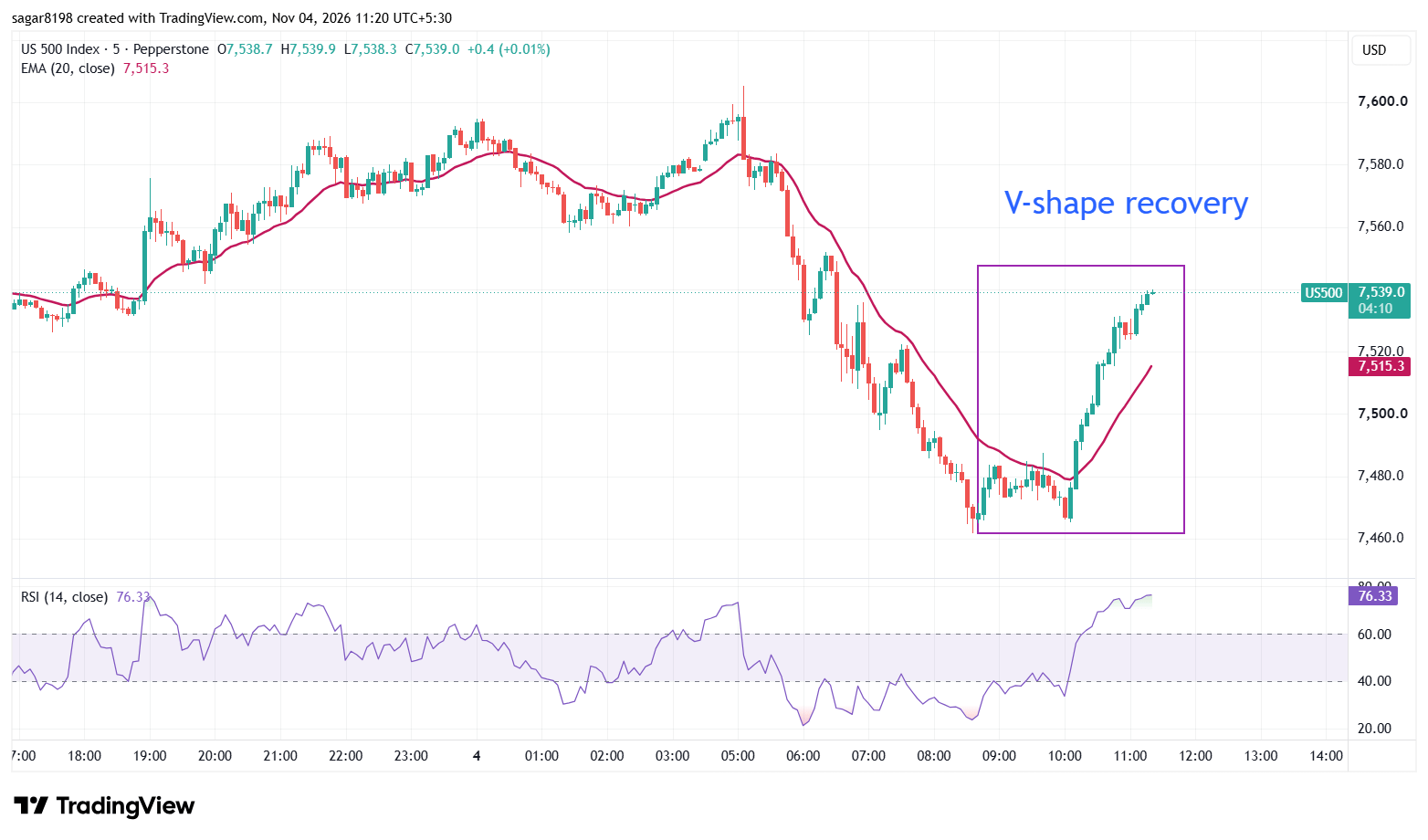
In early European trade, S&P 500 futures have delivered a V-shape recovery, clawing back half of its early losses, but are still 0.6% lower to near 7,530. This seems to be a revival of investors’ risk- appetite.
Given that the Australian currency is highly sensitive to market sentiment, an improvement in risk profile has bolstered the appeal of the antipodean.
A strong recovery move in S&P 500 futures has come even after Democrats have gained majority seats in Senate, and are also expected to turn out victorious in House of Representatives. According to BBC News, Democrats are leading voting count for House with 201 seats. For a majority, they need to acquire 218 seats.
Meanwhile, the US Dollar has also recovered a majority of its early losses. As of writing, the US Dollar Index (DXY), which gauges the Greenback’s value against six major currencies, trades 0.4% lower to near 101.48, but has rebounded sharply from its day’s low of 101.25.
Signs of strong recovery in S&P 500 futures and the US Dollar suggest a “Sell the rumour Buy the News” phenomenon.
On the domestic front, the Reserve Bank of Australia (RBA) hiked its Official Cash Rate (OCR) by 25 basis points (bps) to 4.85% on Tuesday, as expected, and signaled that the bar for another interest rate hike is very high.
AUD/USD Technical Analysis
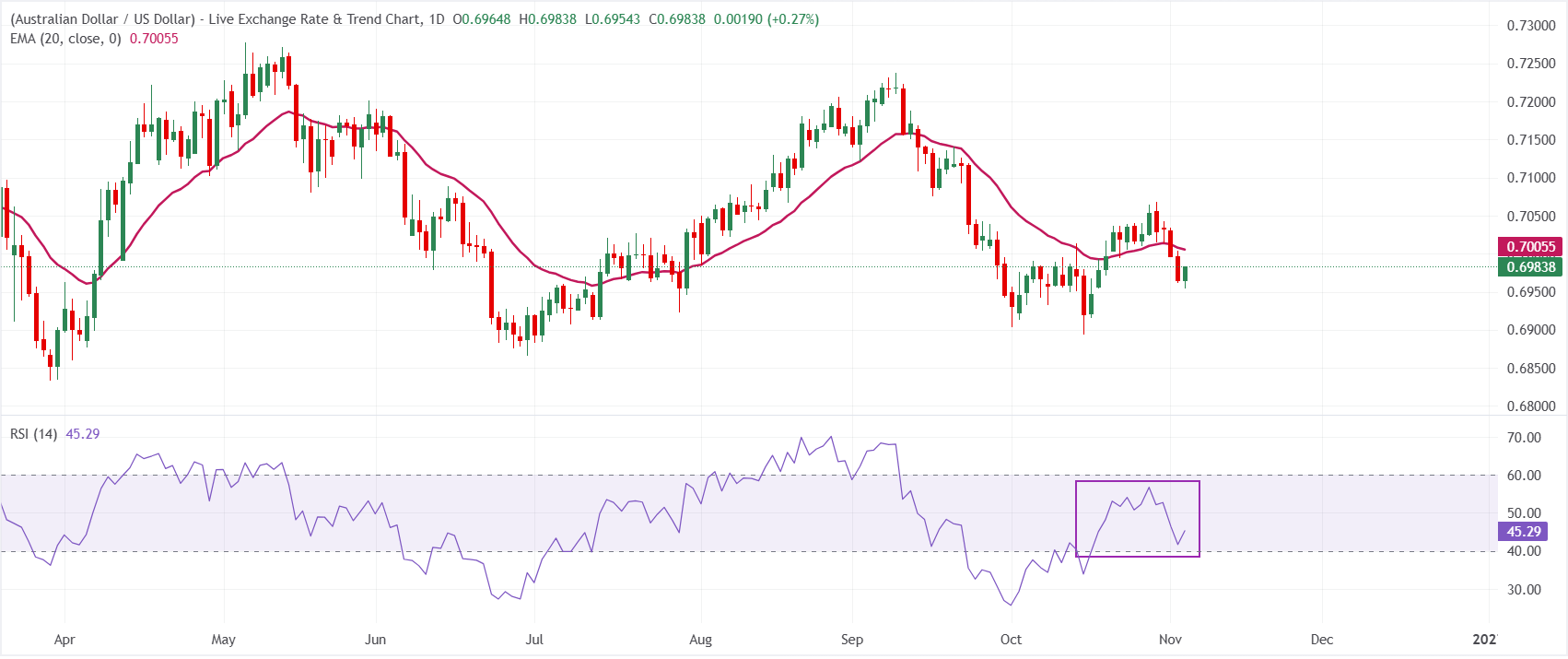
In the daily chart, AUD/USD trades at 0.6982, maintaining a bearish near-term bias as it holds beneath the 20-period Exponential Moving Average (EMA) at 0.7005. The pair’s inability to reclaim this short-term EMA hints at persistent topside pressure, while the Relative Strength Index (RSI) around 45 suggests consolidative momentum rather than oversold conditions, leaving room for further downside if sellers remain in control.
On the topside, immediate resistance is located at the 20-period EMA near 0.7005, which acts as the first barrier to any recovery attempts. A sustained break above this level would be needed to ease the current bearish tone and open the way for a more constructive advance, while failure to overcome it keeps rallies vulnerable to renewed selling interest in the sessions ahead.
(The technical analysis of this story was written with the help of an AI tool. Know more.)
Economic Indicator
RBA Interest Rate Decision
The Reserve Bank of Australia (RBA) announces its interest rate decision at the end of its eight scheduled meetings per year. If the RBA is hawkish about the inflationary outlook of the economy and raises interest rates it is usually bullish for the Australian Dollar (AUD). Likewise, if the RBA has a dovish view on the Australian economy and keeps interest rates unchanged, or cuts them, it is seen as bearish for AUD.
Read more.Last release: Tue Nov 03, 2026 03:30
Frequency: Irregular
Actual: 4.85%
Consensus: 4.85%
Previous: 4.6%
Source: Reserve Bank of Australia
Author

Sagar Dua
FXStreet
Sagar Dua is associated with the financial markets from his college days. Along with pursuing post-graduation in Commerce in 2014, he started his markets training with chart analysis.

















