Australian Dollar finds brief support near 0.6660 against US Dollar, outlook remains weak
- Australian Dollar gauges temporary relief near 0.6660 against the US Dollar.
- Soft Australian labor market data has weakened the Australian Dollar.
- The Fed is expected to deliver a series of interest rate hikes in the near term.


The Australian Dollar (AUD) finds a temporary support near 0.6660 against the US Dollar (USD) in the early European trade on Thursday. Still, the Aussie pair is down 0.4% to near 0.6690.
Earlier in the day, the Australian Dollar faces intense selling pressure after weak employment data for October. The labor market report showed that the Unemployment Rate jumped to 4.9%, the highest level seen since June 2021. The jobless rate was expected to have remained steady at 4.7%.
Australian laborforce witnessed reduction of 43.5K workers, while it was expected to add 25K fresh ones. The economy also saw employers laying-off 36.4K payrolls in September.
Signs of softening Australian labor market conditions are expected to further ease fears of more Reserve Bank of Australia (RBA) interest rate hikes.
Hawkish RBA expectations were already weak as latest monetary policy minutes showed that policymakers are highly concerned about growing economic risks.
Analysts at Commerzbank note that the latest RBA minutes “underscore once again that the threshold for another rate hike is likely to be rather high,” after the central bank recently lifted its policy rate to 4.85%, “its highest level since the global financial crisis in 2008.” They stress that this setting is “already well above the RBA’s estimate of the neutral rate of around 3-4%,” reinforcing the impression that policymakers are reluctant to tighten further.
Commerzbank highlights that “the three members who voted against the latest rate hike warned that the economy could already be close to a sharper downturn,” a signal which, in their view, “suggests that the RBA is likely to be cautious about further rate hikes for now.”
Meanwhile, surging US Dollar due to fears of a series of interest rate hikes by the Federal Reserve (Fed) in the near term is also keeping the Aussie pair under pressure.
AUD/USD Technical Analysis
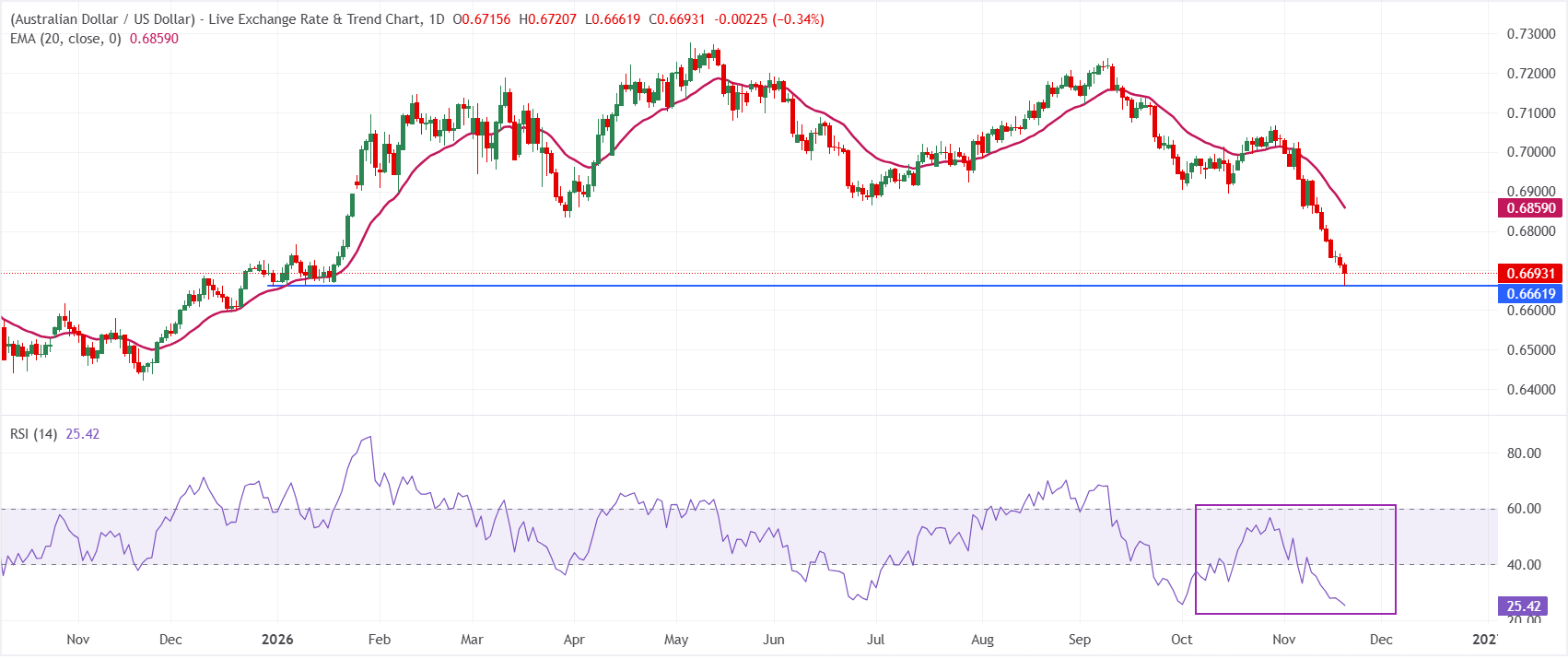
In the daily chart, AUD/USD trades at 0.6693, extending its decline and retaining a bearish near-term bias. The 20-day exponential moving average (EMA) at 0.6859 runs overhead as immediate resistance, underscoring that spot remains entrenched below a key trend gauge. The Relative Strength Index (14) at 25 is in oversold territory, hinting that while selling pressure dominates, the downside could start to lose momentum if bears hesitate to press fresh lows.
On the topside, initial resistance is located at the 20-day EMA around 0.6860, and a daily close above this barrier would be needed to ease the current bearish tone and open room for a corrective bounce. As long as AUD/USD holds beneath this moving average, the pair is expected to stay vulnerable to further downside extension, with traders watching RSI behavior for signs of either exhaustion or renewed bearish acceleration.
(The technical analysis of this story was written with the help of an AI tool. Know more.)
Economic Indicator
Unemployment Rate s.a.
The Unemployment Rate, released by the Australian Bureau of Statistics, is the number of unemployed workers divided by the total civilian labor force, expressed as a percentage. If the rate increases, it indicates a lack of expansion within the Australian labor market and a weakness within the Australian economy. A decrease in the figure is seen as bullish for the Australian Dollar (AUD), while an increase is seen as bearish.
Read more.Last release: Thu Nov 19, 2026 00:30
Frequency: Monthly
Actual: 4.9%
Consensus: 4.7%
Previous: 4.7%
Source: Australian Bureau of Statistics
The Australian Bureau of Statistics (ABS) publishes an overview of trends in the Australian labour market, with unemployment rate a closely watched indicator. It is released about 15 days after the month end and throws light on the overall economic conditions, as it is highly correlated to consumer spending and inflation. Despite the lagging nature of the indicator, it affects the Reserve Bank of Australia’s (RBA) interest rate decisions, in turn, moving the Australian dollar. Upbeat figure tends to be AUD positive.
Author
Sagar Dua
FXStreet
Sagar Dua is associated with the financial markets from his college days. Along with pursuing post-graduation in Commerce in 2014, he started his markets training with chart analysis.