Fed Minutes set to provide further clues on the central bank’s hiking pace
- Fed Minutes are set to be carefully analysed for hints about the pace and scope of the bank’s tightening cycle.
- The FOMC left rates on hold in October amid a “heck of a family fight,” according to Fed Chair Kevin Warsh.
- The US Dollar rallied last week fuelled by hopes of a jumbo rate hike at December’s meeting.


The United States (US) Federal Reserve (Fed) will release the Minutes of October’s Federal Open Market Committee (FOMC) meeting on Wednesday. The report will be carefully analysed by the market, as stubbornly high consumer inflation and the solid labour market data recently released have raised expectations of a half-point rate hike in December.
As expected, the FOMC left the fed funds rate unchanged at the 3.75%-4.00% range in October. The monetary policy statement acknowledged strong economic activity and warned about elevated inflation, but opted to collect more information to determine the appropriate policy stance to bring inflation back to the bank’s 2% target.
In the press conference following the release, Fed Chairman Kevin Warsh denied political reasons behind the decision and affirmed that the committee will be “better positioned” in December to decide whether to raise interest rates further, as in his opinion, the interim period would be “information-rich”.
Labour and inflation data pave the path for further Fed tightening
Among the economic data Chair Warsh was looking forward to were likely the US Nonfarm Payrolls and Consumer Price Index (CPI) reports, released in the last few weeks, both of which have only boosted pressure on the central bank to tighten its monetary policy further.
Nonfarm employment data revealed a 165K increase in net jobs in October, blowing expectations of a 65K rise, while the unemployment rate dropped to 4.1%, also against expectations of a steady 4.2% reading. Wage growth also beat forecasts with a 0.4% increase in October and a 3.1% rise in the previous 12 months.
A few days later, US consumer inflation data showed hotter-than-expected levels for the third month in a row, triggering hawkish comments by an array of influential Federal Reserve policymakers and bringing the possibility of a 50-basis-point rate hike back to the table.
Headline CPI accelerated to 0.4% in October, beyond the 0.3% market consensus, and core inflation rose 0.3% during the same period, instead of the 0.2% anticipated by market analysts. The figures were published in an unusual report by the US Bureau of Labor Statistics (BLS), which lacked yearly data due to the 2025 government shutdown.
These reports have prompted Federal Reserve officials to call for further monetary policy tightening over the last few days. Chicago Fed President Austan Goolsbee and Kansas Fed President Jeffrey Schmid were possibly the most hawkish, urging the central bank to do more and endorsing speculation of a large rate hike in December, but all policymakers have shared the view that inflation should be the Fed’s main concern at the moment.
When will FOMC Minutes be released and how could they affect the US Dollar?
The FOMC will release the Minutes of its October 27-28 monetary policy meeting, scheduled for Wednesday at 19:00 GMT.
The bank kept interest rates unchanged after that meeting, aiming to assess the economic impact of the first interest rate hike in three years in September. Fed Governor Lisa Cook and Cleveland Fed President Beth Hammack voted for back-to-back rate hikes, and Kevin Warsh described the meeting as a “heck of a family fight”, suggesting a strong opposition to that decision.
Macroeconomic data released after the meeting has strengthened the case for Fed hawks. The market has already discounted a quarter-point rate hike in December and projects two to three more hikes for the first half of 2027, as reported by the CME’s FedWatch Tool. In this context, investors will be eager to assess the degree of concern about inflation risks among policymakers as a larger rate hike is still on the cards for December.
The US Dollar Index (DXY), which measures the value of the US Dollar (USD) against a basket of six majors, has jumped more than 2% over the last four weeks to reach fresh 19-month highs. Analysts at MUFG observe that “US 2-year yields remain elevated above 4.8%, following last week’s sharp Treasury selloff,” adding that “the absence of any pushback against recent Fed repricing leaves elevated US yields and the resilient Dollar as key headwinds for regional currencies.”
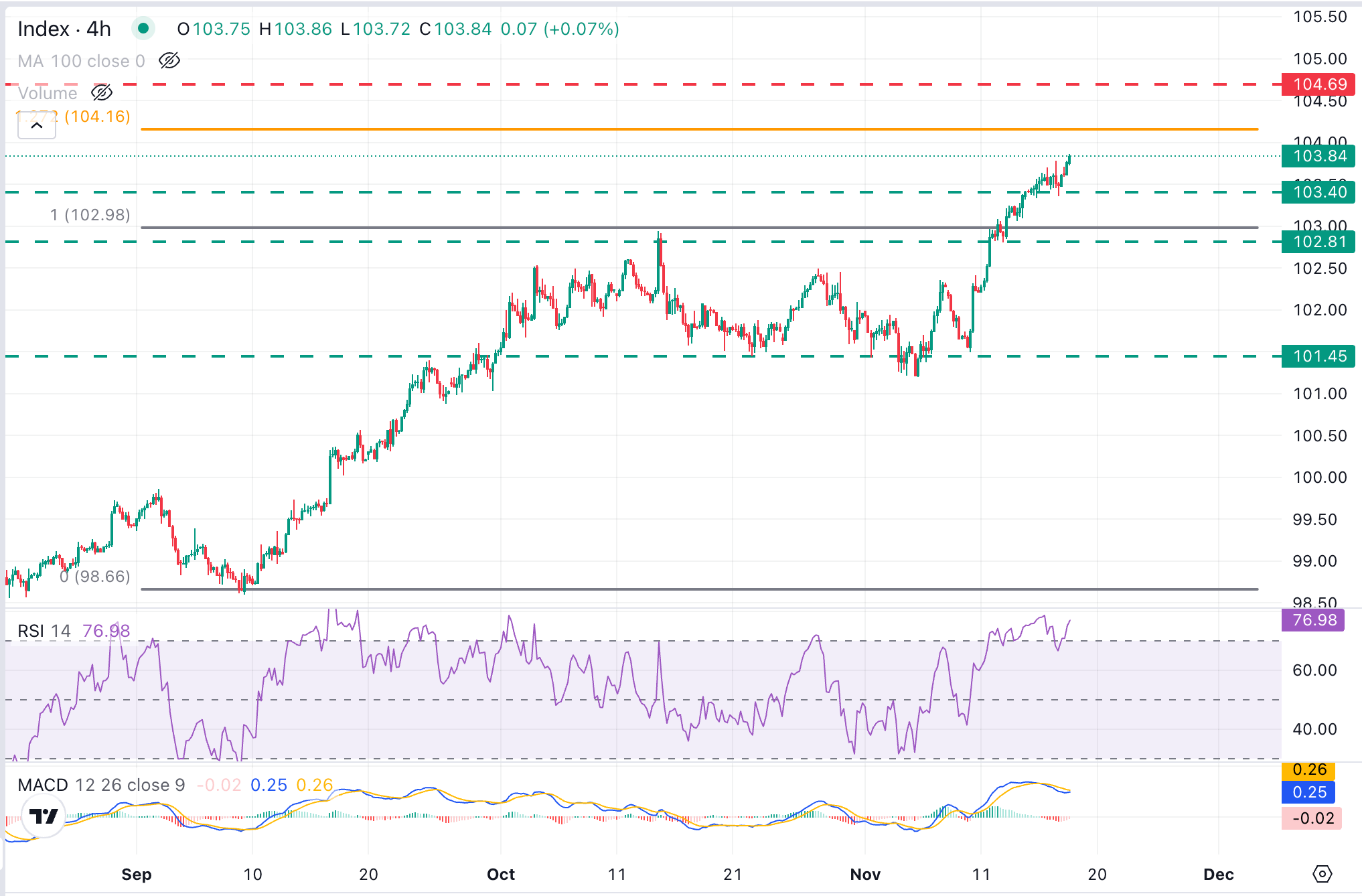
Guillermo Alcalá, FX analyst at FXstreet, warns that “the technical picture shows an overextended rally that is crying for a bearish correction”. The Relative Strength Index (RSI) on the 4-hour chart has reached heavily overbought ground at levels above 75, which should act as a warning for bulls, despite the supportive fundamental scenario.
Bulls are likely to find resistance in the area between the 104.00 psychological level and the 127.2% Fibonacci extension of the September-October rally, just below 104.20. Further up, the next target would be the late March 2025 high in the 104.70 area.
That said, Alcalá sees chances of a consolidation at current levels or some retracement. Immediate support is at Tuesday’s low of 103.36, although the key support is at the area between the October 14 high, at 102.94, and the November 12 low at 102.80.
Interest rates FAQs
Interest rates are charged by financial institutions on loans to borrowers and are paid as interest to savers and depositors. They are influenced by base lending rates, which are set by central banks in response to changes in the economy. Central banks normally have a mandate to ensure price stability, which in most cases means targeting a core inflation rate of around 2%. If inflation falls below target the central bank may cut base lending rates, with a view to stimulating lending and boosting the economy. If inflation rises substantially above 2% it normally results in the central bank raising base lending rates in an attempt to lower inflation.
Higher interest rates generally help strengthen a country’s currency as they make it a more attractive place for global investors to park their money.
Higher interest rates overall weigh on the price of Gold because they increase the opportunity cost of holding Gold instead of investing in an interest-bearing asset or placing cash in the bank. If interest rates are high that usually pushes up the price of the US Dollar (USD), and since Gold is priced in Dollars, this has the effect of lowering the price of Gold.
The Fed funds rate is the overnight rate at which US banks lend to each other. It is the oft-quoted headline rate set by the Federal Reserve at its FOMC meetings. It is set as a range, for example 4.75%-5.00%, though the upper limit (in that case 5.00%) is the quoted figure. Market expectations for future Fed funds rate are tracked by the CME FedWatch tool, which shapes how many financial markets behave in anticipation of future Federal Reserve monetary policy decisions.
Economic Indicator
FOMC Minutes
FOMC stands for The Federal Open Market Committee that organizes 8 meetings in a year and reviews economic and financial conditions, determines the appropriate stance of monetary policy and assesses the risks to its long-run goals of price stability and sustainable economic growth. FOMC Minutes are released by the Board of Governors of the Federal Reserve and are a clear guide to the future US interest rate policy.
Next release: Wed Nov 18, 2026 19:00
Frequency: Irregular
Consensus: -
Previous: -
Source: Federal Reserve
Minutes of the Federal Open Market Committee (FOMC) is usually published three weeks after the day of the policy decision. Investors look for clues regarding the policy outlook in this publication alongside the vote split. A bullish tone is likely to provide a boost to the greenback while a dovish stance is seen as USD-negative. It needs to be noted that the market reaction to FOMC Minutes could be delayed as news outlets don’t have access to the publication before the release, unlike the FOMC’s Policy Statement.
Author
FXStreet Team
FXStreet
Composed of a group of economic journalists and FX experts, the FXStreet content team produces and oversees all content published on FXStreet. It provides a purely journalistic approach to the Forex market.