Australian Dollar extends decline against US Dollar amid surging US bond yields
- Australian Dollar falls further as rising US bond yields diminish the appeal of riskier currencies.
- TD Securities expect the Fed to hike interest rates in December, January and March policy meetings.
- The RBA seems done with its monetary tightening cycle.

The Australian Dollar (AUD) extends its losing spree against the US Dollar (USD) on Friday, trading 0.15% lower at around 0.6795 in the European trade. The Aussie pair underperforms as surging United States (US) Treasury Yields have diminished the appeal of riskier assets, such as the Australian Dollar.
As of writing, 10-year US Treasury Yields hold onto three-week high near $5.13%. Yields on 10-year US bonds have jumped almost 5.5% in the past two trading days.
What has lent strength to US bond yields?
Strategists at Deutsche Bank highlight that the latest US inflation release was the key driver of surging US Treasury Yields, noting that “the monthly core CPI print for October was above consensus at +0.30% (vs. +0.2% expected).” They stress that “it was the third consecutive month with core CPI at +0.3%, and if you take those three months together, the annualised pace for core CPI is running at +3.75%.” Deutsche Bank adds that “that’s the fastest pace on that measure since April 2024, so it made it increasingly difficult to dismiss this as a blip.”
Risks of persistent elevated US inflation have forced market experts to reassess their Federal Reserve’s (Fed) interest rate hike expectations.
According to strategists at TD Securities, the firm has shifted to a more hawkish stance on the near-term policy path, now expecting "25bp hikes in December, January, and March," rather than its earlier call for just December and March.
Meanwhile, the Australian Dollar underperforms as financial markets expect that Reserve Bank of Australia’s (RBA) interest rate cycle has come to an end.
AUD support fades as RBA tightening runs into limits
Analysts at MUFG note that the earlier “pre-emptive nature of monetary tightening in Australia has benefitted the Australian Dollar,” but they now judge that “time appears to have run out for providing support for the currency” as investors conclude the RBA is “running out of scope for additional rate hikes at a time when investors are reappraising their views on additional Fed rate hikes.” They highlight that the RBA has already “hiked on five occasions this year and the policy rate at 4.85% is the highest since 2008 when the RBA was cutting rates into the Global Financial Crisis,” underscoring how front-loaded the current cycle has been. That pre-emptive stance means “the OIS curve through to Q4 2027 shows mostly a flat curve but a probability of a rate cut (-15bps priced) in Q3-Q4 next year,” reinforcing the view that the domestic rate impulse supporting the Aussie is now largely exhausted just as US rate expectations are being repriced higher.
Going forward, investors will focus on the RBA meeting minutes of the October policy meeting, which will be released on Tuesday.
AUD/USD Technical Analysis
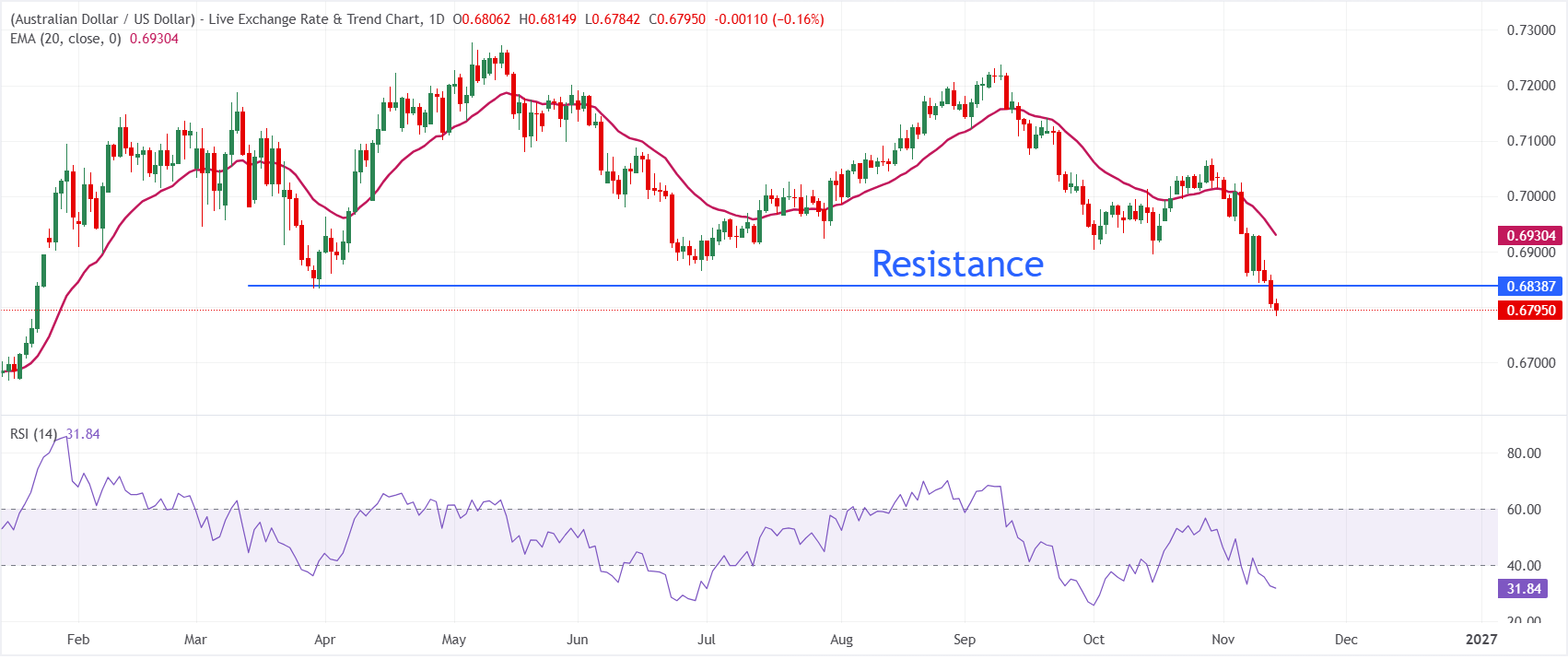
In the daily chart, AUD/USD trades at 0.6795, extending its slide below the 20-day exponential moving average (EMA) at 0.6930, which now acts as immediate overhead resistance and reinforces a bearish near-term bias. The pair’s failure to reclaim this EMA suggests rallies are likely to be sold, while the Relative Strength Index (14) at 31.8 hovers just above oversold territory, hinting at persistent downside pressure with only a modest risk of a corrective bounce.
On the topside, initial resistance is located at the 20-day EMA around 0.6930, and a daily close above this barrier would be needed to ease the current bearish tone and open the way for a more sustained recovery. On the downside, with no clear technical support levels derived from the current dataset, traders may look to prior price lows and psychological marks below 0.6800 as potential demand zones, although the prevailing structure suggests that any such supports remain vulnerable while price holds beneath the EMA.
(The technical analysis of this story was written with the help of an AI tool. Know more.)
Economic Indicator
RBA Meeting Minutes
The minutes of the Reserve Bank of Australia meetings are published two weeks after the interest rate decision. The minutes give a full account of the policy discussion, including differences of view. They also record the votes of the individual members of the Committee. Generally speaking, if the RBA is hawkish about the inflationary outlook for the economy, then the markets see a higher possibility of a rate increase, and that is positive for the AUD.
Read more.Next release: Tue Nov 17, 2026 00:30
Frequency: Weekly
Consensus: -
Previous: -
Source: Reserve Bank of Australia
The Reserve Bank of Australia (RBA) publishes the minutes of its monetary policy meeting two weeks after the interest rate decision is announced. It provides a detailed record of the discussions held between the RBA’s board members on monetary policy and economic conditions that influenced their decision on adjusting interest rates and/or bond buys, significantly impacting the AUD. The minutes also reveal considerations on international economic developments and the exchange rate value.
Author

Sagar Dua
FXStreet
Sagar Dua is associated with the financial markets from his college days. Along with pursuing post-graduation in Commerce in 2014, he started his markets training with chart analysis.