AUD/USD sees slight uptick amid geopolitical tensions, mixed US data
- AUD/USD's modest increase driven by market reactions to US-UK military actions in Yemen and mixed US inflation reports.
- Market overlooks China’s deflationary data, focusing instead on interest rate differentials and economic implications for Australia.
- Resilient Aussie inflation data suggests potential stability in RBA's monetary policy, influencing AUD/USD dynamics.

The Australian Dollar (AUD) registered minuscule gains against the US Dollar (USD) on Friday, shrugging off risk aversion due to tensions arising in the Red Sea, along with softer-than-expected economic data from the United States (US). The AUD/USD trades at 0.6690, up by 0.06%
AUD/USD at crossroads affected by weak data from the US and China
During the overnight session, newswires revealed that the US and the UK attacked Houthi's positions in Yemen in retaliation to an attack on a US ship in the Red Sea. According to Reuters, White House spokesman John Kirby said #the strikes had targeted the Houthis' ability to store, launch and guide missiles or drones, and that their impact was being assessed.”
Aside from this, the latest inflation reports on the producer and consumer side in the US were mixed. Even though the former justifies market participants' expectations for the Federal Reserve’s (Fed) rate cuts in 2024, the latter portrays a picture that households witnessed a rise in prices, mainly focused on shelter and healthcare.
Nevertheless, AUD/USD traders ignored the abovementioned backdrop. They lifted the spot price towards its highest level since January 8, at 0.6728, even though Fed officials stressed that a rate cut in March is not an option.
On the Aussie’s (AUD) front, China’s deflationary data, revealed on Friday, was brushed aside by traders, which remain focused on the reduction of interest rate differentials between Australia and the US. That could hurt economic growth in Australia, as weaker activity in China implies less demand for Aussie goods and services. Meanwhile, the latest inflation report in Australia was positive for households and might prevent the Reserve Bank of Australia (RBA) from tightening monetary policy.
AUD/USD Price Analysis: Technical outlook
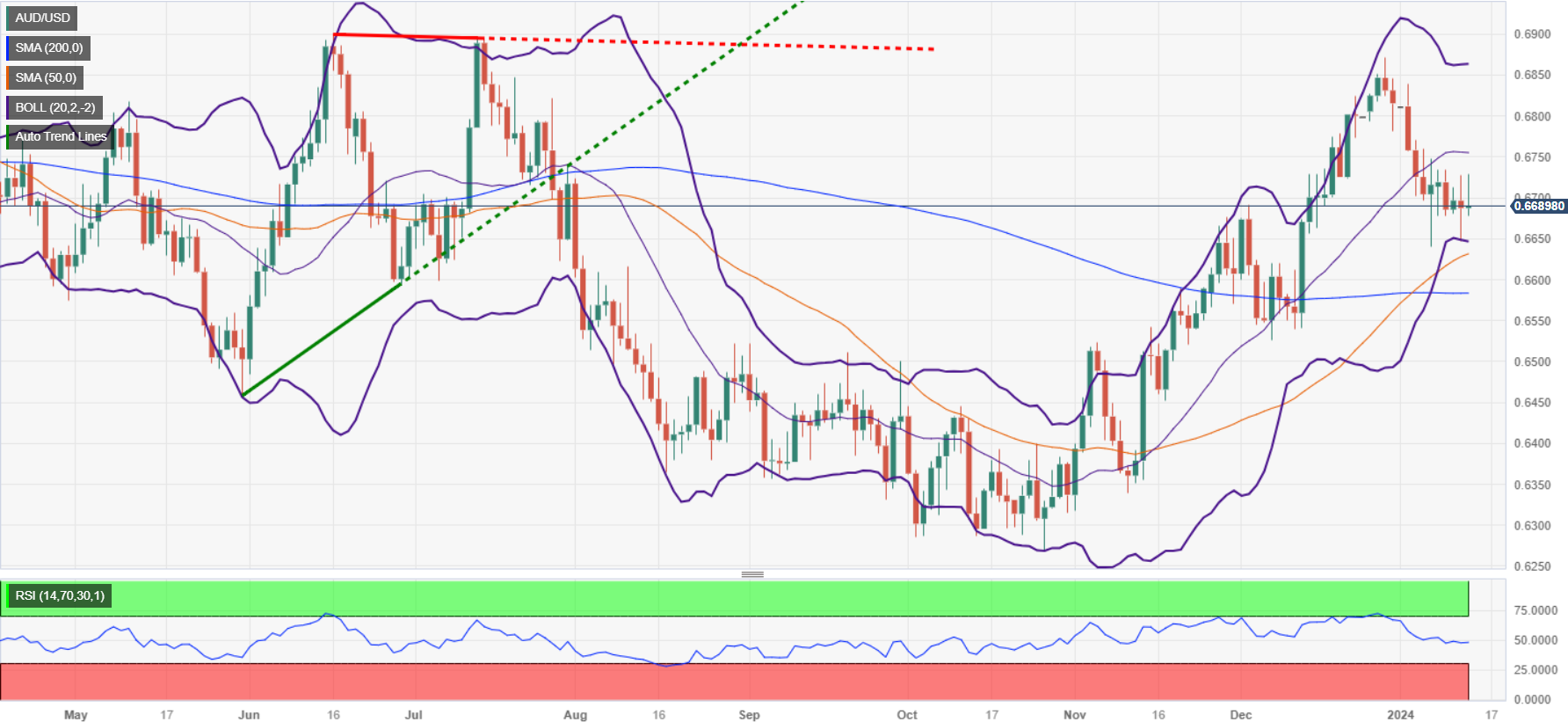
During the last six days, the AUD/USD has been trading within familiar levels, unable to decisively crack the 0.6640/0.6740 range. Despite that, the pair is upward biased after a ‘golden cross’ was formed on January 3, seen as a bullish signal. For a bullish resumption, buyers must reclaim the 0.6740 area, which would expose the 0.6800 figure. On the flip side, the first key support is seen at 0.6640, followed by the 50-day moving average (DMA) at 0.6624, ahead of the 0.6600 mark.
Australian Dollar price this week
The table below shows the percentage change of Australian Dollar (AUD) against listed major currencies this week. Australian Dollar was the strongest against the Canadian Dollar.
| USD | EUR | GBP | CAD | AUD | JPY | NZD | CHF | |
| USD | -0.16% | -0.25% | 0.30% | 0.40% | 0.08% | 0.04% | 0.21% | |
| EUR | 0.16% | -0.09% | 0.47% | 0.57% | 0.25% | 0.22% | 0.40% | |
| GBP | 0.27% | 0.09% | 0.56% | 0.67% | 0.34% | 0.31% | 0.47% | |
| CAD | -0.30% | -0.45% | -0.55% | 0.10% | -0.20% | -0.26% | -0.08% | |
| AUD | -0.40% | -0.56% | -0.65% | -0.10% | -0.31% | -0.36% | -0.19% | |
| JPY | -0.11% | -0.23% | -0.34% | 0.24% | 0.34% | -0.02% | 0.13% | |
| NZD | -0.04% | -0.19% | -0.31% | 0.26% | 0.35% | 0.04% | 0.16% | |
| CHF | -0.21% | -0.40% | -0.47% | 0.09% | 0.19% | -0.12% | -0.16% |
The heat map shows percentage changes of major currencies against each other. The base currency is picked from the left column, while the quote currency is picked from the top row. For example, if you pick the Euro from the left column and move along the horizontal line to the Japanese Yen, the percentage change displayed in the box will represent EUR (base)/JPY (quote).
Author

Christian Borjon Valencia
FXStreet
Markets analyst, news editor, and trading instructor with over 14 years of experience across FX, commodities, US equity indices, and global macro markets.