AUD/USD Price Forecast: Flattens around 0.7150 after recovering early losses
- AUD/USD turns flat at around 0.7150 after recovering from early losses.
- The US Dollar comes under pressure on hopes of a sooner US-Iran deal.
- Investors await the RBA and the FOMC monetary policy meeting minutes.
The AUD/USD pair trades flat around 0.7150 during the European trading session on Monday after recovering significant early losses. The Aussie pair bounces back as the US Dollar (USD) turns upside down on renewed hopes that the United States (US) and Iran will reach a deal soon.
As of writing, the US Dollar Index (DXY), which tracks the Greenback’s value against six major currencies, trades marginally lower to near 99.20. The USD Index fell to 99.15 from its intraday high of 99.40.
During the day, a spokesperson from the Iranian foreign ministry said, “Iran is focused on ending the war at this stage,” while confirming that negotiations through Pakistan are still going on.
US President Donald Trump also stated, in an interview with Fortune, “I can tell you one thing—they [Iran]’re dying to sign [a deal].”
Going forward, investors will focus on the Reserve Bank of Australia (RBA) and the Federal Open Market Committee (FOMC) monetary policy meeting minutes, which will be released on Tuesday and Wednesday, respectively.
AUD/USD technical analysis
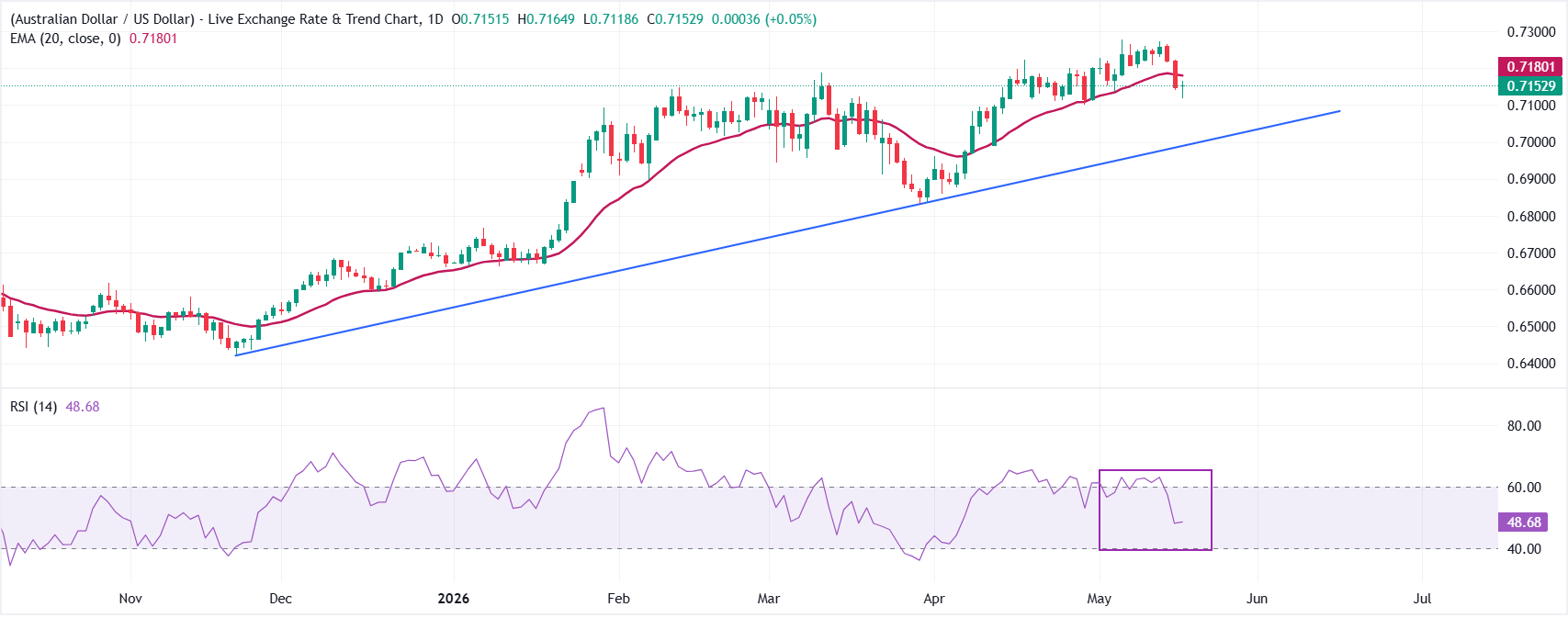
AUD/USD trades almost flat at around 0.7150 as of writing. The price holds just under the 20-day Exponential Moving Average (EMA) at 0.7180, which now acts as near-term resistance and hints at a mildly capped tone. The pair still trades well above the prior uptrend support break level around 0.6992, keeping the broader advance technically intact, while the Relative Strength Index (RSI) at 48 leans slightly lower and suggests fading bullish momentum rather than outright selling pressure.
On the topside, immediate resistance is located at the 20-day EMA near 0.7180; a daily close above this barrier would ease current pressure and reopen the path toward the recent highs. Looking down, the pair could resume its downfall towards 0.7100 if it fails to hold the intraday low at 0.7118. A downside move below 0.7118 would export the price towards the upward-sloping trendline around 0.7000.
(The technical analysis of this story was written with the help of an AI tool.)
Economic Indicator
RBA Meeting Minutes
The minutes of the Reserve Bank of Australia meetings are published two weeks after the interest rate decision. The minutes give a full account of the policy discussion, including differences of view. They also record the votes of the individual members of the Committee. Generally speaking, if the RBA is hawkish about the inflationary outlook for the economy, then the markets see a higher possibility of a rate increase, and that is positive for the AUD.
Read more.Next release: Tue May 19, 2026 01:30
Frequency: Weekly
Consensus: -
Previous: -
Source: Reserve Bank of Australia
The Reserve Bank of Australia (RBA) publishes the minutes of its monetary policy meeting two weeks after the interest rate decision is announced. It provides a detailed record of the discussions held between the RBA’s board members on monetary policy and economic conditions that influenced their decision on adjusting interest rates and/or bond buys, significantly impacting the AUD. The minutes also reveal considerations on international economic developments and the exchange rate value.
Author

Sagar Dua
FXStreet
Sagar Dua is associated with the financial markets from his college days. Along with pursuing post-graduation in Commerce in 2014, he started his markets training with chart analysis.
















