AUD/USD Price Forecast: Approaches four-year high near 0.7280
- AUD/USD rises to near 0.7230 as the Australian Dollar trades broadly firm.
- RBA’s Hauser stresses bringing inflation down.
- Investors await the US CPI data for August scheduled for Friday.

The Australian Dollar (AUD) is higher against its major currency peers, except the Japanese Yen (JPY), on Wednesday, trading 0.16% up at around 0.7230 against the US Dollar (USD) during the European session.
Australian Dollar Price Today
The table below shows the percentage change of Australian Dollar (AUD) against listed major currencies today. Australian Dollar was the strongest against the US Dollar.
| USD | EUR | GBP | JPY | CAD | AUD | NZD | CHF | |
|---|---|---|---|---|---|---|---|---|
| USD | -0.11% | -0.11% | -0.54% | -0.08% | -0.23% | -0.12% | -0.17% | |
| EUR | 0.11% | 0.01% | -0.46% | 0.02% | -0.12% | -0.00% | -0.05% | |
| GBP | 0.11% | -0.01% | -0.46% | 0.03% | -0.11% | -0.00% | -0.05% | |
| JPY | 0.54% | 0.46% | 0.46% | 0.47% | 0.32% | 0.40% | 0.39% | |
| CAD | 0.08% | -0.02% | -0.03% | -0.47% | -0.15% | -0.04% | -0.08% | |
| AUD | 0.23% | 0.12% | 0.11% | -0.32% | 0.15% | 0.11% | 0.08% | |
| NZD | 0.12% | 0.00% | 0.00% | -0.40% | 0.04% | -0.11% | -0.03% | |
| CHF | 0.17% | 0.05% | 0.05% | -0.39% | 0.08% | -0.08% | 0.03% |
The heat map shows percentage changes of major currencies against each other. The base currency is picked from the left column, while the quote currency is picked from the top row. For example, if you pick the Australian Dollar from the left column and move along the horizontal line to the US Dollar, the percentage change displayed in the box will represent AUD (base)/USD (quote).
The antipodean gains were on the back of remarks from Reserve Bank of Australia (RBA) Deputy Governor Andrew Hauser in an interview by the ABC on Tuesday, where she stressed bringing inflation down.
“People want inflation down. People are furious about inflation. I understand why,” Hauser said and added, “It’s unfair. It hits people on low incomes. It damages price signals. It makes the job of companies difficult. What they want us to do is our job and bring inflation down,” Financial Review reported.
Comments from RBA’s Hauser stressing the need to bring inflation down have increased central bank’s interest rate hike expectations.
Rabobank notes that the RBA has “just saw Hauser give a hawkish speech, which has markets thinking of hikes this month and in November.” The bank adds that this prospective tightening path is “very much what the US Treasury would like to see – plus a lot more action on non-housing parts of the economy,” underscoring how a more restrictive RBA stance is increasingly aligned with US policy preferences.
Meanwhile, the US Dollar is under pressure, with investors awaiting the United States (US) Consumer Price Index (CPI) data on Friday.
AUD/USD Technical Analysis
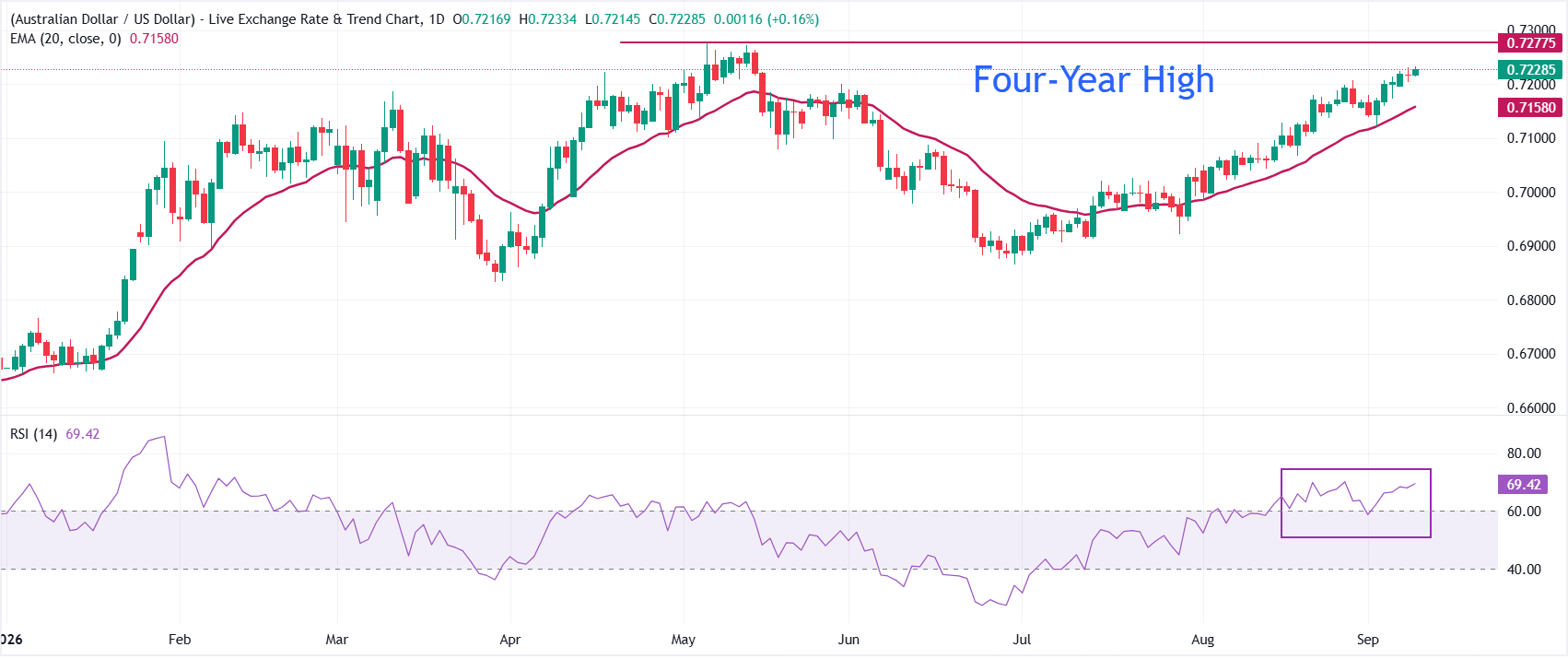
In the daily chart, AUD/USD trades at 0.7229, extending its advance above the 20-day exponential moving average (EMA) at 0.7158 and keeping a clear short-term bullish bias. The pair holds comfortably above this dynamic support, suggesting dips may be shallow for now, while the Relative Strength Index (RSI) at 69.5 hovers just below overbought territory, hinting that upside momentum is strong but increasingly stretched.
On the downside, the 20-day EMA at 0.7158 is the first notable support, and a daily close below it would hint at a deeper corrective phase. On the upside, the pair is expected to extend its advance to near the four-year high at 0.7277.
RBA FAQs
The Reserve Bank of Australia (RBA) sets interest rates and manages monetary policy for Australia. Decisions are made by a board of governors at 11 meetings a year and ad hoc emergency meetings as required. The RBA’s primary mandate is to maintain price stability, which means an inflation rate of 2-3%, but also “..to contribute to the stability of the currency, full employment, and the economic prosperity and welfare of the Australian people.” Its main tool for achieving this is by raising or lowering interest rates. Relatively high interest rates will strengthen the Australian Dollar (AUD) and vice versa. Other RBA tools include quantitative easing and tightening.
While inflation had always traditionally been thought of as a negative factor for currencies since it lowers the value of money in general, the opposite has actually been the case in modern times with the relaxation of cross-border capital controls. Moderately higher inflation now tends to lead central banks to put up their interest rates, which in turn has the effect of attracting more capital inflows from global investors seeking a lucrative place to keep their money. This increases demand for the local currency, which in the case of Australia is the Aussie Dollar.
Macroeconomic data gauges the health of an economy and can have an impact on the value of its currency. Investors prefer to invest their capital in economies that are safe and growing rather than precarious and shrinking. Greater capital inflows increase the aggregate demand and value of the domestic currency. Classic indicators, such as GDP, Manufacturing and Services PMIs, employment, and consumer sentiment surveys can influence AUD. A strong economy may encourage the Reserve Bank of Australia to put up interest rates, also supporting AUD.
Quantitative Easing (QE) is a tool used in extreme situations when lowering interest rates is not enough to restore the flow of credit in the economy. QE is the process by which the Reserve Bank of Australia (RBA) prints Australian Dollars (AUD) for the purpose of buying assets – usually government or corporate bonds – from financial institutions, thereby providing them with much-needed liquidity. QE usually results in a weaker AUD.
Quantitative tightening (QT) is the reverse of QE. It is undertaken after QE when an economic recovery is underway and inflation starts rising. Whilst in QE the Reserve Bank of Australia (RBA) purchases government and corporate bonds from financial institutions to provide them with liquidity, in QT the RBA stops buying more assets, and stops reinvesting the principal maturing on the bonds it already holds. It would be positive (or bullish) for the Australian Dollar.
Author

Sagar Dua
FXStreet
Sagar Dua is associated with the financial markets from his college days. Along with pursuing post-graduation in Commerce in 2014, he started his markets training with chart analysis.

















