AUD/USD kicks off key week with another bullish foot forward
- AUD/USD rose on Monday, climbing another 0.2% and chalking in a fifth straight bullish session.
- The Aussie is getting bolstered by a broad-market weakening in the US Dollar.
- Markets bet big that Friday’s US NFP report will support a Fed rate cut.

AUD/USD rose on Monday, testing around one-fifth of one percent higher to kick off the new trading week. The Australian Dollar (AUD) is riding a broad-market weakening in the US Dollar (USD) as investors pivot into bets that the Federal Reserve (Fed) will be pushed into delivering an interest rate cut by this week’s upcoming US Nonfarm Payrolls (NFP) jobs report.
A heavy data week will take an extra day to spin up into full-fledged wait-and-see mode: US markets are dark on Monday for the Labor Day holiday, crimping intraday flows. Barring any unexpected political headlines, markets are tilting into more of the same and extending last week’s momentum.
Australian GDP and US PMI figures to get swamped out by US NFP jobs numbers
Australian Gross Domestic Product (GDP) growth figures for the second quarter are due on Wednesday, and although Australian economic growth is expected to accelerate to 0.5% QoQ, the overall net effect is likely to remain muted. The Reserve Bank of Australia (RBA) has struck a notably cautious note as of late, and RBA rate cut expectations declined slightly after advance Australian inflation data pointed to an uptick in price pressures.
US data will dominate market sentiment this week. Things will kick off with US ISM Manufacturing Purchasing Managers Index (PMI) survey results on Tuesday, expected to rise to 49.0 from 48.0, with the ISM Services PMI component slated for a Thursday release and forecast to rise to 51.0 from 50.1. A grab bag of Fed officials will deliver speeches on Wednesday, but the latest JOLTS job openings figures, due on the same day, will likely overshadow Fed policymakers towing the data-dependent line.
This Friday’s US NFP net jobs report could be a hard-hitting affair for market participants; the Fed’s ongoing two-way focus on both inflation and employment figures has the US central bank poised for further rate cuts after net job gains through the midpoint of the year took a hard tumble, getting revised down sharply. With further downside revisions on the cards, investors will be hoping for continued NFP weakness to help push the Fed toward an interest rate cut on September 17.
AUD/USD price forecast
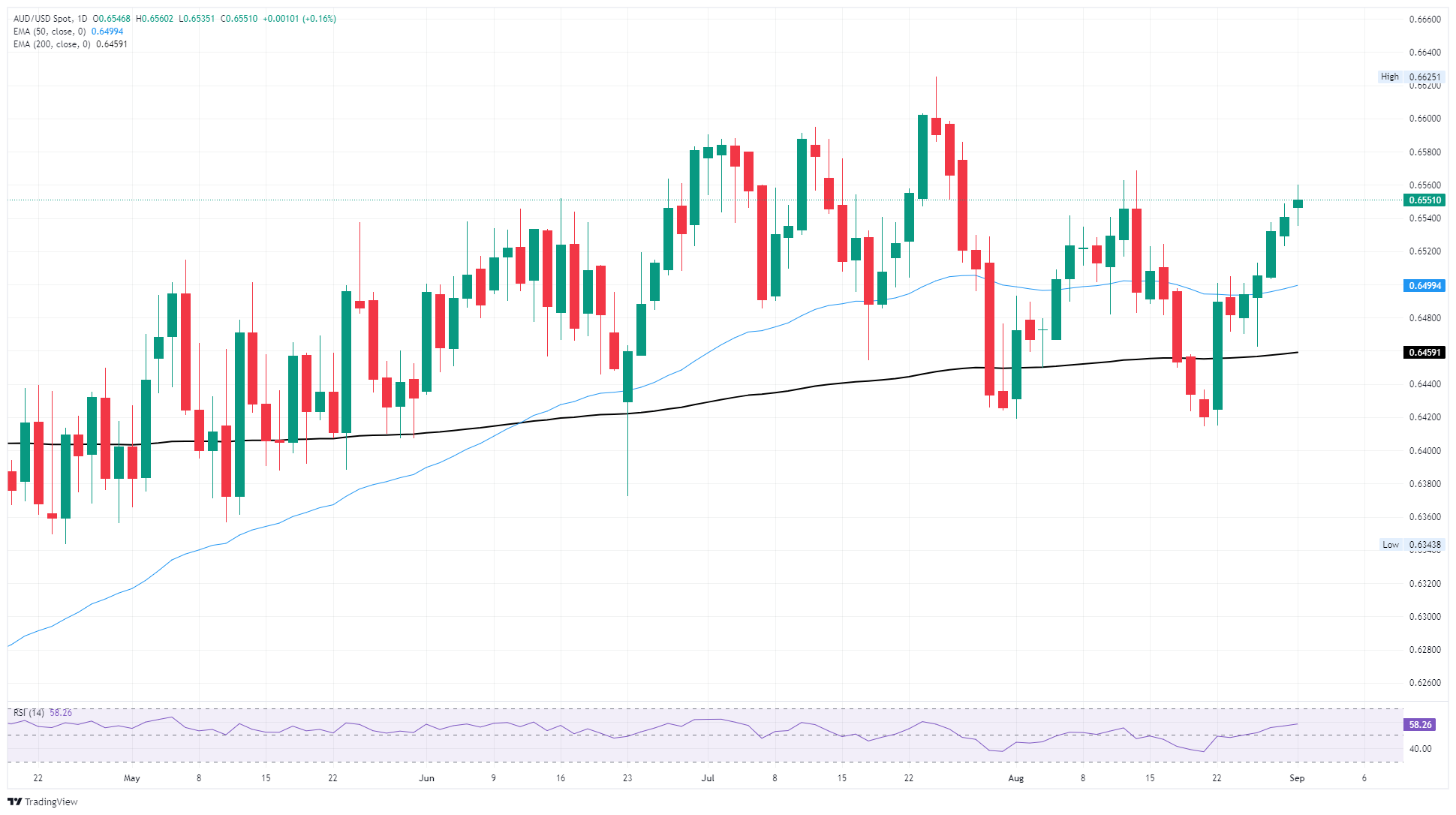
A fifth straight bullish session has put AUD/USD on a collision course with the top end of the pair’s long-running consolidation zone. The 0.6550 region has become familiar ground for the Aussie, and the 200-day Exponential Moving Average (EMA) near 0.6460 is poised to hold steady as a firm technical floor.
The Aussie is up a little over 2.1% against the Greenback bottom-to-top from August’s swing low point near 0.6415. However, AUD/USD bulls are at risk of running out of gas after pushing prices higher for all but one of the last seven straight daily sessions
AUD/USD daily chart
Australian Dollar FAQs
One of the most significant factors for the Australian Dollar (AUD) is the level of interest rates set by the Reserve Bank of Australia (RBA). Because Australia is a resource-rich country another key driver is the price of its biggest export, Iron Ore. The health of the Chinese economy, its largest trading partner, is a factor, as well as inflation in Australia, its growth rate and Trade Balance. Market sentiment – whether investors are taking on more risky assets (risk-on) or seeking safe-havens (risk-off) – is also a factor, with risk-on positive for AUD.
The Reserve Bank of Australia (RBA) influences the Australian Dollar (AUD) by setting the level of interest rates that Australian banks can lend to each other. This influences the level of interest rates in the economy as a whole. The main goal of the RBA is to maintain a stable inflation rate of 2-3% by adjusting interest rates up or down. Relatively high interest rates compared to other major central banks support the AUD, and the opposite for relatively low. The RBA can also use quantitative easing and tightening to influence credit conditions, with the former AUD-negative and the latter AUD-positive.
China is Australia’s largest trading partner so the health of the Chinese economy is a major influence on the value of the Australian Dollar (AUD). When the Chinese economy is doing well it purchases more raw materials, goods and services from Australia, lifting demand for the AUD, and pushing up its value. The opposite is the case when the Chinese economy is not growing as fast as expected. Positive or negative surprises in Chinese growth data, therefore, often have a direct impact on the Australian Dollar and its pairs.
Iron Ore is Australia’s largest export, accounting for $118 billion a year according to data from 2021, with China as its primary destination. The price of Iron Ore, therefore, can be a driver of the Australian Dollar. Generally, if the price of Iron Ore rises, AUD also goes up, as aggregate demand for the currency increases. The opposite is the case if the price of Iron Ore falls. Higher Iron Ore prices also tend to result in a greater likelihood of a positive Trade Balance for Australia, which is also positive of the AUD.
The Trade Balance, which is the difference between what a country earns from its exports versus what it pays for its imports, is another factor that can influence the value of the Australian Dollar. If Australia produces highly sought after exports, then its currency will gain in value purely from the surplus demand created from foreign buyers seeking to purchase its exports versus what it spends to purchase imports. Therefore, a positive net Trade Balance strengthens the AUD, with the opposite effect if the Trade Balance is negative.
Author

Joshua Gibson
FXStreet
Joshua joins the FXStreet team as an Economics and Finance double major from Vancouver Island University with twelve years' experience as an independent trader focusing on technical analysis.