AUD/USD finds intermediate cushion near 0.6660, US PMI and RBA policy highs limelight
- AUD/USD has built an intermediate cushion near 0.6660, further downside looks likely.
- Federal Reserve is expected to remain hawkish as higher oil prices have propelled US inflation expectations.
- Reserve Bank of Australia is expected to hike rates further to 3.80% as inflation is extremely skewed from desired levels.
- AUD/USD has delivered a breakdown of the Head and Shoulder chart pattern whose neckline was placed from 0.6660.

AUD/USD has gauged an intermediate cushion around 0.6660 after a downside move in the Asian session. The Aussie asset has attempted a decent recovery but is likely to remain on the tenterhooks as investors are awaiting the release of United States ISM Manufacturing PMI data for fresh impetus. The Australian Dollar would face enormous volatility as investors are preparing for the interest rate decision by the Reserve Bank of Australia (RBA), which will be announced on Tuesday.
S&P500 futures are auctioning in a negative trajectory in the early European session amid higher oil prices propelled by fears of further oil production cuts by OPEC+, portraying a risk-aversion theme. The burden of higher oil prices will be transferred to producers, which will force them to hike the prices of offerings at factory gates. Eventually, households would be the major victim, which might result in weaker retail demand.
The demand for US government bonds has tumbled amid fresh fears of a rebound in global inflation inspired by higher oil prices. The 10-year US Treasury yields have scaled to near 3.52%.
US Dollar scales higher as Federal Reserve to remain hawkish ahead
A bumper upside move has been recorded in the US Dollar as heightened oil prices are likely to share serious consequences ahead. Various economies were struggling to get on track after a year of stubborn inflation. And now higher oil prices are expected to weaken the efforts yet made to tame sticky inflation. This has supported the US Dollar as the Federal Reserve (Fed) would look for continuing its policy-tightening program to neutralize oil-inspired inflationary pressures. As per the CME Fedwatch tool, the odds for a 25bp rate hike to 5.00-5.25% for May monetary policy meeting have soared above 61%.
Going forward, the US ISM Manufacturing PMI data will keep investors busy. According to the consensus, the Manufacturing PMI is expected to decline marginally to 47.5 from the former release of 47.7. Investors should be aware that the US Manufacturing PMI has remained below 50.0 consecutively in the past four months.
From the US Manufacturing PMI gamut, New Orders Index would hog the limelight as it provides cues about the manufacturing outlook. The forward demand for the manufacturing sector is expected to contract significantly to 44.6 vs. the prior release of 47.00.
One more 25 bps rate hike looks likely from Reserve Bank of Australia
The Australian Dollar remained volatile in the Asian session after the IHS Markit reported weak Caixin Manufacturing PMI data. The economic data has landed at 50.0, lower than the consensus of 51.7 and the former release of 51.5. Being the leading trading partner of China, the Australian Dollar was impacted by a decline in the scale of manufacturing activities in the Chinese economy.
For now, the spotlight has shifted to the interest rate decision by the Reserve Bank of Australia, which will be announced on Tuesday. Reserve Bank of Australia Governor Philip Lowe is expected to hike rates further by 25 basis points (bps) to 3.80%. Australian monthly inflation indicator has softened to 6.8% in February from its peak of 8.4% recorded in December. The presence of evidence conveying a sharp drop in Australian inflation won’t be sufficient to force RBA policymakers to go steady on interest rates.
AUD/USD technical outlook
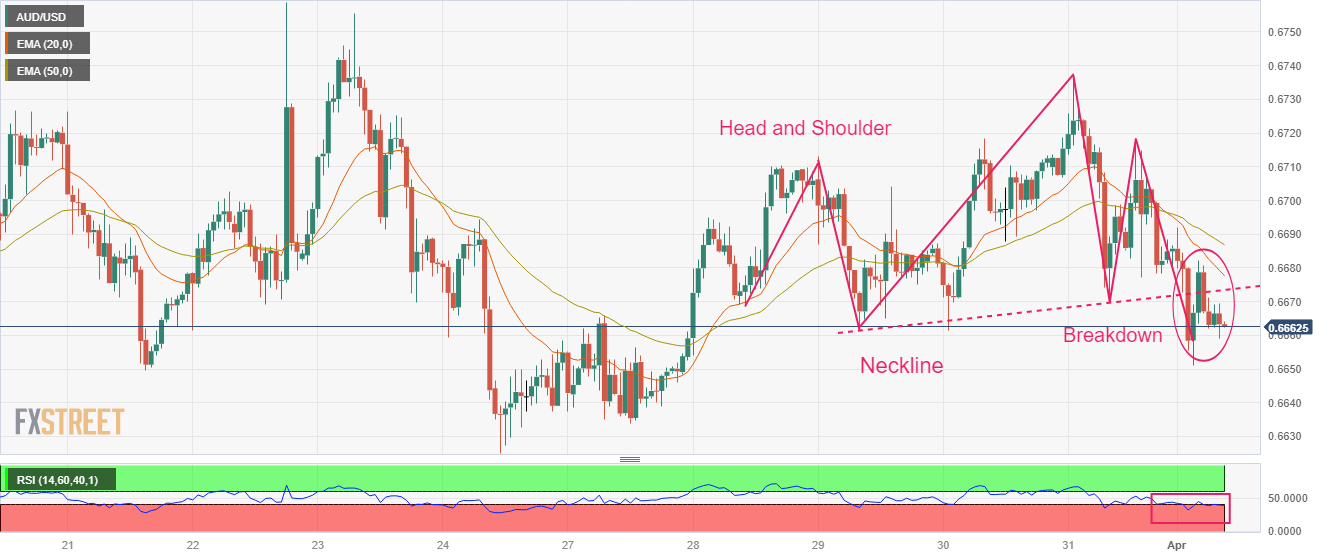
AUD/USD has delivered a breakdown of the Head and Shoulder chart pattern, which indicates an explosion of the prolonged consolidation and results in a bearish reversal, formed on an hourly scale. The neckline of the chart pattern is plotted from March 29 low at 0.6661 has been smashed.
A bear cross, represented by the 20-and 50-period Exponential Moving Average (EMA) at 0.6696 indicated more weakness ahead.
The Relative Strength Index (RSI) (14) has dropped into the bearish range of 20.00-40.00, showing no signs of divergence and no evidence of an oversold situation.
Author

Sagar Dua
FXStreet
Sagar Dua is associated with the financial markets from his college days. Along with pursuing post-graduation in Commerce in 2014, he started his markets training with chart analysis.