|

AUD/JPY Price Analysis: Climbs towards weekly highs, shy of testing 96.00

  • AUD/JPY trades with slight gains at 95.65, lingering below the weekly high of 95.73.
  • Bullish technical indicators hint at upward potential, including a favorable Ichimoku Cloud setup.
  • Key resistance and support levels were identified at 96.00 and 95.12, respectively, framing the short-term outlook.

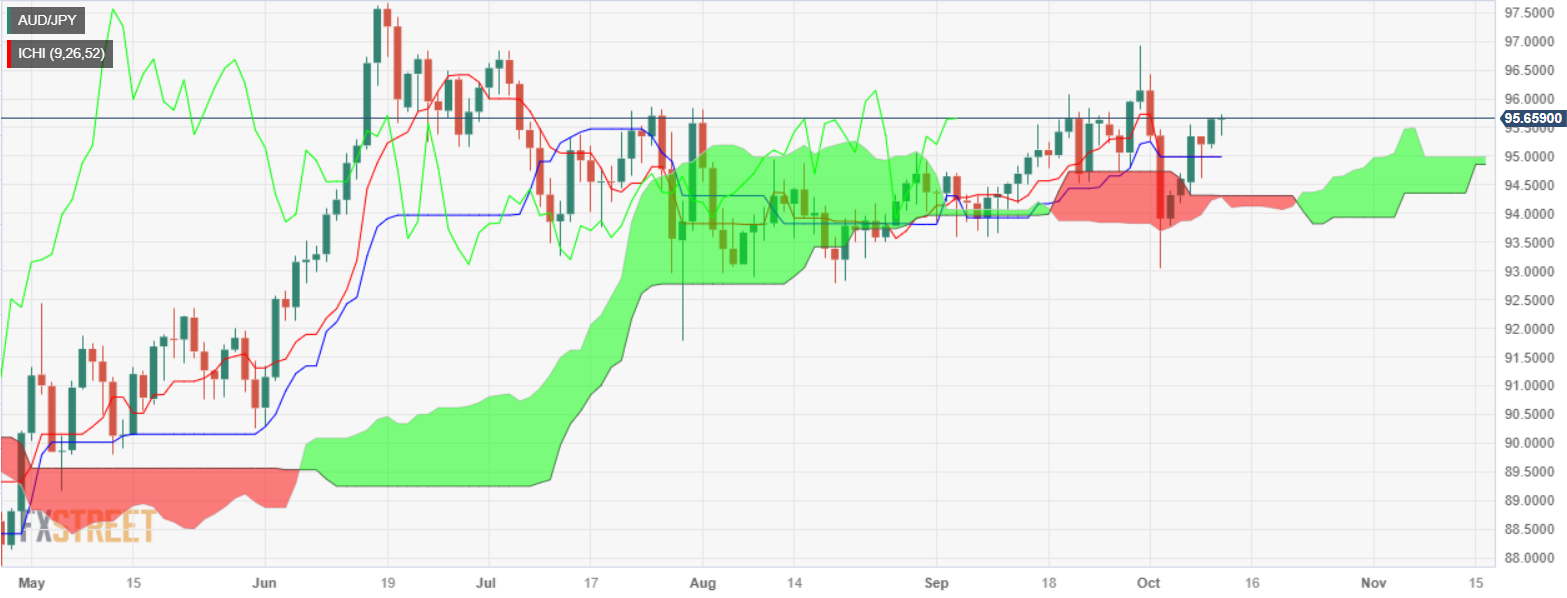
AUD/JPY marches high late in the New York session but remains trading below the daily/weekly high reached earlier during the North American session at around 95.73, though it remains trading with minuscule gains of 0.02%, at around 95.65.

Price action depicts the cross-currency pair remaining sideways, though slightly tilted to the upside. The AUD/JPY sits above the Ichimoku Cloud (Kumo), a bullish signal, with the Tenkan and Kijun-Sen located in an orderly bullish way, while Chikou Span turned bullish three days ago. Hence, in the near-term, the pair is upward biased.

The AUD/JPY first resistance would be the 96.00 figure, followed by the September 29 swing high at 96.92, before testing the 97.00 mark. On the flip side, the cross-pair first support would be the October 10 daily low of 95.12, followed by the 95.00 mark. Once those two levels are cleared, the AUD/JPY could slide towards testing the October 3 low of 93.01.

AUD/JPY Price Action – Daily chart
AUD/JPY Key Technical Levels

AUD/JPY

Overview
Today last price95.64
Today Daily Change0.00
Today Daily Change %0.00
Today daily open95.64
 
Trends
Daily SMA2095.18
Daily SMA5094.47
Daily SMA10094.51
Daily SMA20092.45
 
Levels
Previous Daily High95.66
Previous Daily Low95.13
Previous Weekly High96.42
Previous Weekly Low93.05
Previous Monthly High96.92
Previous Monthly Low93.59
Daily Fibonacci 38.2%95.46
Daily Fibonacci 61.8%95.33
Daily Pivot Point S195.3
Daily Pivot Point S294.95
Daily Pivot Point S394.77
Daily Pivot Point R195.83
Daily Pivot Point R296.01
Daily Pivot Point R396.35

Author

Christian Borjon Valencia

Markets analyst, news editor, and trading instructor with over 14 years of experience across FX, commodities, US equity indices, and global macro markets.


More from Christian Borjon Valencia
Share:

Editor's Picks

AUD/USD struggles below 0.7100, lowest since August 4 amid bullish USD

AUD/USD remains depressed below 0.7100 at the start of a new week, trading near its lowest level since August 4 amid a bullish US Dollar. US bond yields hold near multi-year highs amid inflation risks from higher oil prices and rising bets on a Fed rate hike in October. This, along with the US-Iran standoff, continues to underpin the safe-haven buck and weigh on the currency pair as traders now look to the RBA policy meeting on Tuesday.

USD/JPY climbs back to 157.75 after BoJ minutes amid firm USD

USD/JPY attracts some dip-buyers at the start of a new week, reversing part of Friday's slide driven by speculation that authorities will step in again to prop up the Japanese Yen. However, the BoJ's relative dovish-leaning tone caps the JPY. Meanwhile, the US Dollar regains traction as the US-Iran standoff supports crude oil prices, fueling inflation fears and reaffirming bets for an October Fed rate hike. This further support the pair.

Gold slides to $4,200 on Fed hike bets and Iran risks

Gold falls hard at the start of a new week, sliding back closer to $4,200 and the lower boundary of the monthly range. Firming October Fed rate-hike bets, along with oil-driven inflation risks, keep US bond yields elevated near multi-year highs, helping the US Dollar regain positive traction amid persistent Iran risks. These factors weigh heavily on the bullion.

Week ahead: Rate hike bets face a crucial data week
Despite the solid drop from the mid-September high, oil prices remained in the driver’s seat for another week, setting the tone in financial markets. Six months have passed since the late-February start of the US-Iran conflict, and there is still no breakthrough in the stalled talks, despite pressure from regional leaders and the rest of the world.
After the Trump Xi summit, markets are trading three clocks
The summit delivered time, not a deal. Trade, oil and chips now each run to a date, and the macro backdrop matters more than the pageantry. Markets wanted a deal and got a calendar date instead. Xi Jinping left Washington on Friday after tea at the White House and a tour of the National Archives.
Fed vs BoJ: Both hiked. The market only believes one of them – and the chart shows which

The Fed and the BoJ have just done something remarkably similar. Both central banks raised interest rates by 25 bps last week, both are confronting inflation risks, and both signal that future decisions will depend on incoming economic data.