AMD’s rally puts a price on Nvidia’s uncertainty
AMD’s improving earnings outlook helps explain its strength. However, sustaining the rally will require that growth to produce more cash for shareholders.
Summary
- Nvidia’s leadership transition has increased uncertainty about its ability to sustain an exceptionally profitable business.
- AMD is benefiting from stronger earnings forecasts and its growing importance as an alternative supplier.
- Nevertheless, expanding production and supporting customers require financial commitments. The next question is whether rising sales translate into stronger cash generation.
Market overview
Nvidia’s leadership crisis has created an opening for AMD. Yet the companies’ diverging share prices reflect more than investors moving from one chipmaker to another.
For Nvidia, investors must reassess how confidently they can project future profits after the departure of its founder. For AMD, they are raising earnings expectations as its data-center business expands. Consequently, one company faces greater uncertainty around an established profit stream, while the other faces growing expectations about what it can deliver.
The central argument is that AMD’s rally has a credible earnings foundation, but its durability depends on converting that growth into sustainable profits and cash flow per share.
Why Nvidia’s leadership change matters
Jensen Huang resigned on November 12, and Chief Financial Officer Colette Kress became interim chief executive. Although Nvidia expects operations and its product roadmap to continue without interruption, investors must now assess how effectively the new leadership can coordinate a demanding expansion.
That coordination matters because Nvidia sells an interconnected computing platform. Its AI accelerators work alongside networking equipment and its CUDA software ecosystem. Therefore, maintaining its advantage requires reliable execution across hardware, software and customer deployments.
The company enters this transition from a position of considerable financial strength. Revenue in the quarter ended July 26 rose 106% to $96.2 billion, while gross margin reached 75%. That margin measures revenue remaining after direct sales costs, before research, administration and other expenses.
These results help explain why the leadership transition is so consequential: investors are reassessing the reliability of a highly profitable business.
Why AMD’s opportunity extends beyond AI chips
AMD competes through several businesses. EPYC processors handle server computing, Instinct accelerators support AI workloads, and Ryzen processors and Radeon graphics serve the PC market. Meanwhile, its Helios systems and ROCm software strengthen its ability to offer broader AI infrastructure solutions.
Importantly, these products can complement Nvidia’s technology. Dell’s PowerEdge XE9685L, for example, combines AMD EPYC processors with Nvidia B200 GPUs.
As a result, AMD can grow within deployments that also generate Nvidia revenue. Its rising data-center sales therefore need to be examined by product before drawing conclusions about competitive market-share gains.
The growth figures reveal increasing concentration
AMD’s September-quarter results show substantial progress. Data Center revenue increased to $8.546 billion from $4.341 billion a year earlier, while its segment operating margin expanded to approximately 33.7% from 24.7%.
Because segment profit grew faster than revenue, the business demonstrated improving operating leverage.
However, another calculation reveals how concentrated that growth has become. Data Center added $4.205 billion in revenue, exceeding the group’s total increase of $4.131 billion. It therefore generated approximately 102% of incremental revenue, while the remaining businesses collectively contracted by $74 million.
This means AMD’s broad product portfolio currently provides less diversification of growth than it might initially suggest. Its expansion increasingly depends on the infrastructure spending cycle that also supports Nvidia.
Rising earnings forecasts support the rally
AMD’s share-price strength also reflects improving profit expectations.
Consensus data retrieved from Yahoo Finance put 2027 adjusted earnings at $17.69 per share, approximately 12% above the estimate a month earlier. At the chart reference price of $585.30, that represents roughly 33 times forecast annual earnings.
The forecast implies approximately 119% earnings growth from the current 2026 consensus. Consequently, investors have a reason to reassess AMD’s value beyond the opportunity created by Nvidia’s difficulties.
Nevertheless, those expectations establish a demanding benchmark. Even strong results can disappoint if investors have already anticipated something better.
AMD’s fourth-quarter guidance illustrates this tension. Revenue is expected to rise approximately 27% sequentially to $17 billion, while adjusted gross margin is projected at 55%, compared with 56% in the third quarter. Sales are accelerating, but investors must also monitor the profitability of that expansion.
Cash flow shows what expansion requires
This is where the financial analysis becomes more revealing.
AMD’s third-quarter free cash flow fell approximately 64% to $554 million from $1.53 billion a year earlier. Receivables and inventory absorbed cash, while capital expenditure increased.
A growing company can experience this pattern because it pays for production and builds inventory before collecting all the cash from customers. Therefore, higher accounting profits do not necessarily produce stronger cash flow immediately.
The longer period provides useful balance: nine-month free cash flow increased approximately 36% to $4.678 billion. The quarterly decline warrants monitoring, but it does not establish lasting deterioration.
AMD is also making commitments to support the infrastructure behind customer demand. Its filing disclosed $6.175 billion of cloud-compute capacity commitments and $8.5 billion in maximum potential payments under guarantees supporting commercial partners.
These arrangements carry different obligations. Capacity commitments can decrease as third parties pay, whereas guarantees require partner default. No commercial partner was in default at September 26.
Nevertheless, they connect AMD’s growth to customers’ financial health. Becoming a more important supplier can require accepting additional financial exposure, which makes cash collection and infrastructure utilization increasingly relevant to shareholders.
Nvidia faces similar execution demands. Its latest filing disclosed $279 billion in supply and capacity commitments, up from $119 billion the previous quarter. These span future periods and include agreements that may be adjusted.
Both companies therefore need ambitious investment plans to become funded, operational computing capacity.
Technical analysis
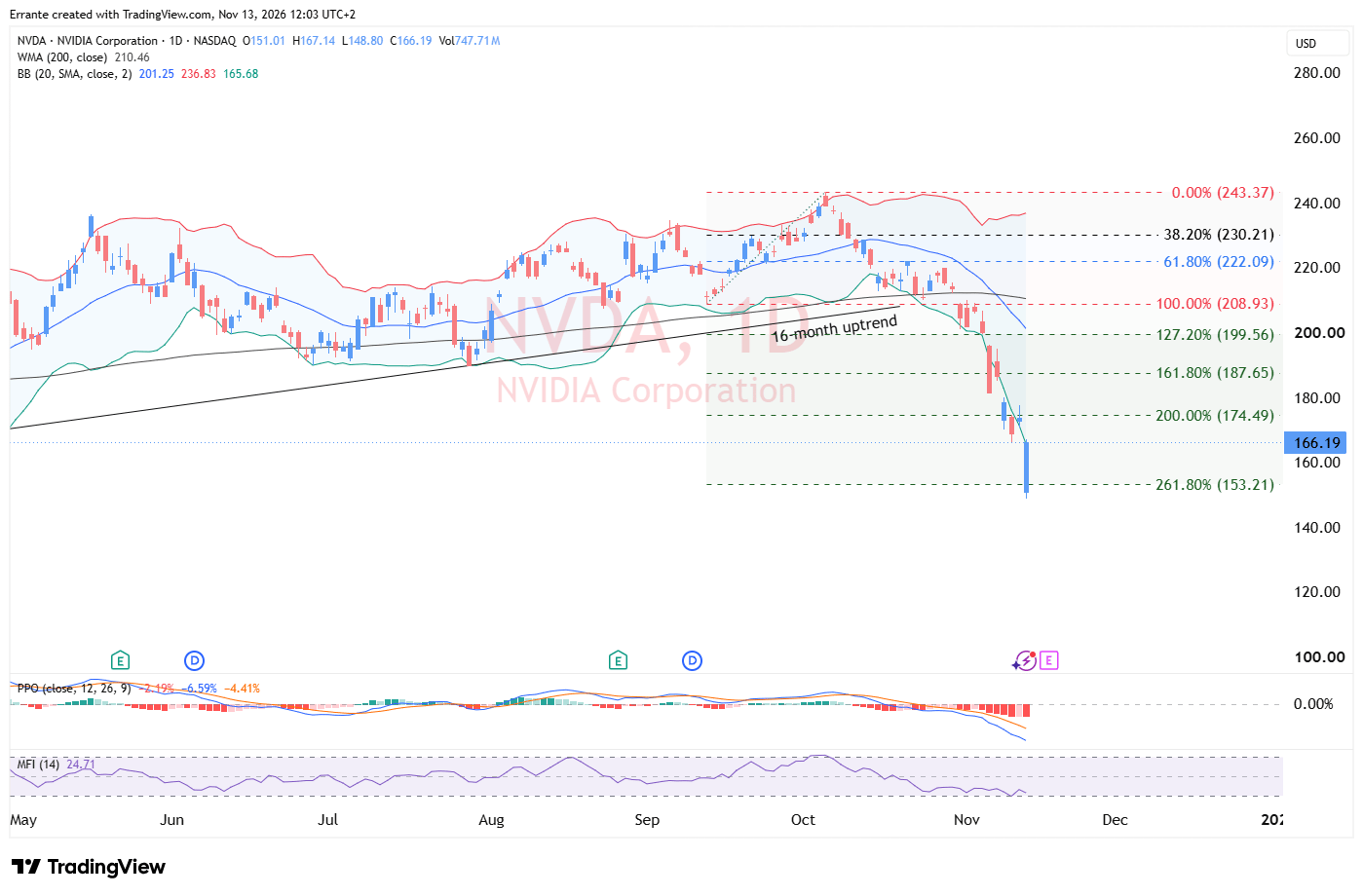
Nvidia is attempting to stabilize at $166.19 after breaking its rising trendline. It remains below its 200-period weighted moving average near $210.46, while weak momentum suggests the rebound still needs confirmation.
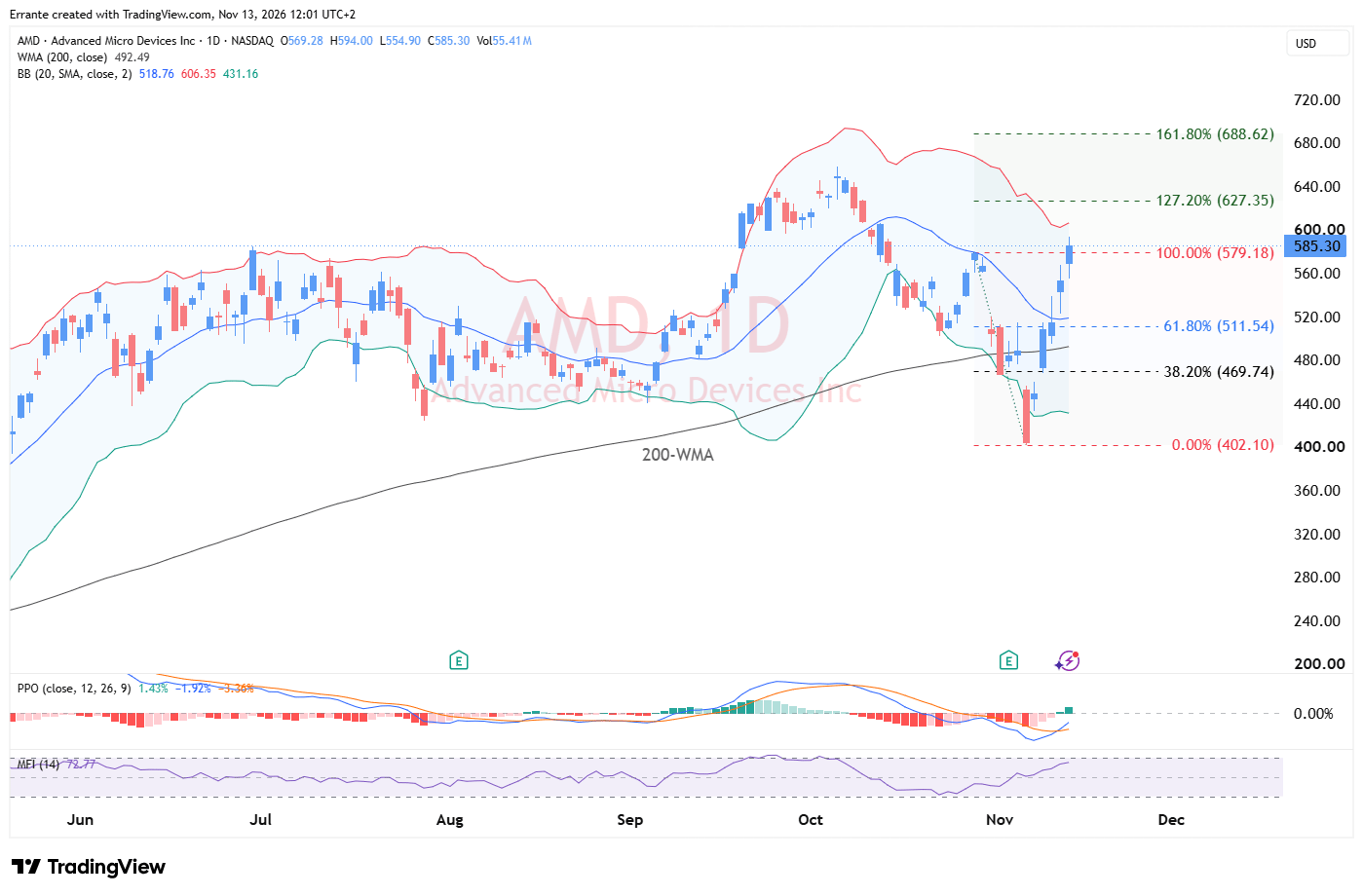
AMD has recovered to $585.30 and reclaimed the $579.18 Fibonacci reference. Momentum is improving, although strong recent buying pressure suggests the advance is becoming stretched. Holding the reclaimed level would give the recovery stronger technical support.
Fundamental outlook
Nvidia’s November 17 earnings release is the next major checkpoint. Previous guidance called for revenue of $108 billion, plus or minus 2%, and gross margin of 74%, plus or minus 0.5 percentage points.
The results will establish operating performance, while management’s outlook should help clarify customer demand, delivery schedules and the effects of the leadership transition.
For AMD, subsequent updates must connect higher earnings expectations with repeat deployments and improving cash conversion.
At the same time, financing conditions remain relevant to both companies. The US 10-year Treasury yield reached 5.10% on November 12. Higher borrowing costs can make infrastructure projects harder to finance, while also reducing the present value investors assign to future profits.
Scenario map
Daily closes help distinguish sustained moves from brief price spikes.
Stock | Main scenario | Alternative scenario | Structural invalidation |
Nvidia | Below $174.49, downside references remain $153.21 and $148.80. | Reclaiming $174.49 opens $187.65, followed by $199.56. | Sustained recovery above $208.93–$210.46 undermines the broader bearish structure. |
AMD | Holding $579.18 supports $606.35 and $627.35. | Losing $579.18 exposes $518.76–$511.54. | A sustained break below $492.49 undermines the broader recovery. |
Trading takeaways
- Follow earnings revisions alongside cash flow, because stronger sales can require substantial funding before generating cash.
- Look for closing-price confirmation and follow-through around key levels, especially during earnings volatility.
- Recognize the shared exposure: both companies depend on customers continuing to finance and deploy AI infrastructure.
Conclusion
AMD’s improving earnings outlook supports its growing strategic importance. However, customers also gain bargaining power when credible alternatives emerge, while suppliers bear the financial demands of expansion.
The strongest evidence of a lasting advantage will be sustained growth in profits and free cash flow per share. That is what would turn AMD’s opportunity into durable shareholder value.
Author

Ali Mortazavi
Errante
BEc, CMSA, Member of IFTA - International Federation of Technical Analysis, Associate Member of STA - Society of Technical Analysis (UK).

















