Bank of Japan set to hike in December: Why the Japanese Yen is still weakening anyway

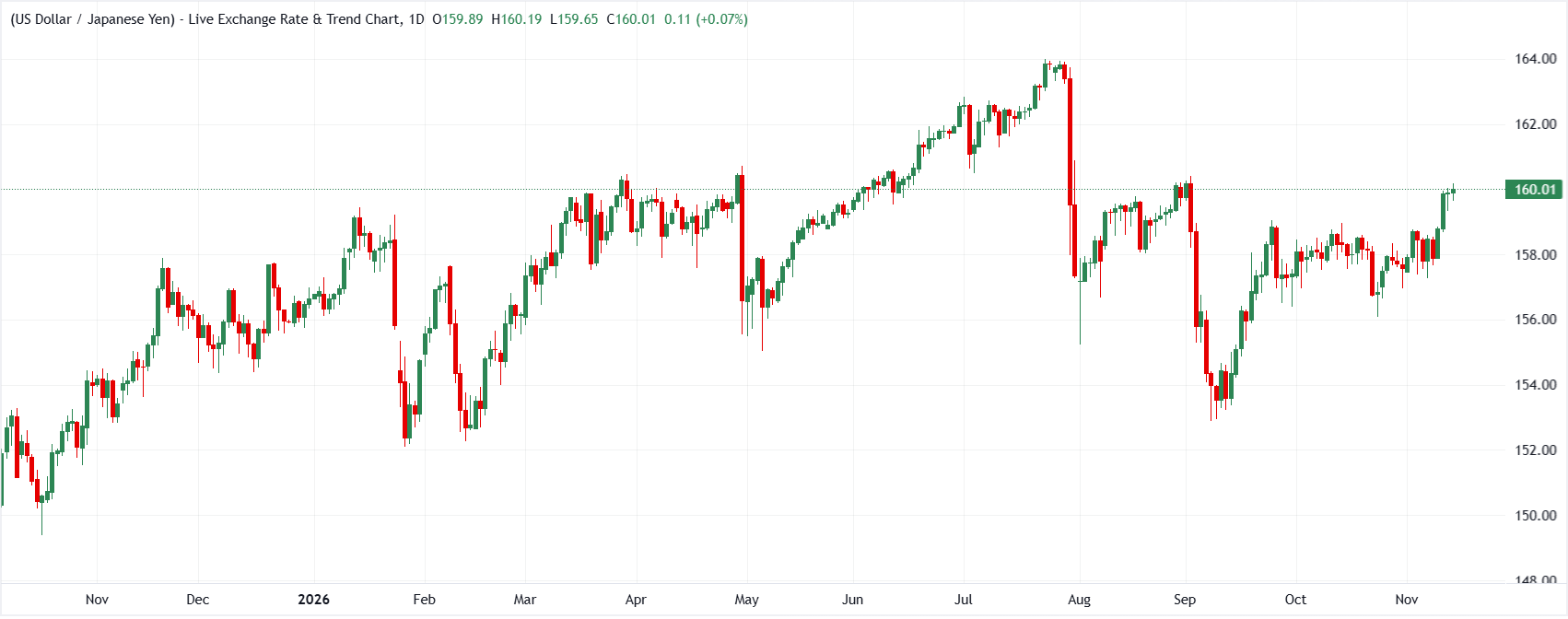
The Japanese Yen (JPY) remains under sustained pressure near multi-month lows as USD/JPY pushes above the 160.00 level for a second consecutive session, prompting official warnings from Japanese Finance Minister Katayama regarding one-sided and rapid foreign exchange moves. While resilient domestic economic activity — highlighted by projected Q3 real GDP growth of 0.8% QoQ saar — and above-target inflation bolster expectations for a 25 bps Bank of Japan (BoJ) rate hike in December, upward revisions to Federal Reserve (Fed) tightening expectations are counteracting domestic policy support. Institutional strategists at DBS Group Research, Societe Generale, and Commerzbank are assessing whether technical breakouts above 160.00 will extend near-term Yen weakness toward 162.20 or if Japan’s shifting interest rate landscape will anchor a longer-term JPY recovery.
DBS expects solid growth and above-target inflation to justify December BoJ rate hike
Economists at DBS Group Research forecast Japan’s third-quarter real GDP to expand by 0.8% QoQ saar, underpinned by AI-driven export demand and wage-led domestic consumption. Although October trade figures are projected to show the trade deficit widening to JPY1.2 trillion despite 17% YoY export growth, persistent above-target inflation driven by higher energy costs and a weak Yen should reinforce the case for a 25 bps Bank of Japan rate hike in December.
"Real GDP is expected to expand by 0.8% qoq saar in 3Q, broadly in line with trend... October trade data are likely to show export growth remaining solid at 17% yoy, but the trade deficit widening to JPY1.2tn... Overall, these data should reinforce the case for a 25bp BOJ rate hike at the December policy meeting, with growth around trend, inflation above target, and continued pressure on external balance/exchange rate."
Societe Generale warns USD/JPY breakout above 160 risks further Yen losses toward 162.20
Kenneth Broux and colleagues at Societe Generale note that USD/JPY has broken above the upper boundary of its narrow consolidation range and reclaimed its 200-day moving average, trading above 160.00 for a second straight day before verbal warnings from Finance Minister Katayama tempered gains. With initial support established at the 200-day SMA near 158.70, a sustained push higher exposes the Japanese Yen to key resistance levels at 160.40/160.70 and 162.20.
"USD/JPY witnessed a sharp rebound in September and evolved within a narrow consolidation. It has now broken out above the upper limit of this rang denoting possibility of extension in bounce. The next potential hurdles could be located at April high of 160.40/160.70 and projections near 162.20... The pair has reclaimed the 200-DMA. If a short-term pullback develops, the moving average at 158.70 could be an important support... USD/JPY: 159.66 - 160.19 overnight range. Spot trades through 160 for second day before traders pare back on warning by FinMin Katayama one-sided action and rapid forex moves. Support 158.70, resistance 160.70."
Commerzbank sees Fed-BoJ policy convergence capping near-term Yen gains before structural recovery
Volkmar Baur at Commerzbank argues that revised expectations for an additional Federal Reserve rate hike in March neutralize the currency impact of projected Bank of Japan rate increases in December and next spring. Because parallel tightening signals central bank convergence rather than divergence, Commerzbank sees limited near-term upside for the Japanese Yen — projecting only a modest move toward 155.00 by mid-2027 — before structurally more attractive domestic bond yields support a sustained longer-term JPY recovery.
"This reassessment of our US central bank expectations naturally impacts our forecast for the Japanese yen as well. Our economists no longer expect the US central bank to halt its interest rate hikes in December. Instead, they have factored in a further rate rise by the Fed in March... While we also expect the Bank of Japan to implement two further rate rises - in December and in spring next year - this no longer favours the Japanese yen. Rather, it signals a convergence between the central banks, which will likely have little impact on the currency... Consequently, we see little potential for the Japanese yen in the near future. In recent days, the yen has already weakened slightly due to rising market expectations regarding the Fed, and is currently trading just below USD-JPY 160. By the middle of next year, we now expect only a slight appreciation towards 155... In the longer term, however, we continue to expect the JPY to strengthen. The structural shift in Japan’s interest rate landscape means that domestic bonds are once again significantly more attractive, particularly for Japanese investors."
Key Takeaway
The Japanese Yen faces a tug-of-war between strengthening domestic macro fundamentals and persistent external rate pressures near the 160.00 level. While DBS Group Research emphasizes that trend GDP growth (0.8% QoQ saar) and sticky inflation firmly justify a 25 bps BoJ rate hike in December, Societe Generale warns that USD/JPY’s technical breakout above its 200-day SMA (158.70) leaves the Yen vulnerable to testing 160.40/160.70 and 162.20 unless official intervention halts the move. Ultimately, Commerzbank underscores that parallel Federal Reserve tightening into March will cap near-term JPY appreciation near 155.00, delaying a more durable Yen turnaround until higher Japanese bond yields attract sustained domestic capital inflows over the longer term.
(This article was created with the help of an Artificial Intelligence tool and reviewed by an editor. Know more.)
Author

FXStreet Insights Team
FXStreet
The FXStreet Insights Team is a group of journalists that handpicks selected market observations published by renowned experts. The content includes notes by commercial as well as additional insights by internal and external analysts.

















