|

AMC Share Price: AMC Leads the way as meme stocks rebound to start the week

  • NYSE:AMC surged by 8.92% on Monday as meme stocks rallied out of the weekend.
  • AMC Apes continue to target institutions with its #DarkpoolAbuse movement.
  • U.S. theaters see the weakest weekend so far this summer.

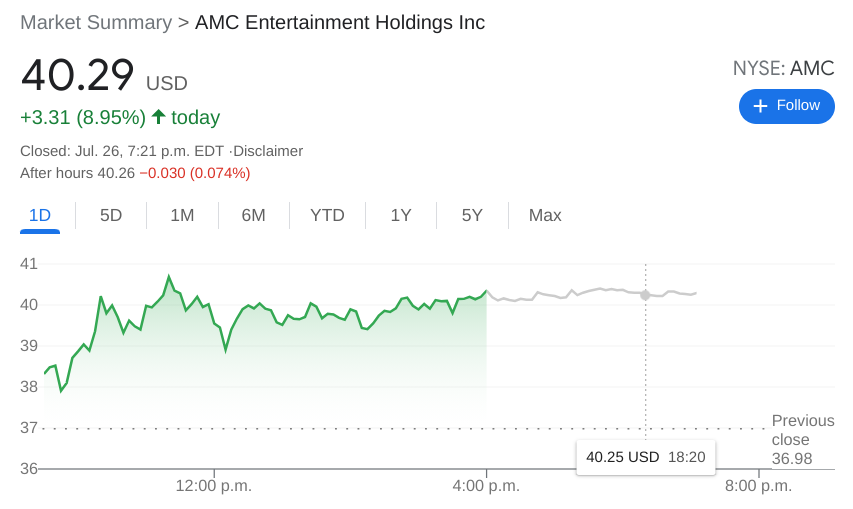
NYSE:AMC is still beaten down, but you have to give credit to its loyal following for remaining steadfast in their movement. Shares of AMC rebounded on Monday, gaining 8.92% to close the session at $40.29. The broader markets exhibited further trepidation ahead of the monetary policy updates from the Federal Reserve later this week. The major indices were anchored by big tech having a strong day, although small-cap stocks had a whipsaw session with the Russell 2000 eking out a small gain by the closing bell. 


Stay up to speed with hot stocks' news!


AMC Apes continued to push the agenda for the SEC to investigate dark pool activity for the stock. The hashtag #DarkPoolAbuse was still trending in Twitter investing circles, as the war against institutional investors continues to be the driving force behind the short squeeze movement. Adding another layer to this, is the impending IPO of the trading platform Robinhood, which retail traders allege manipulated the initial short squeeze of GameStop (NYSE:GME) back in January. Robinhood also sees much of its revenues from payment for order flow, which has been another controversial part of its business model. 

AMC stock forecast
AMC is also still struggling on the business side of things as U.S. theater locations saw the lowest box office revenues of the summer so far. Total ticket sales failed to reach $70 million for the first time this summer, and is a far cry from two years ago when theaters reported $155 million in revenue for the same weekend. A lack of summer blockbusters and rising delta variant cases are thought to be reasons for the slow box office weekend. 

Author

More from Stocks Reporter
Share:

Editor's Picks

GBP/USD drops to multi-week lows below 1.3300

GBP/USD sets aside Friday’s uptick and breaches below the 1.3300 yardstcik on Monday to hit new multi-week troughs. Falling crude oil prices following a pause in the Middle East conflict in combination with the recent soft reading in UK inflation appear to play against any BoE tightening ahead of the bank’s event later in the week.

EUR/USD meets support near 1.1370

EUR/USD fades the initial bull run past 1.1400 the figure, deflating toward the 1.1370 zone on Monday. That said, the pair reverses two daily drops in a row on the back of the irresolute price action in the US Dollar, at the time when investors continue to closely follow developments from the Middle East conflict. Next on tap is the release of the US Consumer Confidence gauge by the Conference Board.

Gold struggles to extend gains beyond $4,100
Spot Gold gapped higher at the beginning of the new week, as a pause in Middle East hostilities underpinned the mood and weighed on the US Dollar (USD). The XAU/USD pair traded as high as $4,116.20 during Asian trading hours, following a pause in strikes between Iran and the United States (US).
Bitcoin vs Gold: BTC and Gold struggle to gain momentum despite US-Iran truce
Market participants are changing gears on Monday from the war between the United States (US) and Iran in the Middle East to the anticipated Federal Reserve (Fed) interest rate decision. Meanwhile, Bitcoin (BTC) and Gold (XAU) are losing momentum, with BTC slipping below the pivotal $65,000 level while XAU remains sideways in the $4,000-$4,100 range.
Pause in military action fails to inspire market rally
More tech volatility has outweighed the impact of the pause in US-Iran fighting, says Chris Beauchamp, Chief Market Analyst at online trading and investing platform IG. When a calming of Middle Eastern hostilities fails to provoke a major up day in stocks, you know there is more trouble ahead.
US Dollar mid-year outlook: Exceptional currency, exceptional risks?
The US Dollar enters the second half of 2026 in a markedly different position from a year ago. The King currency has recovered, reflecting persistent US inflation, changing expectations for Fed policy, geopolitical tensions and renewed demand for defensive assets.