|

Alphabet Q2 earnings soar as Anthropic stake explodes in value

  • Alphabet earnings rise nearly 300% YoY on $98 billion increase in equity portfolio value.
  • Google Cloud revenue spikes 82% YoY to $24.5 billion.
  • Search revenue rises 17% YoY, YouTube ads gain 13% YoY.

Alphabet (GOOG, GOOGL) reported $9.11 in earnings per share on Wednesday evening, a whopping $6.11 ahead of the Wall Street consensus. But the share price moved little after an initial period of volatility (with GOOGL spiking to $353 and falling below $332 before leveling off near the regular session's close at $342) as the lion's share of the increase owed itself to a $98 billion increase in the value of Alphabet's equity portfolio, which most analysts believe is largely tied its approximate 14% stake in Anthropic and was already priced in.

Revenue in the second quarter rose 24% YoY to $119.8 billion and beat the Wall Street consensus by over $2.8 billion.

“Our AI investments are redefining what’s possible across every part of our business," said CEO Sundar Pichai. "Q2 was an amazing quarter, [...] driven by demand for AI infrastructure and AI solutions. It’s great to see wide adoption of Gemini Enterprise, with nearly 90% of the Fortune 100 using it."

Google Cloud had an immensely successful quarter as its annual revenue growth rate rose from 63% in Q1 to 82% in Q2 at $24.8 billion.

Google Services revenues increased 15% to $94.5 billion, led by 17% growth in Google Search & other, 15% in Google subscriptions, platforms, and devices, and 13% in YouTube ads.

Google's operating margin rose two percentage points to 34% in Q2.
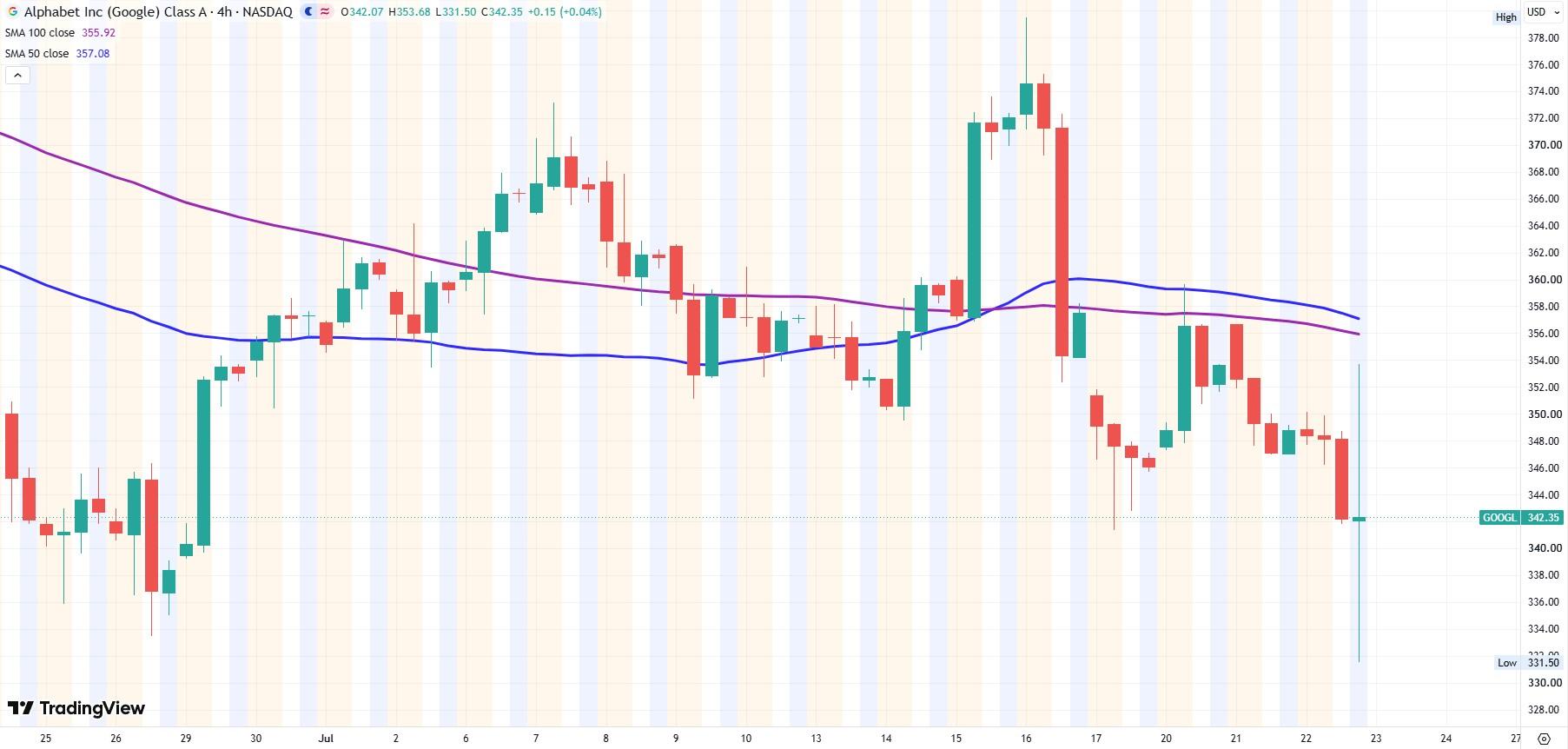
GOOGL 4-hour chart
GOOGL 4-hour chart

Author

Clay Webster

Clay Webster

FXStreet

Clay Webster grew up in the US outside Buffalo, New York and Lancaster, Pennsylvania. He began investing after college following the 2008 financial crisis.


More from Clay Webster
Share:

Editor's Picks

GBP/USD stays below 1.3400 after soft UK CPI data

GBP/USD struggles to gain traction and stays below 1.3400 in the second half of the day on Wednesday. The UK annual Consumer Price Index (CPI) inflation cooled to 2.6% in June against the market forecast of 2.7%, making it difficult for the British Pound gather recovery momentum. Meanwhile, investors keep a close eye on headlines coming out of the Middle East.

EUR/USD stabilizes near 1.1400 as markets focus on geopolitics

EUR/USD trades in a narrow channel at around 1.1400 on Wednesday. In the absence of high-impact data releases, escalating geopolitical tensions in the Middle East caps the pair's upside. On Thursday, the European Central Bank (ECB) will announce monetary policy decisions.

Gold extends rally as Middle East concerns intensify

Gold extends gains for the fourth consecutive day, standing comfortably above $4,100, unfazed by the risk-off market amid rising tensions in Iran and higher Oil prices. The pair has rallied nearly 2.5% so far this week and is on track for its best weekly performance in more than three months.

XRP consolidates as inflows and volume climb
Ripple (XRP) retains a slightly bullish outlook on Wednesday despite logging a minor correction from the supply range near $1.15. The remittance token is down 0.5% on the day, reflecting a broader cryptocurrency market drawdown, primarily driven by persistent geopolitical tensions between the United States (US) and Iran in the Middle East.
US – Fed preview: A divided hold
The first month after Kevin Warsh's debut at the FOMC's June meeting has brought mixed signals on the inflation front. On one hand, the re-escalation of the war in Iran has lifted energy prices higher again. Yet on the other hand, Warsh's hawkish comments have already lifted real rates, supported broad USD and tightened financial conditions while realized inflation surprised to the downside in June.
US Dollar mid-year outlook: Exceptional currency, exceptional risks?
The US Dollar enters the second half of 2026 in a markedly different position from a year ago. The King currency has recovered, reflecting persistent US inflation, changing expectations for Fed policy, geopolitical tensions and renewed demand for defensive assets.















