Alibaba's $10 billion raise puts the Amazon vs BABA contest on a new footing

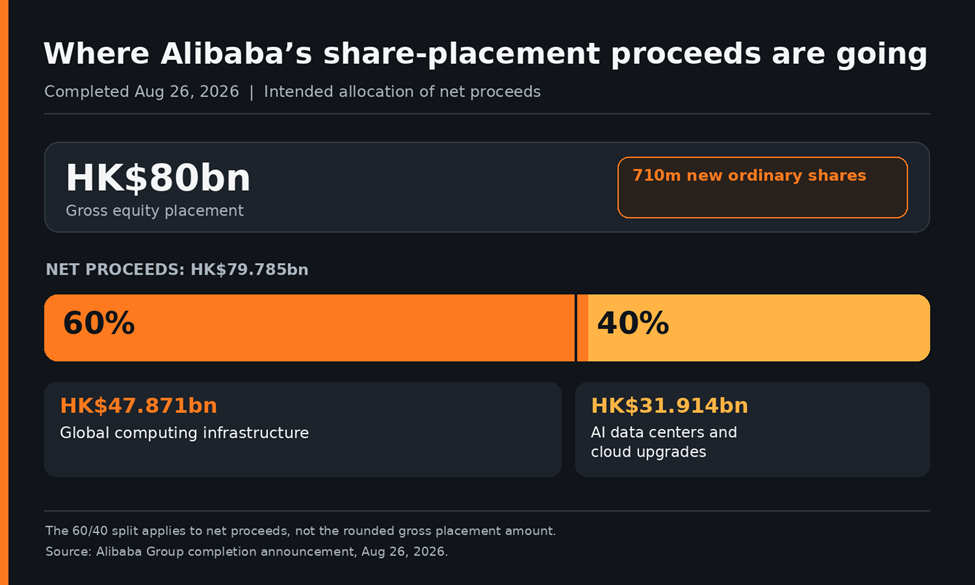
Alibaba's AI expansion now has a visible price tag for shareholders. On August 23, it announced an HK$80 billion ($10.2 billion) placement of new shares, completed three days later. The company plans to put roughly 60% of the proceeds into computing capacity and 40% into data centers and cloud upgrades. Amazon is spending heavily on compute as well, but Alibaba chose equity financing while its free cash flow is under strain.
The old Amazon vs. Alibaba debate used to revolve around online marketplaces. This AMZN/BABA comparison now turns on how long each side can keep building capacity, designing chips, and selling AI services before the cost wears down investor patience.
Alibaba’s growth carries a funding bill
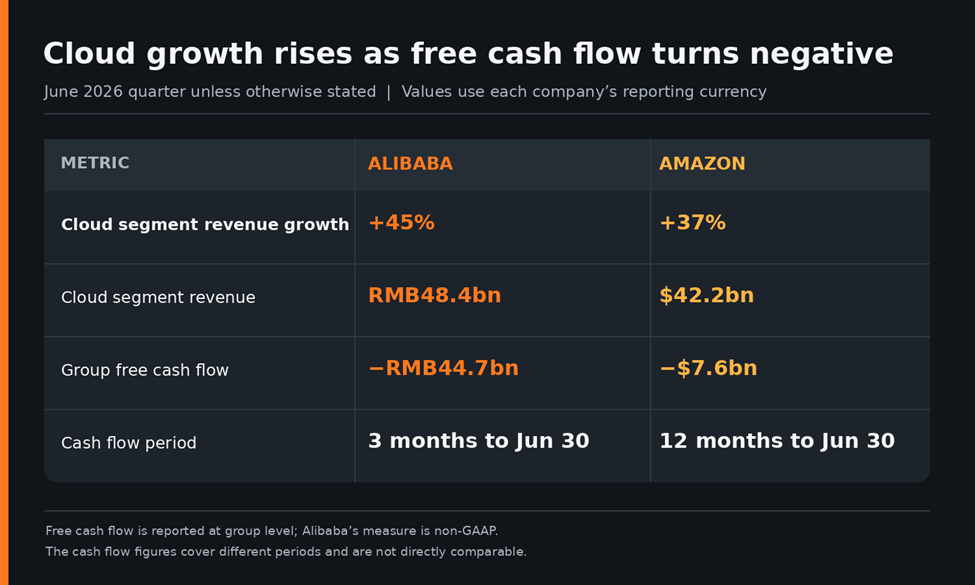
Alibaba’s AI Cloud and Compute Services revenue rose 45% year over year to RMB48.4 billion in the June quarter. Segment adjusted EBITA more than doubled to RMB5.6 billion. Demand is growing, but group capital expenditure climbed 75% to RMB67.7 billion. Quarterly free cash flow, a non-GAAP measure, came in at negative RMB44.7 billion ($6.6 billion). GAAP net income fell 75%, partly because of lower investment gains and other charges. Adjusted net income declined 38%.
That profitable cloud segment misses much of the cost tied to Alibaba’s broader AI push. Its AI Labs and Applications segment posted an RMB13.9 billion adjusted EBITA loss, reflecting higher investment in AI capabilities and the Qwen app inference.
That distinction matters for BABA stock valuation. The placement created 710 million new ordinary shares, diluting existing holders even if the resulting investment eventually pays off. Alibaba held roughly $69.9 billion in unrestricted cash and other liquid investments at the end of June. The share sale does not signal a cash emergency by itself. It spreads the financing cost across a larger shareholder base.
Alibaba’s chip-to-model approach also changes the Amazon vs. Alibaba business model comparison. Its marketplaces give the company a route to consumers and merchants. Cloud infrastructure and Qwen models can serve Alibaba’s own products and external clients. On September 22, the company unveiled a new AI chip and outlined plans for a larger model. These ambitions add weight to the question behind any Alibaba stock forecast: how quickly will AI revenue turn into group cash flow?
Amazon can spend more, but its cash flow is feeling it
Amazon has a much larger revenue base. Second-quarter sales reached $200.6 billion, including $42.2 billion from AWS. AWS generated $16.6 billion in operating income, a profit engine alongside stores and advertising. Management has projected about $200 billion of companywide capital expenditure for 2026, covering opportunities including AI, chips, robotics, and satellites. It is not an AI-only budget.
Scale does not make the bill disappear. Amazon reported $161.4 billion in operating cash flow over the trailing 12 months, yet free cash flow was negative $7.6 billion as equipment purchases accelerated, primarily for AI. Alibaba’s $6.6 billion free cash outflow, by contrast, covers one quarter. AWS sales rose 37% in the June quarter, but for AMZN stock valuation, the issue is how much cash the new capacity will ultimately generate.
Where the AMZN/BABA comparison shifts to returns on compute
The Alibaba vs. Amazon revenue gap is why an Amazon vs. Alibaba comparison based only on spending totals falls short. Amazon’s capex projection covers an entire global group. Alibaba’s placement is a financing transaction, not a spending budget. Cloud growth, margins, and free cash flow reveal more about the return on each buildout.
For readers following Versus Trade AMZN BABA markets, Amazon stock performance, and Alibaba’s expanded share count tell different parts of the story. Those who trade Amazon vs. Alibaba exposure face distinct risks. Amazon must justify the scale of its investment. Alibaba must show that AI growth outweighs dilution and losses elsewhere in its AI business.
Deciding which is better, Amazon or Alibaba, cannot be settled by one quarter’s spending or an Amazon stock forecast built on cloud demand alone. An Alibaba group vs Amazon comparison also has to factor in the baba stock dividend question alongside dilution. The new shares give Alibaba more capital to build. They also raise the return its existing shareholders need from the project.
Author