Alibaba Stock Earnings: BABA beats solidly on top and bottom lines
- Alibaba beats EPS estimates on FQ 2023, revenue down YoY for first time in company history.
- SEC placed BABA on list of companies in danger of delisting.
- BABA stock jumps almost 5% on positive release.

UPDATE: Alibaba served up earnings that impressed its beleaguered investors on Thursday morning. Fiscal first quarter 2023 (quarter ending in June 2022) earnings came in above consensus at $1.75 in earnings per average diluted share (EPADS) on revenue of $30.69 billion. BABA stock jumped 4.7% to $100.20 in the premarket. Revenue came in $530 million above expectations and beat EPADS consensus by 19 cents. Still, revenue was down about $1.1 billion YoY, the first time that has happened in its life as a public company.
Alibaba (BABA) stock is advancing more than 2% in Thursday's premarket ahead of fiscal first quarter 2023 earnings that are expected to arrive about two hours prior to the opening bell in New York. Wall Street consensus has adjusted EPS at $1.56 for the quarter with sales of $30.16 billion.
Also read: Amazon Stock Deep Dive: AMZN price target at $106 with near-term risks offset by long-term growth
Alibaba stock earnings news
Alibaba has been under immense pressure and intrigue of late as several crises have happened to overlap in recent weeks. First, Alibaba founder Jack Ma said he would step down and relinquish control of Alibaba's former subsidiary Ant Group. Following immense pressure from Chinese regulators, Ma will reduce his current 50.5% control of the fintech giant. Ma owns 10% of Ant Group outright and then controls another portion of its voting power by owning a 34% stake in Hangzhou Yunbo Investment Consultancy, which owns another portion of Ant Group. Alibaba is also about one-third of Ant Group. BABA stock fell some 5% when the new change was announced since it demonstrated that the Chinese government was continuing to meddle with Alibaba.
Then there is the case of the Securites & Exchange Commission (SEC), which placed Alibaba on a list of companies in danger of being delisted if management refuses to share internal audits. These audits must be shared with the SEC's US Public Company Accounting Oversight Board (PCAOB), due to 2019's Holding Foreign Companies Accountable Act (HFCAA). BABA stock plunged more than 11% on that news last Friday. Sharing internal corporate audits is currently forbidden by a 2009 Chinese law, though regulators in China say there are working to amend it to allow for foreign equity listings.
Alibaba released a statement saying it was doing everything in its power to remain listed on the New York Stock Exchange, but it seems to be hedging its bets by applying for a primary listing on the Hong Kong Stock Exchange (HKEX).
This brings us to Alibaba's Thursday earnings release. Of the nine EPS revisions from analysts in the past 90 days, seven of them were downward revisions. The most important point to make about forecasts is that analyst consensus is saying this quarter will be the first YoY revenue drop since the company had its IPO. Wall Street is expecting $30.16 billion despite Alibaba bringing in $31.8 billion during the same quarter last year. This would also be lower than the most recent quarter's $30.28 billion.
Eddie Leung from Bank of America Securities says domestic spending in China is still under pressure since the spring covid shutdowns went into effect but that there is a gradual recovery. Most analysts hold that Alibaba will return to better growth in the latter half of the year.
Alibaba stock forecast
BABA stock daily chart below is not looking its best. After early July saw Alibaba stock surmount the March 23 swing high, shares quickly fell off and have been mostly falling since. Last Tuesday, BABA found perfect support at the rising lower trend line that has been in place since March 15. This puts BABA in a symmetrical wedge structure with the apex near $106. This makes $106 the over/under for the price trend. If BABA overtakes $106, then it is seen as bullish. Below $106, where it is now, is bearish. To break out of the wedge, BABA stock needs to climb through the top trend line at around $122.50.
Despite the past two sessions seeing BABA launch off support, the Moving Average Convergence Divergence (MACD) is trending down – another bearish sign. Below the bottom ascending trend line of the wedge sits support at $82 and $74.
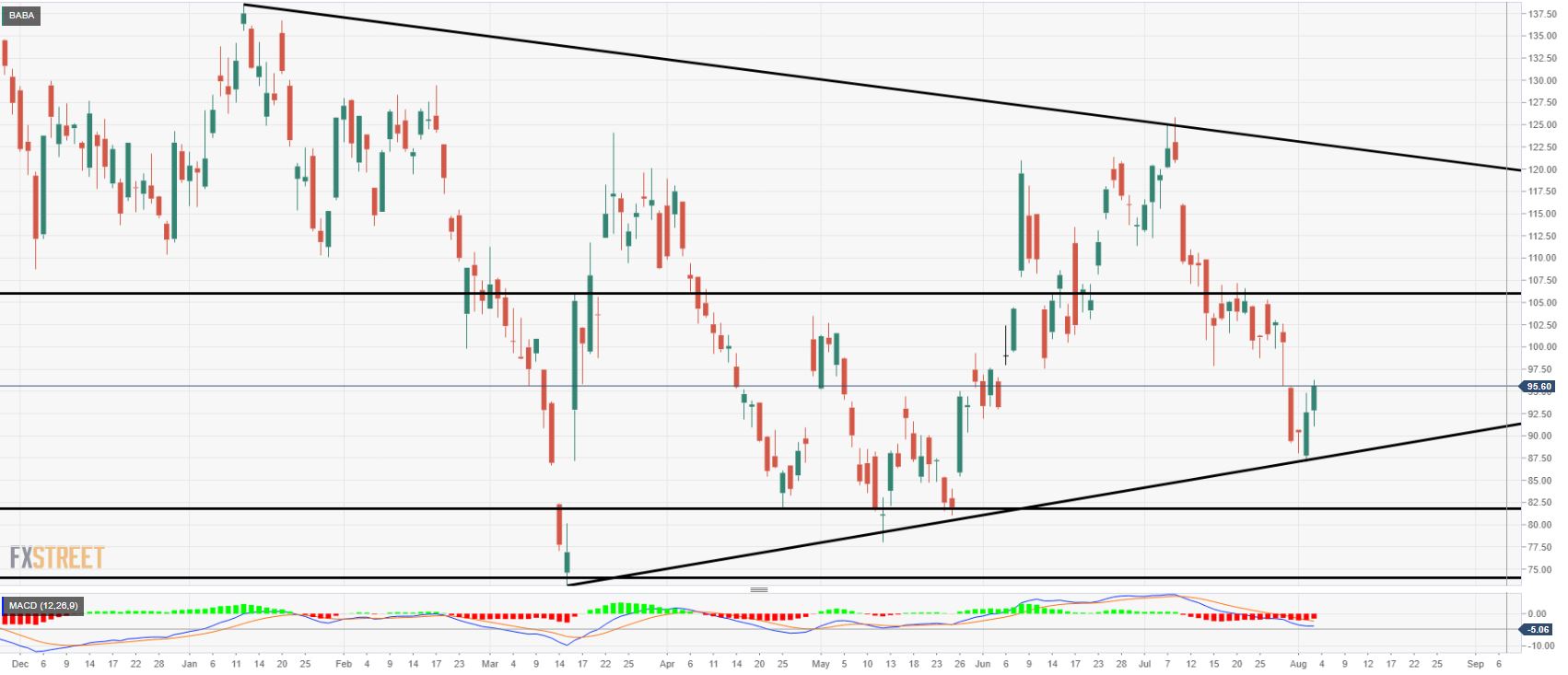
BABA stock daily chart
Author

Clay Webster
FXStreet
Clay Webster grew up in the US outside Buffalo, New York and Lancaster, Pennsylvania. He began investing after college following the 2008 financial crisis.

















