A tale of two earnings reports: Rolls Royce beats Nvidia, because its European

The last 24 hours has seen a plethora of earnings reports, but two stand out: Nvidia and Rolls Royce. The contrasting investor response to both earnings reports is stark, and tells us something important about this market.
Starting with Nvidia first, the tech giant posted $68bn of revenue for last quarter, it forecast Q1 revenues of $78bn and net income was $39.5bn, 5% more than analysts expected. Nvidia’s fundamental strength is undeniable: gross profit margin was 75% last quarter and cash and cash equivalents on Nvidia’s balance sheet have grown by $20bn in a year.
However, the stock market’s response to these earnings has been fairly tepid. Its stock price is up by barely 1% so far, even though earnings blasted past expectations and the forecasts are good too.
Compare that to Rolls Royce. The stock price is surging on Thursday, and is higher by 6%, helping to drive the FTSE 100 to a fresh record high. Rolls Royce’s earnings report for 2025 was also strong, it reported revenues of £20.05bn, and net income of £2.7bn, 13% above forecast. Gross profit margin was a respectable 29.1%, and expectations are for a 1.4% increase in revenues next year.
Although Rolls Royce posted a solid earnings report, it’s not at the same level as Nvidia’s, which reported a 65.5% increase in revenues in 2025, compared to a year ago. So why are investors favouring RR over Nvidia?
There are few reasons for this, in our view, including the following:
- Rolls Royce added a sweetener for investors, a record $9bn share buyback over the next two years. Nvidia announced a super $60bn buyback last year but did not increase buybacks or dividends in its latest earnings report.
- Nvidia’s results were practically flawless, but there is a concern that the bulk of Nvidia’s deep pocketed customers, the hyperscalers, can maintain their current pace of capex spending.
- In contrast, Rolls Royce’s customer base is more stable. It includes airlines, who need its engines, air forces, and navies. Although data centres are also a key source of demand for RR, the company has a diversified client base, something that investors love, but Nvidia lacks.
- Rolls Royce also expects operating profit to rise to £4.9bn to £5.2bn by 2028, up from £2.7bn last year. This is down to strong levels of defense spending. The EU has made budget rules more flexible for members to allow them to boost defense spending by 1.5% of GDP. Added to this, the EU’s ReArm plan aims to mobilize EUR 800bn in additional defense spending by 2030. The UK is also boosting defense spending, and plans to spend 2.5% of GDP on defense per year by 2027. Government spending is usually a rich and reliable vein of sales growth for defense companies and it will boost RR’s future revenues. This compares to Nvidia’s client base, which is concentrated in mega cap tech firms, who could cut back on capex spending plans and shift their strategies if the environment around AI changes. RR’s future demand growth is thus seen as more stable than Nvidia’s.
- Rolls Royce’s share price surged to a record high on the back of this earnings report, which helped the FTSE 100 to also reach a fresh record. The FTSE 100 is the top performing European stock index so far this year and is higher by 9.5% on a currency adjusted basis. This compares with a 1.4% gain for the S&P 500 and a decline of 0.3% for the Nasdaq.
The contrasting fortunes between Nvidia and Rolls Royce are also a sign of a preference for European stocks over US stocks. There could also be a political element to this, as investors are put off US assets due to a weak dollar, concerns about central bank independence and tariff friction. US geopolitical interventions in regions like Venezuela and rising tensions with Iran, have reshaped expectations for political stability and global security, that feeds into demand for Rolls Royce. At the same time, investors are scrutinizing the IA trade like never before.
Not only is Rolls Royce a defense stock, but it is also European, and that is a major attraction right now, even if its earnings report is not as glowing as Nvidia’s.
Rolls Royce and Nvidia, normalized to show how they move together, The share price performance gap has widened in recent months
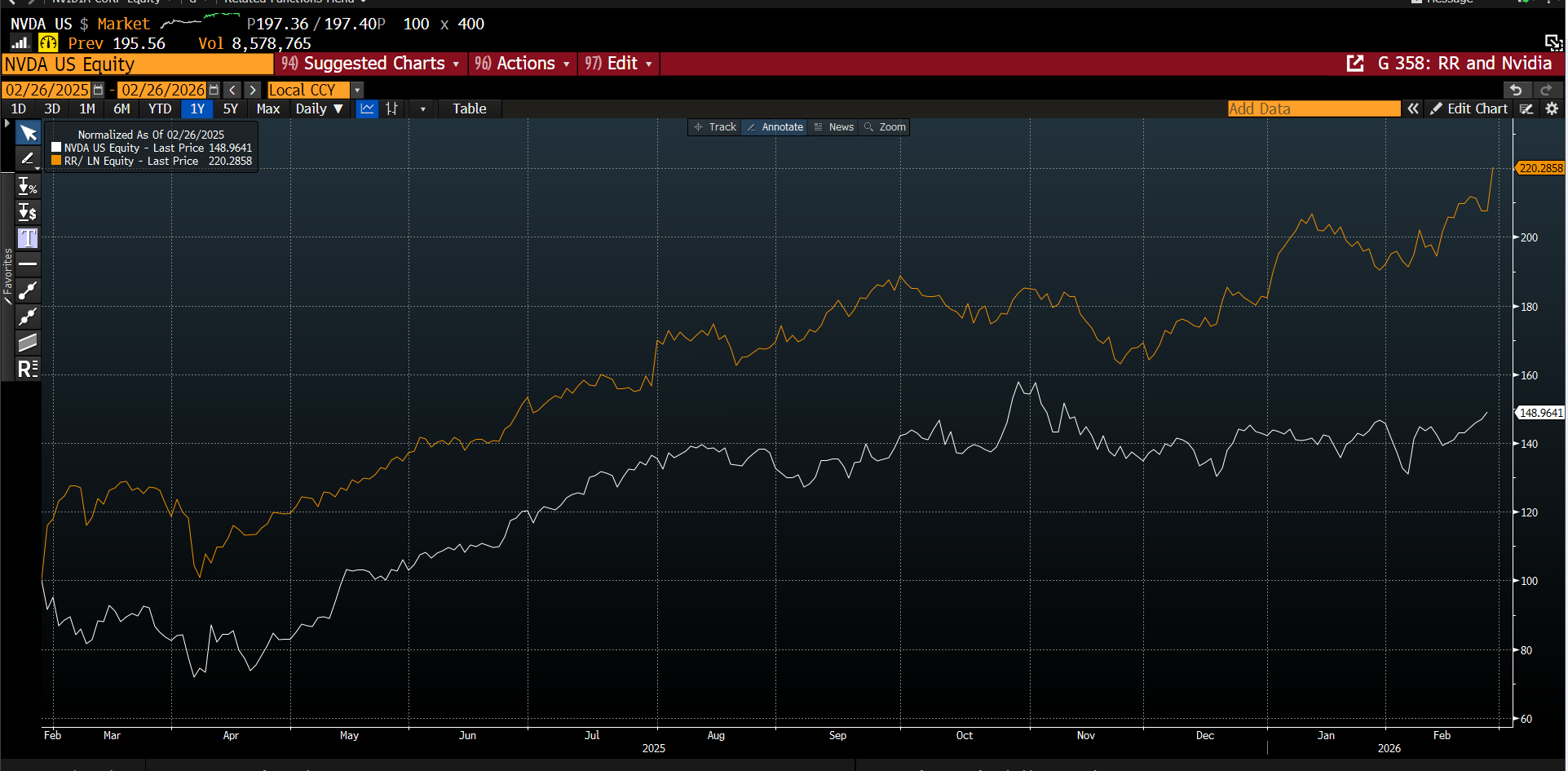
Source: XTB and Bloomberg
Author

Kathleen Brooks
XTB UK
Kathleen has nearly 15 years’ experience working with some of the leading retail trading and investment companies in the City of London.