154.06: Japanese Yen hits fresh six-month highs amid hopes of steeper BoJ hikes
- USD/JPY resumes its downtrend on Monday and hits fresh six-month lows near 154.00.
- Market expectations of a faster BoJ tightening path have sent the Yen rallying across the board over the last few weeks.
- The pair is trading below the neckline of a large bearish Head & Shoulders pattern.

The Japanese Yen (JPY) resumes its uptrend against the US Dollar (USD) on Monday, as the dust from a bright US Nonfarm Payrolls (NFP) report settles, and Japanese officials hint at some steepening of the Bank of Japan’s (BoJ) tightening cycle ahead. The USD/JPY pair has breached the support area around 155.15 to hit fresh six-month lows near 154.00 on Monday.
Analysts at Danske Bank note a marked shift in Japanese policy expectations, highlighting that in Japan, "Takuji Aida, economic adviser to PM Takaichi and seen as one of the most vocal opponents of BoJ rate hikes, now expects the Bank of Japan to raise rates at its 17-18 September meeting, followed by another hike by January next year."
"Aida warns that a faster tightening pace could weigh on the economy," affirm the Danske Bank experts in a note, which suggests that more rate hikes might be on the BoJ's pipeline.
NBIM shift underscores rotation from US Treasuries into Japan
Beyond that, Shreyas Gopal, Deutsche Bank’s FX analyst, has examined the implications of the Norges Bank Investment Management (NBIM) portfolio changes, concluding that the planned reallocation is “likely to, on net, result in a notable reduction in ownership of US Treasuries and a significant increase in allocation to Japanese government bonds.”
The report frames this shift as part of a broader reassessment of sovereign risk and diversification priorities, with the move into Japan’s government bond market seen as a potentially supportive medium-term factor for the Yen, even if the absolute flow size remains modest relative to global benchmarks.
Technical Analysis: USD/JPY highlights a large H&S formation
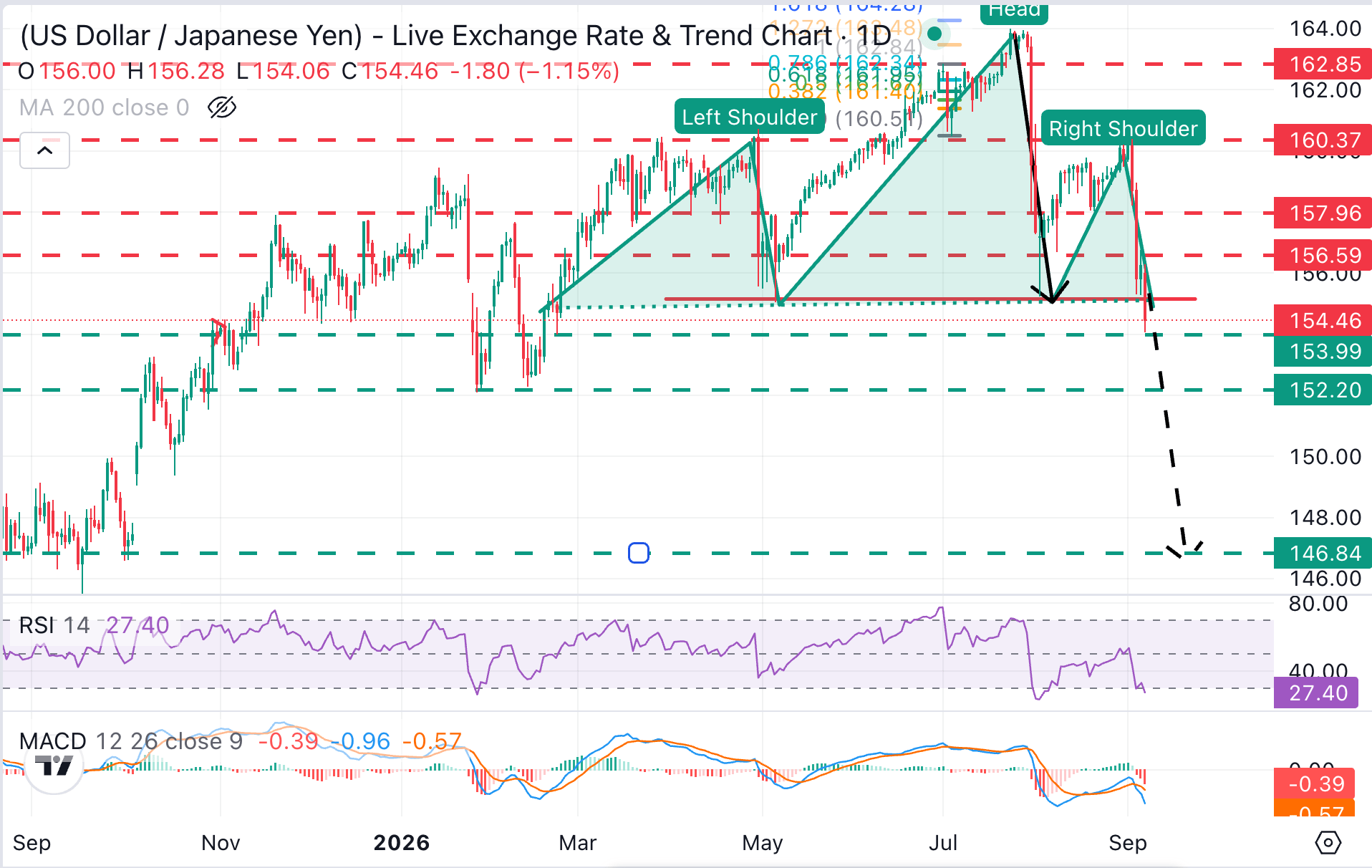
USD/JPY has pierced a support area a few pips above 155.00 on Monday, which is the neckline of a bearish Head & Shoulders (H&S) pattern on the daily chart, a common figure for trend shifts. Momentum indicators show the daily Relative Strength Index (RSI) (14) reaching oversold levels near 27, and the Moving Average Convergence Divergence (MACD) on the same timeframe heading lower at levels sub-zero. This reinforces the current downward momentum despite the risk of a corrective bounce.
The pair is now testing support at the February 24 low in the 154.00 area. Further down, the late January lows just above 152.00 will be targeted. The H&S's measured target is at the October 2025 low, at the 149.60 area. Upside attempts above the mentioned 155.15 area, on the other hand, are likely to meet resistance at the August 7 low, in the 156.60 area, and the August 20 low, near 158.00.
(The technical analysis of this story was written with the help of an AI tool. Know more.)
Bank of Japan FAQs
The Bank of Japan (BoJ) is the Japanese central bank, which sets monetary policy in the country. Its mandate is to issue banknotes and carry out currency and monetary control to ensure price stability, which means an inflation target of around 2%.
The Bank of Japan embarked in an ultra-loose monetary policy in 2013 in order to stimulate the economy and fuel inflation amid a low-inflationary environment. The bank’s policy is based on Quantitative and Qualitative Easing (QQE), or printing notes to buy assets such as government or corporate bonds to provide liquidity. In 2016, the bank doubled down on its strategy and further loosened policy by first introducing negative interest rates and then directly controlling the yield of its 10-year government bonds. In March 2024, the BoJ lifted interest rates, effectively retreating from the ultra-loose monetary policy stance.
The Bank’s massive stimulus caused the Yen to depreciate against its main currency peers. This process exacerbated in 2022 and 2023 due to an increasing policy divergence between the Bank of Japan and other main central banks, which opted to increase interest rates sharply to fight decades-high levels of inflation. The BoJ’s policy led to a widening differential with other currencies, dragging down the value of the Yen. This trend partly reversed in 2024, when the BoJ decided to abandon its ultra-loose policy stance.
A weaker Yen and the spike in global energy prices led to an increase in Japanese inflation, which exceeded the BoJ’s 2% target. The prospect of rising salaries in the country – a key element fuelling inflation – also contributed to the move.
Author

Guillermo Alcala
FXStreet
Graduated in Communication Sciences at the Universidad del Pais Vasco and Universiteit van Amsterdam, Guillermo has been working as financial news editor and copywriter in diverse Forex-related firms, like FXStreet and Kantox.